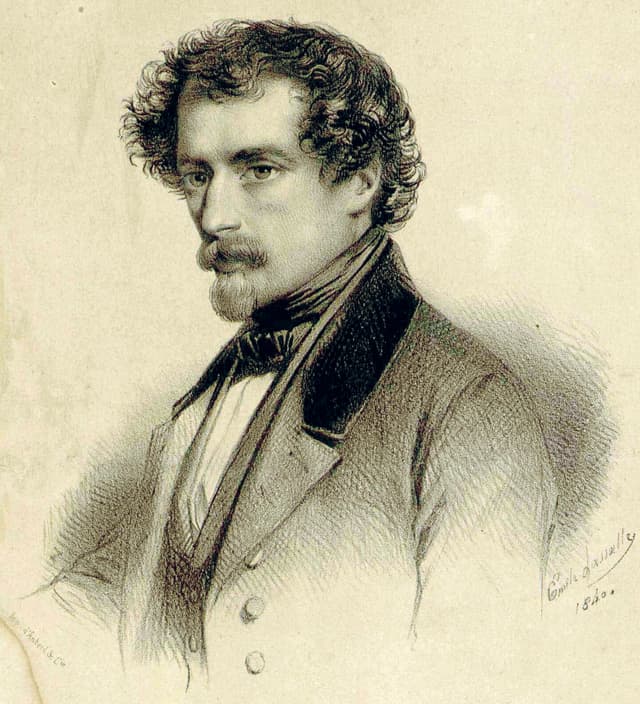
J. J. Grandville
Jean Ignace Isidore Gérard, known by his pseudonym J. J. Grandville, was a prominent French illustrator and caricaturist whose work significantly shaped the landscape of visual satire in the 19th century. Born in Nancy, France, into a family of artists, he honed his drawing skills under the guidance of his father before moving to Paris in the early 1820s. Grandville gained recognition with his 1829 publication of 'Les Métamorphoses du jour,' a collection of 70 lithographs that showcased his unique blend of the dreamlike and the grotesque, establishing him as a key figure in the era of French caricature. His illustrations often featured anthropomorphic and zoomorphic figures, which not only served as social commentary but also anticipated the styles of later artists including John Tenniel and Walt Disney. Throughout his career, Grandville's work evolved in response to the political climate of France, particularly during the July Revolution of 1830. He collaborated with contemporaries like Honoré Daumier to produce biting political cartoons that critiqued the monarchy of Louis Philippe I. Following the imposition of strict censorship laws, he shifted his focus to book illustration, lending his artistic vision to classic texts such as 'Robinson Crusoe' and 'Gulliver's Travels.' His later works, including 'Un autre monde' and 'Les fleurs animées,' were increasingly centered around his illustrations, with narratives crafted to complement his art. Despite a tragic personal life marked by the loss of his first wife and children, Grandville's legacy endures as a precursor to surrealism, influencing generations of artists and earning him a place as one of the most innovative caricaturists of his time.
Books from the author









Link to this page
Add a free, dofollow link to Lex on your blog, forum, syllabus, or reading list.

<a href="https://lex-books.com/author/j-j-grandville"><img src="https://lex-books.com/badges/read-on-lex.svg" alt="J. J. Grandville on Lex" width="160" height="40"></a>[](https://lex-books.com/author/j-j-grandville)[url=https://lex-books.com/author/j-j-grandville][img]https://lex-books.com/badges/read-on-lex.svg[/img][/url]J. J. Grandville on Lex: https://lex-books.com/author/j-j-grandville