
Hypatia Bradlaugh Bonner
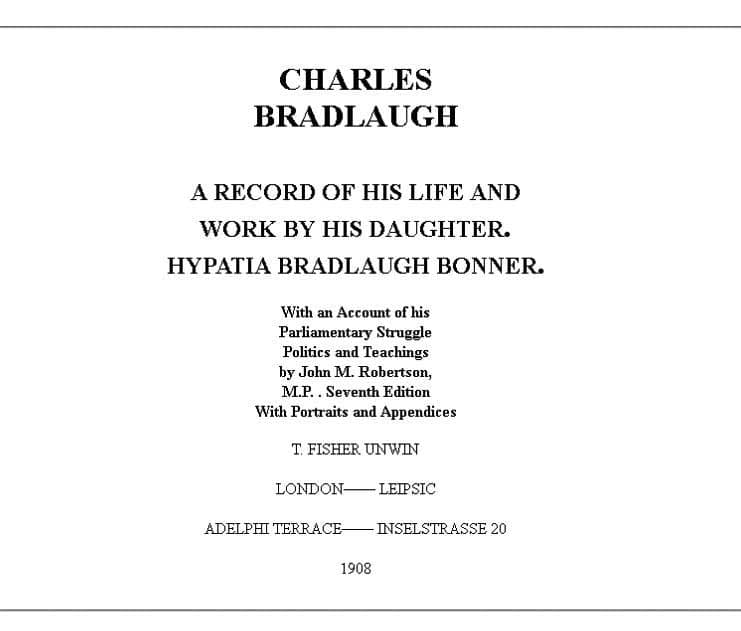
Hypatia Bradlaugh Bonner was a prominent British peace activist, author, and advocate for atheism and freethought. Born into a family steeped in radical political thought, she was the daughter of Charles Bradlaugh, a notable atheist and political reformer. Hypatia's upbringing significantly influenced her worldview, leading her to become an outspoken proponent of social justice and women's rights. She was deeply involved in various movements aimed at promoting peace and secularism, often using her writing as a platform to challenge societal norms and advocate for reform. Among her notable works, Bonner authored 'The Life of Charles Bradlaugh,' a biography of her father that highlighted his contributions to atheism and political activism. She also wrote extensively on topics such as women's suffrage and the importance of rational thought in public discourse. Bonner's commitment to these causes made her a significant figure in the early 20th-century feminist and secular movements. Her legacy endures as a testament to her dedication to social change and her role in advancing the rights of women and the principles of freethought in a time of considerable societal upheaval.
Famous Quotes
View all 3 quotes“It was not Christianity which freed the slave: Christianity accepted slavery; Christian ministers defended it; Christian merchants trafficked in human flesh and blood, and drew their profits from the unspeakable horrors of the middle passage. Christian slaveholders treated their slaves as they did the cattle in their fields: they worked them, scourged them, mated them , parted them, and sold them at will. Abolition came with the decline in religious belief, and largely through the efforts of those who were denounced as heretics.”
“It is difficult to exaggerate the adverse influence of the precepts and practices of religion upon the status and happiness of woman. Owing to the fact that upon women devolves the burden of motherhood, with all its accompanying disabilities, they always have been, and always must be, at a natural disadvantage in the struggle of life as compared with men.... With certain exceptions, women all the world over have been relegated to a position of inferiority in the community, greater or less according to the religion and the social organisation of the people; the more religious the people the lower the status of the women...”
“Away with all these gods and godlings; they are worse than useless.”
Books from the author



Link to this page
Add a free, dofollow link to Lex on your blog, forum, syllabus, or reading list.

<a href="https://lex-books.com/author/hypatia-bradlaugh-bonner"><img src="https://lex-books.com/badges/read-on-lex.svg" alt="Hypatia Bradlaugh Bonner on Lex" width="160" height="40"></a>[](https://lex-books.com/author/hypatia-bradlaugh-bonner)[url=https://lex-books.com/author/hypatia-bradlaugh-bonner][img]https://lex-books.com/badges/read-on-lex.svg[/img][/url]Hypatia Bradlaugh Bonner on Lex: https://lex-books.com/author/hypatia-bradlaugh-bonner