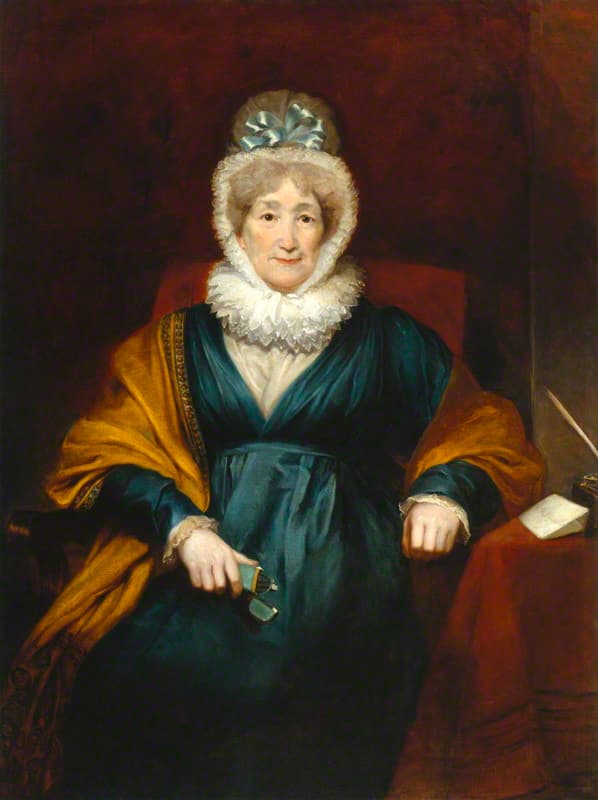
Hannah More
Hannah More was an influential English writer, philanthropist, and playwright, known for her moral and religious writings in the late 18th and early 19th centuries. Born in Bristol, she began her literary career by writing plays and quickly became a prominent figure in London's literary circles, associated with notable contemporaries such as Samuel Johnson and David Garrick. As a leading member of the Bluestockings, a group of intellectual women, More's works evolved to reflect her evangelical beliefs, particularly in her later poetry and plays. In the 1790s, More gained recognition for her 'Cheap Repository Tracts,' a series of pamphlets aimed at the literate poor that addressed moral, religious, and political issues in response to the radical ideas presented in Thomas Paine's 'Rights of Man.' Her philanthropic efforts extended to founding schools in rural Somerset with her sister, Martha, where they focused on educating the poor while limiting their reading and writing skills. More's political conservatism and anti-feminist views positioned her as a counter-revolutionary figure, and she remains a complex character in the history of women's literature and social reform, advocating for moral education and the abolition of the slave trade while also embodying the contradictions of her time.
Famous Quotes
View all 3 quotes“Forgiveness is the economy of the heart.…forgiveness saves the expense of anger, the cost of hatred, the waste of spirits.”
“Love never reasons but profusely gives......gives like a thoughtless prodigal, it's all and trembles then, lest it has done too little.”
“Twas doing nothing was his curse. Is there a vice can plague us worse?”
Books from the author





Link to this page
Add a free, dofollow link to Lex on your blog, forum, syllabus, or reading list.

<a href="https://lex-books.com/author/hannah-more"><img src="https://lex-books.com/badges/read-on-lex.svg" alt="Hannah More on Lex" width="160" height="40"></a>[](https://lex-books.com/author/hannah-more)[url=https://lex-books.com/author/hannah-more][img]https://lex-books.com/badges/read-on-lex.svg[/img][/url]Hannah More on Lex: https://lex-books.com/author/hannah-more