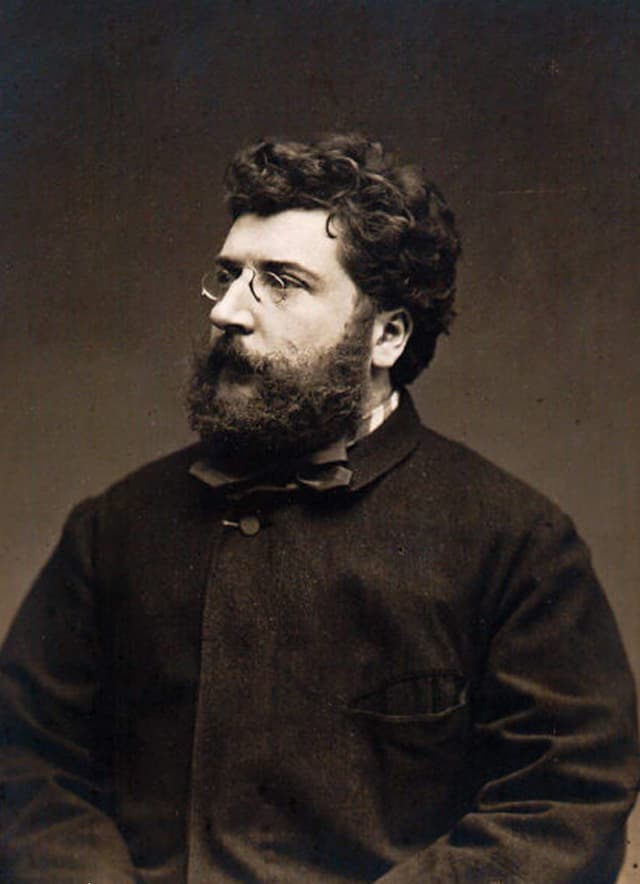
Georges Bizet
Georges Bizet[n 1] (né Alexandre César Léopold Bizet; 25 October 1838 – 3 June 1875) was a French composer of the Romantic era. Best known for his operas in a career cut short by his early death, Bizet achieved few successes before his final work, Carmen, which has become one of the most popular and frequently performed works in the entire opera repertoire. During a brilliant student career at the Conservatoire de Paris, Bizet won many prizes, including the prestigious Prix de Rome in 1857. He was recognised as an outstanding pianist, though he chose not to capitalise on this skill and rarely performed in public. Returning to Paris after almost three years in Italy, he found that the main Parisian opera theatres preferred the established classical repertoire to the works of newcomers. His keyboard and orchestral compositions were likewise largely ignored; as a result, his career stalled, and he earned his living mainly by arranging and transcribing the music of others. Restless for success, he began many theatrical projects during the 1860s, most of which were abandoned. Neither of his two operas that reached the stage in this time—Les pêcheurs de perles and La jolie fille de Perth—were immediately successful. After the Franco-Prussian War of 1870–1871, during which Bizet served in the National Guard, he had little success with his one-act opera Djamileh, though an orchestral suite derived from his incidental music to Alphonse Daudet's play L'Arlésienne was instantly popular. The production of his final opera, Carmen, was delayed because of fears that its themes of betrayal and murder would offend audiences. After its premiere on 3 March 1875, Bizet was convinced that the work was a failure; he died of a heart attack three months later, unaware that it would prove a spectacular and enduring success.
Famous Quotes
View all 3 quotes“Love is rebellious bird that nobody can tame, and it's all in vain to call it if it chooses to refuse.”
“L’amour est enfant de Bohême, Il n’a jamais jamais connu de loi. Si tou ne m’aimes pas, je t’aime. Si je t’aime, prends garde à toi!”
“In 1857, Bizet departed for Rome and spent three years there. He studied the landscape, the culture, Italian literature and art. Musically he studied the scores of the great masters. At the end of the first year he was asked to submit a religious work as his required composition. As a self-described atheist, Bizet felt uneasy and hypocritical writing a religious piece. Instead, he submitted a comic opera. Publicly, the committee accepted, acknowledging his musical talent. Privately, the committee conveyed their displeasure. Thus, early in his career, Bizet displayed an independent spirit that would be reflected in innovative ideas in his opera composition. [ The Pearl Fishers - Georges Bizet, Virginia Opera ]”
Books from the author


Link to this page
Add a free, dofollow link to Lex on your blog, forum, syllabus, or reading list.

<a href="https://lex-books.com/author/georges-bizet"><img src="https://lex-books.com/badges/read-on-lex.svg" alt="Georges Bizet on Lex" width="160" height="40"></a>[](https://lex-books.com/author/georges-bizet)[url=https://lex-books.com/author/georges-bizet][img]https://lex-books.com/badges/read-on-lex.svg[/img][/url]Georges Bizet on Lex: https://lex-books.com/author/georges-bizet