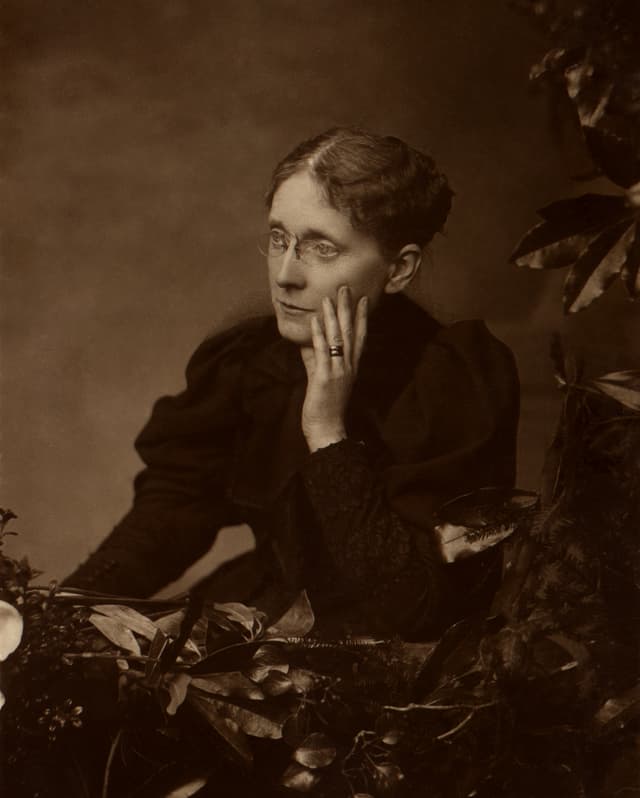
Frances E. Willard
Frances E. Willard was a prominent American educator, reformer, and women's suffrage advocate in the late 19th and early 20th centuries. Born in 1839 in Churchville, New York, she became a key figure in the temperance movement and served as the president of the Woman's Christian Temperance Union (WCTU) from 1879 until her death in 1898. Willard's leadership transformed the WCTU into a powerful organization that not only campaigned against alcohol consumption but also advocated for women's rights and social reform. Her influential writings, including 'Woman and Temperance' and 'A Woman of the Century,' articulated the connection between temperance and women's empowerment, making her a significant voice in the fight for social justice during her time. Willard's legacy extends beyond her immediate contributions to temperance and suffrage. She was a pioneering figure in the establishment of women's colleges and advocated for women's education, believing that educated women could lead societal change. Her efforts laid the groundwork for future generations of women activists and reformers. Willard's vision of a more equitable society resonated with many, and her work continues to inspire those who fight for social justice and gender equality today.
Famous Quotes
View all 8 quotes“If women patronize the wheel the number of buyers will be twice as large. If women ride they must, when riding, dress more rationally than they have been wont to do. If they do this many prejudices as to what they may be allowed to wear will melt away. Reason will gain upon precedent and ere long the comfortable, sensible, and artistic wardrobe of the rider will make the conventional style of woman's dress absurd to the eye and unenduring to the understanding. A reform often advances most rapidly by indirection. An ounce of practice is worth a ton of theory; and the graceful and becoming costume of woman on the bicycle will convince the world that has brushed aside the theories, no matter how well constructed, and the arguments, no matter how logical, of dress-reformers.””
“Another writer argued in an 1895 issue of the Cosmopolitan that by riding a bicycle, a woman would "become mistress of herself," transformed into a "rational, useful being restored to health and sanity.””
“In 1895, Ann Strong declared in the Minneapolis Tribune that bicycles were "just as good company as most husbands" and that when a bicycle gets shabby or old a woman could "dispose of it and get a new one without shocking the entire community.””
Books from the author



Link to this page
Add a free, dofollow link to Lex on your blog, forum, syllabus, or reading list.

<a href="https://lex-books.com/author/frances-e-willard-2"><img src="https://lex-books.com/badges/read-on-lex.svg" alt="Frances E. Willard on Lex" width="160" height="40"></a>[](https://lex-books.com/author/frances-e-willard-2)[url=https://lex-books.com/author/frances-e-willard-2][img]https://lex-books.com/badges/read-on-lex.svg[/img][/url]Frances E. Willard on Lex: https://lex-books.com/author/frances-e-willard-2