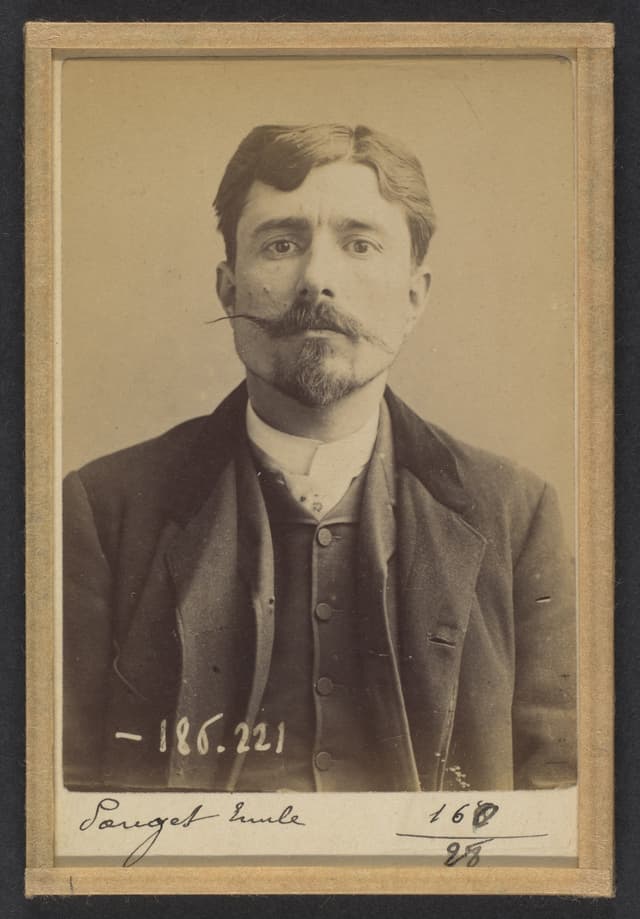
Emile Pouget
Émile Pouget was a prominent French journalist and anarchist pamphleteer who played a crucial role in the development of revolutionary syndicalism in France. His influential newspaper, Le Père Peinard, distinguished itself from earlier anarchist publications through its innovative use of vernacular and urban slang, making radical ideas more accessible to the working class. Pouget is credited with popularizing the term 'sabotage' as a tactical approach for labor movements, a concept that was later embraced by the General Confederation of Labour (CGT) at its Toulouse Congress in 1897. His work combined anarchist political theory with revolutionary syndicalist tactics, positioning him as an early figure in anarcho-syndicalism. Introduced to radical politics through his stepfather, Pouget became a significant figure in the anarchist movement, notably leading a protest at Les Invalides in 1883 alongside Louise Michel, where the black flag of anarchism was flown for the first time. His activism led to his imprisonment and subsequent exile in London due to the repressive Lois scélérates. During his time in London, he engaged with international anarchist militants and the British trade unionist movement, which further shaped his revolutionary syndicalist ideology. After returning to France, he continued to advocate for labor rights and revolutionary ideas through publications like La Sociale and became a key leader within the CGT. However, following a series of arrests and the decline of his final newspaper, La Révolution, Pouget gradually withdrew from active politics, living a quieter life until his death in 1931.
Books from the author








Link to this page
Add a free, dofollow link to Lex on your blog, forum, syllabus, or reading list.

<a href="https://lex-books.com/author/emile-pouget"><img src="https://lex-books.com/badges/read-on-lex.svg" alt="Emile Pouget on Lex" width="160" height="40"></a>[](https://lex-books.com/author/emile-pouget)[url=https://lex-books.com/author/emile-pouget][img]https://lex-books.com/badges/read-on-lex.svg[/img][/url]Emile Pouget on Lex: https://lex-books.com/author/emile-pouget