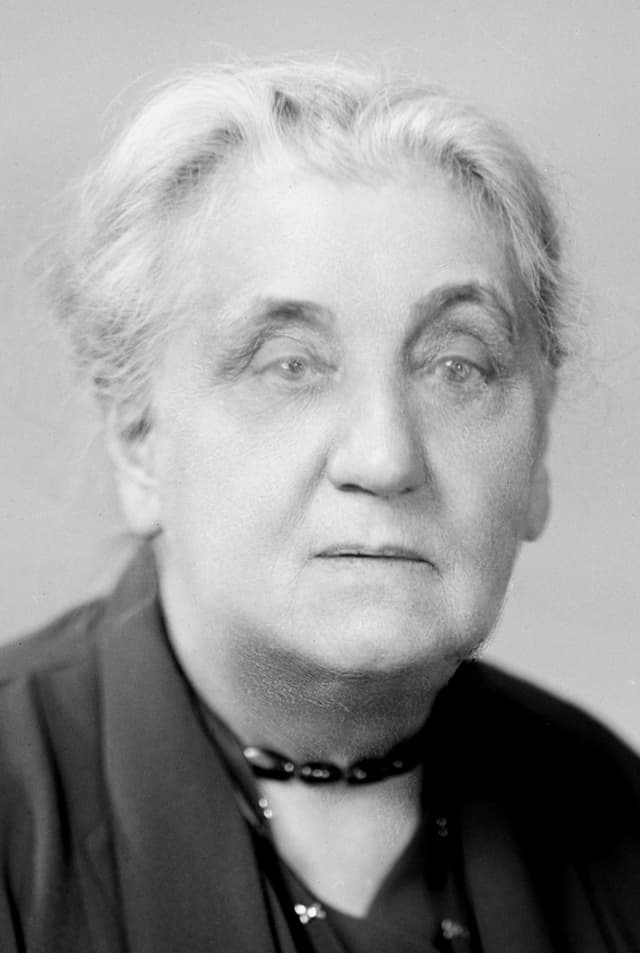
Jane Addams
Jane Addams was a pioneering American social reformer, philosopher, and author, best known for her role in the establishment of Hull House in Chicago in 1889. This settlement house became a vital community center that provided essential services to impoverished immigrant families, marking a significant step in the development of social work in the United States. As a radical pragmatist, Addams was not only a leader in the Progressive Era but also a prominent advocate for women's suffrage and world peace. Her work emphasized the importance of addressing social issues through a lens that connected public policy with domestic responsibilities, particularly those traditionally assigned to women. In recognition of her contributions, Addams became the first American woman to receive the Nobel Peace Prize in 1931, sharing the honor with Nicholas Murray Butler. She was also a co-founder of the American Civil Liberties Union (ACLU) in 1920 and received an honorary Master of Arts degree from Yale University in 1910, becoming the first woman to do so. Throughout her life, Addams championed causes related to children's welfare, public health, and social justice, leaving a lasting legacy as one of the most influential figures in American social reform and public philosophy. By the time of her death in 1935, she had become the most recognized female public figure in the United States, embodying the spirit of activism and reform that characterized her era.
Famous Quotes
View all 16 quotes“The good we secure for ourselves is precarious and uncertain until it is secured for all of us and incorporated into our common life.””
“True peace is not merely the absence of war, it is the presence of justice.””
“Nothing could be worse than the fear that one had given up too soon, and left one unexpended effort that might have saved the world.””
Books from the author













Link to this page
Add a free, dofollow link to Lex on your blog, forum, syllabus, or reading list.

<a href="https://lex-books.com/author/jane-addams"><img src="https://lex-books.com/badges/read-on-lex.svg" alt="Jane Addams on Lex" width="160" height="40"></a>[](https://lex-books.com/author/jane-addams)[url=https://lex-books.com/author/jane-addams][img]https://lex-books.com/badges/read-on-lex.svg[/img][/url]Jane Addams on Lex: https://lex-books.com/author/jane-addams