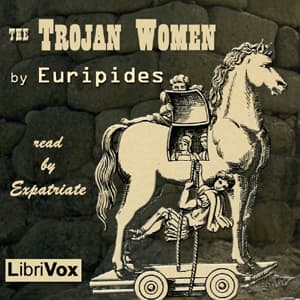
The Trojan Women of Euripides
1900
The Trojan Women of Euripides
1900
Translated by Gilbert Murray
Among the surviving Greek tragedies, only Euripides gives us the complete reckoning of a defeated city. The Trojan Women opens on the smoldering ruins of Troy, where Hecuba, former queen, wakes to find her world utterly erased. Her daughters are gone, her kingdom ash, her people slaughtered or enslaved. As the Greek herald Talthybius arrives to parcel out the surviving women like war prizes, Euripides constructs something radical: a tragedy not of heroes or kings, but of the invisible casualties, the wives and mothers whose only crime was being on the losing side. Andromache learns her son will be thrown from the walls. Cassandra is awarded to Agamemnon. Hecuba watches her family dissolve into the Greek fleet. But the play's genius lies in its double vision: Euripides also shows us the victors degrading themselves, their victory hollow, their gods disgusted. Written during the Peloponnesian War, this is ancient theater's most uncompromising anti-war statement, and it remains eerily, terribly relevant. Twenty-five centuries later, we still stage it because it answers a question no one else asks: what remains when the cheering stops?
Editions
X-Ray
“Soon all of you immortalsWill be as dead as we are! Come on then, what are you waiting for?Have you run out of thunderbolts?””
— Euripides
“Necio es el mortal que, creyéndose siempre feliz, se abandona al placer: la fortuna, cual furiosa delirante, salta aquí y allá, y a ninguno concede perpetua dicha””
— Euripides
“There liveth not in my life any moreThe hope that others have. Nor will I tellThe lie to mine own heart, that aught is wellOr shall be well…. Yet, O, to dream were sweet!””
— Euripides
“...I'd never want my museto be a singer of nothing but disaster.””
— Euripides
“الموتى وحدهم هم الذين لا يبكون على آلامهم.””
— Euripides
“Death cannot be what Life is, Child; the cupOf Death is empty, and Life hath always hope.””
— Euripides
“Would ye be wise, ye Cities, fly from war!””
— Euripides
“And whatso man they callHappy, believe not ere the last day fall!””
— Euripides
“My legs are trembling, but I won't fall””
— Euripides
Link to this book
Add a free, dofollow link to Lex on your blog, forum, syllabus, or reading list.

<a href="https://lex-books.com/book/the-trojan-women-of-euripides-0fea0a2f-6928-4c21-8acc-ebfd8de74511"><img src="https://lex-books.com/badges/read-on-lex.svg" alt="Read The Trojan Women of Euripides by Euripides free on Lex" width="160" height="40"></a>[](https://lex-books.com/book/the-trojan-women-of-euripides-0fea0a2f-6928-4c21-8acc-ebfd8de74511)[url=https://lex-books.com/book/the-trojan-women-of-euripides-0fea0a2f-6928-4c21-8acc-ebfd8de74511][img]https://lex-books.com/badges/read-on-lex.svg[/img][/url]Read The Trojan Women of Euripides by Euripides free on Lex: https://lex-books.com/book/the-trojan-women-of-euripides-0fea0a2f-6928-4c21-8acc-ebfd8de74511Cite this book
Reading this edition for a paper or guide? Copy a citation.
Euripides. The Trojan Women of Euripides. Lex, lex-books.com/book/the-trojan-women-of-euripides-0fea0a2f-6928-4c21-8acc-ebfd8de74511.Euripides (1900). The Trojan Women of Euripides. Lex. https://lex-books.com/book/the-trojan-women-of-euripides-0fea0a2f-6928-4c21-8acc-ebfd8de74511Euripides. The Trojan Women of Euripides. Lex. https://lex-books.com/book/the-trojan-women-of-euripides-0fea0a2f-6928-4c21-8acc-ebfd8de74511.