The Frogs
1884
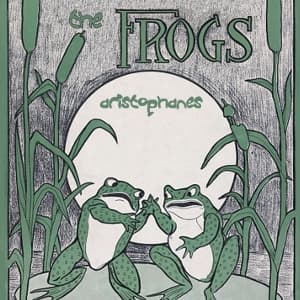
Dionysus, god of wine and theater, is having a crisis. The greatest tragedian in Athens just died, and what remains on stage is, in his opinion, garbage. So he does what any rational deity would do: he grabs his slave Xanthias and heads to the underworld to kidnap Euripides back from the dead. What follows is one of the oldest surviving examples of Old Comedy, a genre that made later Roman satire look positively prim. Aristophanes sends his frogs to croak at the audience, lets his slave land the best punchlines, and stages a literal showdown between two dead playwrights fighting for the throne of tragedy. It's a literary brawl wrapped in a road trip through hell, with the god of drama himself too cowardly to face a scary shade without histrionics. The play works as both ancient Greek comedy and surprisingly sharp commentary on what art owes to the city that makes it. Aristophanes asks: does tragedy instruct or merely entertain? Is Aeschylus's grandeur or Euripides's psychological depth the higher form? And why are these questions being argued in front of an audience of frogs?
Editions
X-Ray
“Have you ever been struck by a sudden desire for - soup?””
— Aristophanes
“better not bring up a lion inside your city,But if you must, then humour all his moods.””
— Aristophanes
“Dionysus: Have you e'er felt a sudden lust for soup?Heracles: Soup! Zeus-a-mercy, yes, ten thousand times.””
— Aristophanes
“After all, one of Aristophanes’ chief aims was to make humor of important dimensions of human life and society, while at the same time encouraging his audience to think about them in ways discouraged, or even forbidden, outside the comic theater. The issue of freedom of speech and thought (especially religious and moral thought) is especially relevant to Aristophanes’ plays, and it is important to bear in mind that one of the hallmarks of Aristophanic comedy is to encourage us to question the status quo.””
— Aristophanes
“But even in this perilous situation, the popular leader Cleophon managed to persuade the Athenians to reject the chance of a negotiated peace offered by Sparta after Arginusae, so that it is hardly surprising that the Athenians responded so warmly to the parabasis of Frogs, where the Chorus aptly upbraids them for choosing as leaders and fighters not the best men but the worst, just as they have traded their gold and silver coinage for base metal (686-705, 717-37).””
— Aristophanes
“In the first half of the play he is the anti-heroic and burlesque figure long familiar in comedy and satyr drama.””
— Aristophanes
“The Chorus of Eleusinian Initiates lead Dionysus and Aeschylus off in a torchlight procession recalling the inspirational finale of Aeschylus’ Oresteia.””
— Aristophanes
“In the second half of the play he arbitrates a contest between the poets Aeschylus and Euripides for pre-eminence in the art of tragedy.””
— Aristophanes
“Frogs embraces two transcendent issues, the decline of Athens as a great power, as the long Peloponnesian War (431-404) approached its end, and the decline of tragedy as a great form of art, with the recent deaths of the last two preeminent tragedians.””
— Aristophanes
Link to this book
Add a free, dofollow link to Lex on your blog, forum, syllabus, or reading list.

<a href="https://lex-books.com/book/the-frogs-2371aadd-7324-43e0-8eb6-f66c62f0abba"><img src="https://lex-books.com/badges/read-on-lex.svg" alt="Read The Frogs by Aristophanes free on Lex" width="160" height="40"></a>[](https://lex-books.com/book/the-frogs-2371aadd-7324-43e0-8eb6-f66c62f0abba)[url=https://lex-books.com/book/the-frogs-2371aadd-7324-43e0-8eb6-f66c62f0abba][img]https://lex-books.com/badges/read-on-lex.svg[/img][/url]Read The Frogs by Aristophanes free on Lex: https://lex-books.com/book/the-frogs-2371aadd-7324-43e0-8eb6-f66c62f0abbaCite this book
Reading this edition for a paper or guide? Copy a citation.
Aristophanes. The Frogs. Lex, lex-books.com/book/the-frogs-2371aadd-7324-43e0-8eb6-f66c62f0abba.Aristophanes (1884). The Frogs. Lex. https://lex-books.com/book/the-frogs-2371aadd-7324-43e0-8eb6-f66c62f0abbaAristophanes. The Frogs. Lex. https://lex-books.com/book/the-frogs-2371aadd-7324-43e0-8eb6-f66c62f0abba.