Soliloquies in England, and Later Soliloquies
1922
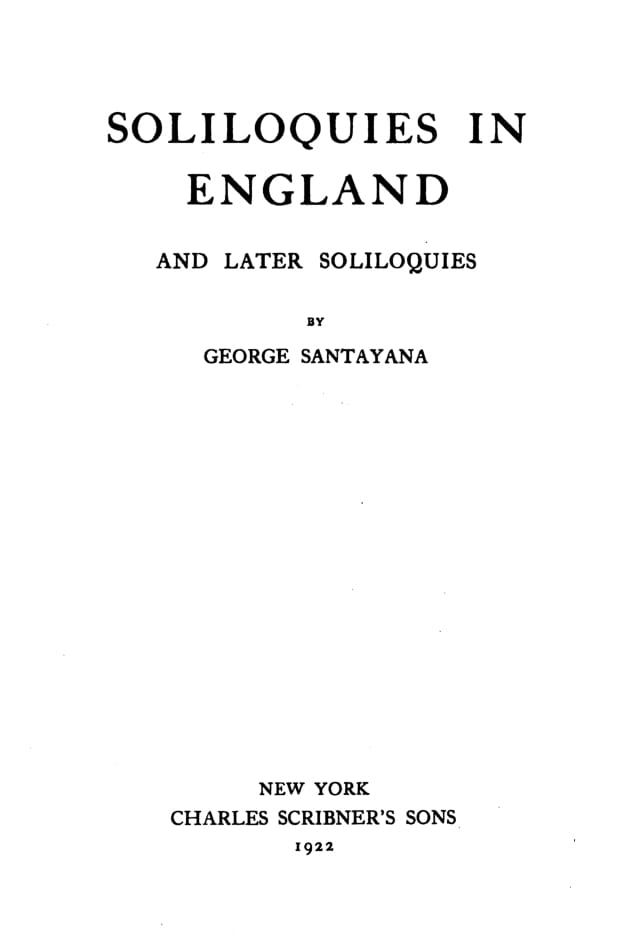
Soliloquies in England, and Later Soliloquies
1922
Between 1914 and 1918, the Spanish philosopher George Santayana wandered the English countryside while Europe tore itself apart. This collection of essays records those wanderings: not a war diary, but something stranger and more enduring. Santayana, a man who belonged to no nation entirely, observed England with the clarity of an outsider and the depth of a thinker who understood that nations, like individuals, reveal their truest selves in crisis. He writes of the English landscape as sanctuary, the quiet villages untouched by shells, the sheep cropping grass as if history had not veered into madness. Yet these are not merely pastoral reveries. Santayana uses the contrast between nature's indifference and human catastrophe to probe something deeper: what liberty means when civilization contracts into barbarism, what identity survives when everything familiar dissolves. The prose carries the weight of a mind that has read Plato and Lucretius but remains firmly rooted in the present moment. These soliloquies, then, are not confessions but reckonings: a philosopher alone with a world that has made no sense, finding in that failure a strange freedom.
Editions

X-Ray
“My atheism, like that of , is true piety towards the universe and denies only gods fashioned by men in their own image, to be servants of their human interests.””
— George Santayana
“Only the dead have seen the end of war.””
— George Santayana
“Masks are arrested expressions and admirable echoes of feeling, at once faithful, discrete, and superlative. Living things in contact with the air must acquire a cuticle, and it is not urged against cuticles that they are not hearts; yet some philosophers seem to be angry with images for not being things, and with words for not being feelings. Words and images are like shells, no less integral parts of nature than are the substances they cover, but better addressed to the eye and more open to observation. I would not say that substance exists for the sake of appearance, or faces for the sake of masks, or the passions for the sake of poetry and virtue. Nothing arises in nature for the sake of anything else; all these phases and products are involved equally in the round of existence.””
— George Santayana
“Instinctively the Englishman is no missionary, no conqueror. He prefers the country to the town, and home to foreign parts. He is rather glad and relieved if only natives will remain natives and strangers strangers, and at a comfortable distance from himself. Yet outwardly he is most hospitable and accepts almost anybody for the time being; he travels and conquers without a settled design, because he has the instinct of exploration. His adventures are all external; they change him so little that he is not afraid of them. He carries his English weather in his heart wherever he goes, and it becomes a cool spot in the desert, and a steady and sane oracle amongst all the deliriums of mankind. Never since the heroic days of Greece has the world had such a sweet, just, boyish master. It will be a black day for the human race when scientific blackguards, conspirators, churls, and fanatics manage to supplant him.””
— George Santayana
Link to this book
Add a free, dofollow link to Lex on your blog, forum, syllabus, or reading list.

<a href="https://lex-books.com/book/soliloquies-in-england-and-later-soliloquies-f1b69a42-49b6-45f7-b361-1f44399d64cf"><img src="https://lex-books.com/badges/read-on-lex.svg" alt="Read Soliloquies in England, and Later Soliloquies by George Santayana free on Lex" width="160" height="40"></a>[](https://lex-books.com/book/soliloquies-in-england-and-later-soliloquies-f1b69a42-49b6-45f7-b361-1f44399d64cf)[url=https://lex-books.com/book/soliloquies-in-england-and-later-soliloquies-f1b69a42-49b6-45f7-b361-1f44399d64cf][img]https://lex-books.com/badges/read-on-lex.svg[/img][/url]Read Soliloquies in England, and Later Soliloquies by George Santayana free on Lex: https://lex-books.com/book/soliloquies-in-england-and-later-soliloquies-f1b69a42-49b6-45f7-b361-1f44399d64cfCite this book
Reading this edition for a paper or guide? Copy a citation.
Santayana, George. Soliloquies in England, and Later Soliloquies. Lex, lex-books.com/book/soliloquies-in-england-and-later-soliloquies-f1b69a42-49b6-45f7-b361-1f44399d64cf.Santayana, G. (1922). Soliloquies in England, and Later Soliloquies. Lex. https://lex-books.com/book/soliloquies-in-england-and-later-soliloquies-f1b69a42-49b6-45f7-b361-1f44399d64cfSantayana, George. Soliloquies in England, and Later Soliloquies. Lex. https://lex-books.com/book/soliloquies-in-england-and-later-soliloquies-f1b69a42-49b6-45f7-b361-1f44399d64cf.