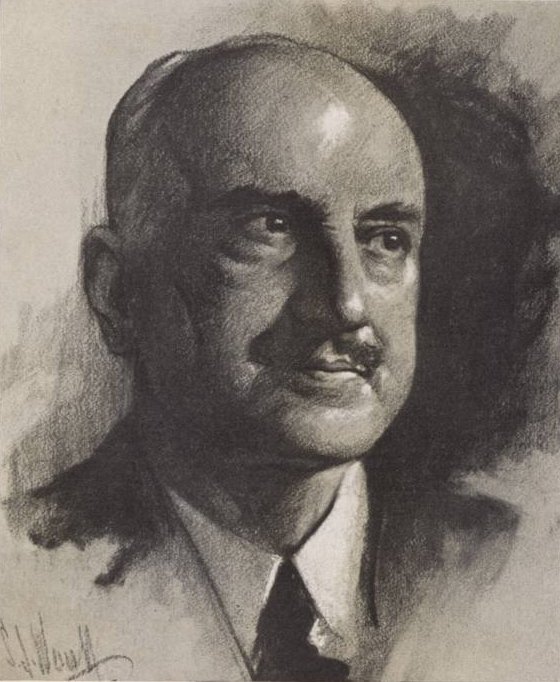
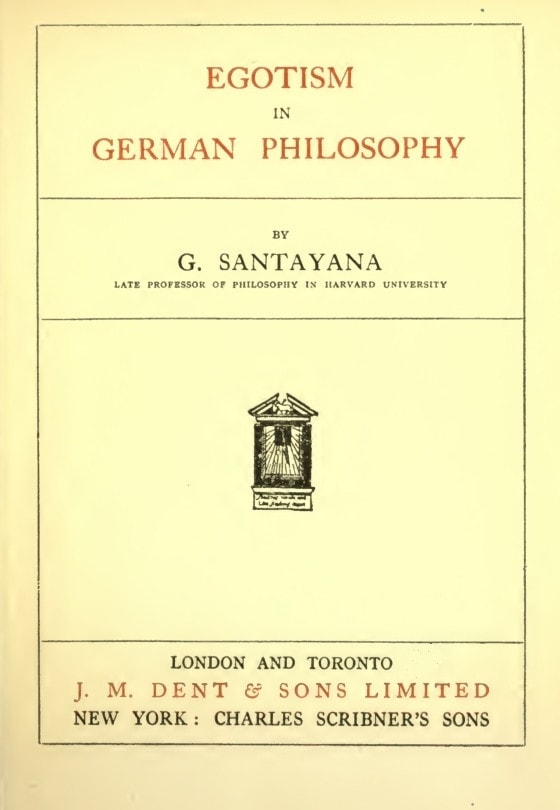
Egotism in German Philosophy
1916
Egotism in German Philosophy, published in 1916 by George Santayana, critically examines the subjective nature of German philosophical thought, particularly focusing on figures like Kant, Fichte, and Hegel. Santayana argues that their emphasis on the individual self leads to a distorted understanding of reality and communal values. The book explores the implications of this egotism on culture and morality, highlighting its influence on later philosophical movements such as existentialism and phenomenology. This work serves as a significant critique of the philosophical landscape of early 20th-century Germany.
Editions
X-Ray
“Dissatisfaction with the actual is what usually leads people to frame ideals at all, or at least to hold them fast; but such a negative motive leaves the ideal vague and without consistency. If we could suddenly have our will, we should very likely find the result trivial or horrible.””
— George Santayana
“The intellectual ignominy of believing what we believe simply because of the time and place of our birth, escapes many evolutionists. Far from trying to overcome this natural prejudice of position, they raise it into a point of pride. They declare all opinions ever held in the past to be superseded, and are apparently content that their own should be superseded to-morrow, but meantime they cover you with obloquy if you are so backward or so forward as not to agree with them to-day. They accept as inevitable the total dominion of the point of view. Each new date, even in the life of an individual thinker, is expected by them to mark a new phase of doctrine. Indeed, truth is an object which transcendental philosophy cannot envisage: the absolute ego must be satisfied with consistency. How should the truth, actual, natural, or divine, be an expression of the living will that attempts, or in their case despairs, to discover it? Yet that everything, even the truth, is an expression of the living will, is the corner-stone of this philosophy.””
— George Santayana
“The transcendental theory of a world merely imagined by the ego, and the will that deems itself absolute are certainly desperate delusions; but not more desperate or deluded than many another system that millions have been brought to accept. The thing bears all the marks of a new religion. The fact that the established religions of Germany are still forms of Christianity may obscure the explicit and heathen character of the new faith: it passes for a somewhat faded speculation, or for the creed of a few extremists, when in reality it dominates the judgment and conduct of the nation. No religious tyranny could be more complete. It has its prophets in the great philosophers and historians of the last century; its high priests and pharisees in the government and the professors; its faithful flock in the disciplined mass of the nation; its heretics in the socialists; its dupes in the Catholics and the liberals, to both of whom the national creed, if they understood it, would be an abomination; it has its martyrs now by the million, and its victims among unbelievers are even more numerous, for its victims, in some degree, are all men.””
— George Santayana
Link to this book
Add a free, dofollow link to Lex on your blog, forum, syllabus, or reading list.

<a href="https://lex-books.com/book/egotism-in-german-philosophy-a6ab7cb6-5562-43ca-8e1b-ba2b419e5435"><img src="https://lex-books.com/badges/read-on-lex.svg" alt="Read Egotism in German Philosophy by George Santayana free on Lex" width="160" height="40"></a>[](https://lex-books.com/book/egotism-in-german-philosophy-a6ab7cb6-5562-43ca-8e1b-ba2b419e5435)[url=https://lex-books.com/book/egotism-in-german-philosophy-a6ab7cb6-5562-43ca-8e1b-ba2b419e5435][img]https://lex-books.com/badges/read-on-lex.svg[/img][/url]Read Egotism in German Philosophy by George Santayana free on Lex: https://lex-books.com/book/egotism-in-german-philosophy-a6ab7cb6-5562-43ca-8e1b-ba2b419e5435Cite this book
Reading this edition for a paper or guide? Copy a citation.
Santayana, George. Egotism in German Philosophy. Lex, lex-books.com/book/egotism-in-german-philosophy-a6ab7cb6-5562-43ca-8e1b-ba2b419e5435.Santayana, G. (1916). Egotism in German Philosophy. Lex. https://lex-books.com/book/egotism-in-german-philosophy-a6ab7cb6-5562-43ca-8e1b-ba2b419e5435Santayana, George. Egotism in German Philosophy. Lex. https://lex-books.com/book/egotism-in-german-philosophy-a6ab7cb6-5562-43ca-8e1b-ba2b419e5435.