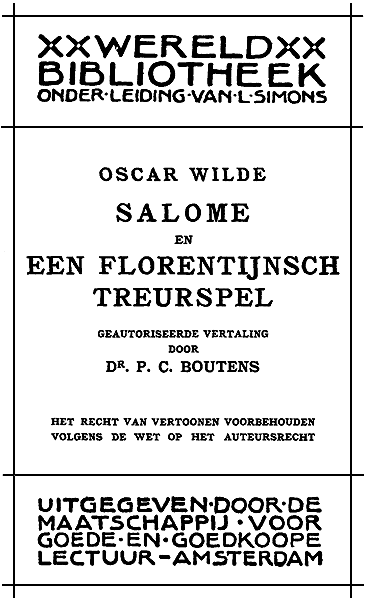
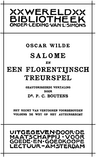
Salome En Een Florentijnsch Treurspel
1893
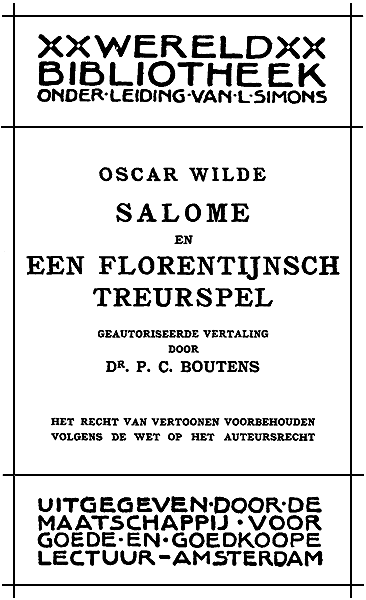
Salome En Een Florentijnsch Treurspel
1893
Translated by Boutens P. C.
A play written in the late 19th century. The work centers around the character of Salome, the daughter of Herodias, exploring themes of desire, power, and sacrifice. As the narrative unfolds, it captures the complex dynamics between Salome, Herod, and the prophet Jokanaän, ultimately leading to dramatic and tragic consequences. At the start of the play, Salome's beauty captivates those around her, including the Young Syrian and Herod, who is intrigued yet troubled. The scene is set on a terrace outside Herod's palace, where tension arises as soldiers and guests discuss the presence of Jokanaän, who prophesies doom. Salome expresses a desire to speak with Jokanaän, despite warnings from the others, revealing her fascination with him. As the narrative progresses, Salome's yearning for Jokanaän intensifies, leading her to request his head on a silver platter, marking a pivotal shift towards a tragic climax. This opening segment establishes a rich atmospheric tension and hints at the dark fates that await the characters.
Editions
X-Ray
“The mystery of love is greater than the mystery of death.””
— Oscar Wilde
“It is not wise to find symbols in everything that one sees. It makes life too full of terrors.””
— Oscar Wilde
“How pale the Princess is! Never have I seen her so pale. She is like the shadow of a white rose in a mirror of silver.””
— Oscar Wilde
“Salomé, Salomé, dance for me. I pray thee dance for me. I am sad to-night. Yes, I am passing sad to-night. When I came hither I slipped in blood, which is an evil omen; and I heard, I am sure I heard in the air a beating of wings, a beating of giant wings. I cannot tell what they mean .... I am sad to-night. Therefore dance for me. Dance for me, Salomé, I beseech you. If you dance for me you may ask of me what you will, and I will give it you, even unto the half of my kingdom.””
— Oscar Wilde
“Neither at things, nor at people should one look. Only in mirrors should one look, for mirrors do but show us masks.””
— Oscar Wilde
“The long black nights, when the moon hides her face, when the stars are afraid, are not so black. The silence that dwells in the forest is not so black. There is nothing in the world so black as thy hair.””
— Oscar Wilde
“I am athirst for thy beauty; I am hungry for thy body; and neither wine nor apples can appease my desire. What shall I do now, Iokanaan? Neither the floods nor the great waters can quench my passion. I was a princess, and thou didst scorn me. I was a virgin, and thou didst take my virginity from me. I was chaste, and thou didst fill my veins with fire . . .””
— Oscar Wilde
“Look at the moon! How strange the moon seems! She is like a woman rising from a tomb. She is like a dead woman. You would fancy she was looking for dead things.””
— Oscar Wilde
“Ah! thou wouldst not suffer me to kiss thy mouth, Iokanaan. Well! I will kiss it now. I will bite it with my teeth as one bites a ripe fruit. Yes, I will kiss thy mouth, Iokanaan. I said it; did I not say it? I said it. Ah! I will kiss it now . . . . But wherefore dost thou not look at me, Iokanaan? Thine eyes that were so terrible, so full of rage and scorn, are shut now. Wherefore are they shut? Open thine eyes! Lift up thine eyelids, Iokanaan! Wherefore dost thou not look at me? Art thou afraid of me, Iokanaan, that thou wilt not look at me?””
— Oscar Wilde
Link to this book
Add a free, dofollow link to Lex on your blog, forum, syllabus, or reading list.

<a href="https://lex-books.com/book/salome-en-een-florentijnsch-treurspel-17a4d4e7-4115-4a19-9c6f-f6906146085c"><img src="https://lex-books.com/badges/read-on-lex.svg" alt="Read Salome En Een Florentijnsch Treurspel by Oscar Wilde free on Lex" width="160" height="40"></a>[](https://lex-books.com/book/salome-en-een-florentijnsch-treurspel-17a4d4e7-4115-4a19-9c6f-f6906146085c)[url=https://lex-books.com/book/salome-en-een-florentijnsch-treurspel-17a4d4e7-4115-4a19-9c6f-f6906146085c][img]https://lex-books.com/badges/read-on-lex.svg[/img][/url]Read Salome En Een Florentijnsch Treurspel by Oscar Wilde free on Lex: https://lex-books.com/book/salome-en-een-florentijnsch-treurspel-17a4d4e7-4115-4a19-9c6f-f6906146085cCite this book
Reading this edition for a paper or guide? Copy a citation.
Wilde, Oscar. Salome En Een Florentijnsch Treurspel. Lex, lex-books.com/book/salome-en-een-florentijnsch-treurspel-17a4d4e7-4115-4a19-9c6f-f6906146085c.Wilde, O. (1893). Salome En Een Florentijnsch Treurspel. Lex. https://lex-books.com/book/salome-en-een-florentijnsch-treurspel-17a4d4e7-4115-4a19-9c6f-f6906146085cWilde, Oscar. Salome En Een Florentijnsch Treurspel. Lex. https://lex-books.com/book/salome-en-een-florentijnsch-treurspel-17a4d4e7-4115-4a19-9c6f-f6906146085c.