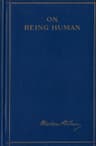
On Being Human
1916

What does it mean to be human when modernity threatens to hollow us out? Woodrow Wilson, before he became president, wrote this passionate philosophical inquiry into the crisis of selfhood in the machine age. Published in 1916, as the world hurtled toward unprecedented upheaval, the essay proposes a counterargument: that true humanity is not individual achievement but genuine encounter with others. Wilson contends that authentic humanity demands balancing our capacities, spontaneity, intelligence, and moral sense while remaining curiously open to the world beyond ourselves. He warns against the isolating forces of urban life and transactional relationships, arguing that real connection and community are what save us from becoming less than human. This is a call for a renaissance of empathy and shared purpose, a reminder that we become fully ourselves only in relation to others.
Editions
X-Ray
“You devour a book meant to be read, not because you would fill yourself or have an anxious care to be nourished, but because it contains such stuff as it makes the mind hungry to look upon.””
— Woodrow Wilson
“we read, if we have the true reader’s zest and plate, not to grow more knowing, but to be less pent up and bound within a little circle,”
— Woodrow Wilson
“We wish companionship and renewal of spirit, enrichment of thought and the full adventure of the mind; and we desire fair company, and a larger world in which to find them.””
— Woodrow Wilson
Link to this book
Add a free, dofollow link to Lex on your blog, forum, syllabus, or reading list.

<a href="https://lex-books.com/book/on-being-human-6aff9b01-3ec1-477e-84d0-9359cebd14ee"><img src="https://lex-books.com/badges/read-on-lex.svg" alt="Read On Being Human by Woodrow Wilson free on Lex" width="160" height="40"></a>[](https://lex-books.com/book/on-being-human-6aff9b01-3ec1-477e-84d0-9359cebd14ee)[url=https://lex-books.com/book/on-being-human-6aff9b01-3ec1-477e-84d0-9359cebd14ee][img]https://lex-books.com/badges/read-on-lex.svg[/img][/url]Read On Being Human by Woodrow Wilson free on Lex: https://lex-books.com/book/on-being-human-6aff9b01-3ec1-477e-84d0-9359cebd14eeCite this book
Reading this edition for a paper or guide? Copy a citation.
Wilson, Woodrow. On Being Human. Lex, lex-books.com/book/on-being-human-6aff9b01-3ec1-477e-84d0-9359cebd14ee.Wilson, W. (1916). On Being Human. Lex. https://lex-books.com/book/on-being-human-6aff9b01-3ec1-477e-84d0-9359cebd14eeWilson, Woodrow. On Being Human. Lex. https://lex-books.com/book/on-being-human-6aff9b01-3ec1-477e-84d0-9359cebd14ee.