On a Chinese Screen
1922
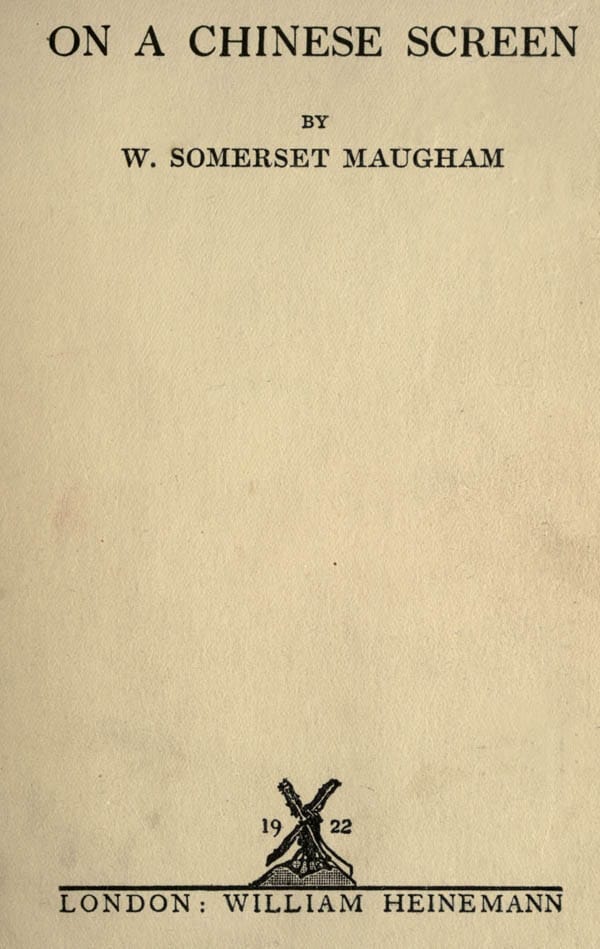
On a Chinese Screen, published in 1922 by W. Somerset Maugham, is a travel narrative that presents a series of sketches from his journey along the Yangtze River in 1919-1920. The book captures Maugham's observations of both the rich culture of China and the experiences of Westerners struggling to adapt to their surroundings. Notable for its vivid descriptions and insightful commentary, it reflects on the contrast between the allure of the East and the challenges faced by foreigners in a vastly different society.
Editions

X-Ray
“I was interested in this because it bore out an opinion of mine that philosophy is an affair of character rather than of logic: the philosopher believes not according to evidence, but according to his own temperament; and his thinking merely serves to make reasonable what his instinct regards as true.””
— W. Somerset Maugham
“But his study of Western philosophy had only served in the end to satisfy him that wisdom after all was to be found within the limits of the Confucian canon. He accepted its philosophy with conviction. It answered the needs of his spirit with a completeness which made all foreign learning seem vain. I was interested in this because it bore out an opinion of mine that philosophy is an affair of character rather than of logic: the philosopher believes not according to evidence, but according to his own temperament; and his thinking merely serves to make reasonable what his instinct regards as true. If Confucianism gained so firm a hold on the Chinese it is because it explained and expressed them as no other system of thought could do.””
— W. Somerset Maugham
“Well," they said, "did you see the blighter shot?""You bet I did," he said, in a loud and casual voice."Everything go off alright?""He wriggled a bit." He turned to the bartender. "Same as usual, John.””
— W. Somerset Maugham
“But when, reaching the top of the hill, you come once more to the crenellated walls that surround the city and go out through the frowning gate, you come to the graves. They stretch over the country, one mile, two miles, three, four, five, interminable green mounds, up and down the hills, with grey stones to which the people once a year come to offer libation and to tell the dead how fare the living whom they left behind; and they are as thickly crowded, the dead, as are the living in the city; and they seem to press upon the living as though they would force them into the turbid, swirling river.There is something menacing about those serried ranks. It is as though they were laying siege to the city, with a sullen ruthlessness, biding their time; and as though in the end, encroaching irresistibly as fate, they would drive those seething throngs before them till the houses and the streets were covered by them, and the green mounds came down to the water gate.Then at last silence, silence would dwell there un-disturbed.They are uncanny, those green graves, they are terrifying. They seem to wait.””
— W. Somerset Maugham
“It is a city of a thousand noises.There are the peddlers who announce their presence by a wooden gong; the clappers of the blind musician or of the masseuse; the shrill falsetto of a man singing in a tavern; the loud beating of a gong from a house where a wedding or a funeral is being celebrated. There are the raucous shouts of the coolies and chair-bearers; the menacing whines of the beggars, caricatures of humanity, their emaciated limbs barely covered by filthy tatters and revolting with disease; the cracked melancholy of the bugler who incessantly practises a call he can never get; and then, like a bass to which all these are a barbaric melody, the insistent sound of conversation, of people laughing, quarrelling, joking, shouting, arguing, gossiping. It is a cease less din. It is extraordinary at first, then confusing, exasperating, and at last maddening. You long for a moment's utter silence. It seems to you that it would be a voluptuous delight.””
— W. Somerset Maugham
“But the officer did not think the spot suitable. He told the man to rise. He walked a yard or two and knelt down again. A soldier was detached from the squad and took up his position behind the prisoner, three feet from him perhaps; he raised his gun; the officer gave the word of command; he fired. The criminal fell forward and he moved a little, convulsively. Theofficer went up to him, and seeing that he was not quite dead emptied two barrels of his revolver into the body. Then he formed up his soldiers once more. The judge gave the vice-consul a smile, but it was a grimace rather than a smile; it distorted painfully that fat good-humoured face.””
— W. Somerset Maugham
“She took me into a little anteroom, near the entrance, and there lying on a table under a counterpane were four new-born babes.They had just been washed and put into long clothes. The counterpane was lifted off. They lay side by side, on their backs, four tiny wriggling mites, very red in the face, rather cross perhaps because they had been bathed, and very hungry.Their eyes seemed preternaturally large.They were so small, so helpless: you were forced to smile when you looked at them and at the same time you felt a lump in your throat.””
— W. Somerset Maugham
“But you, do you know what you are doing?" he exclaimed."What is the reason for which you deem yourselves our betters? Have you excelled us in arts or letters? Have our thinkers been less profound than yours? Has our civilisation been less elaborate, less complicated, less refined than yours? Why, when you lived in caves and clothed yourselves with skins we were a cultured people. Do you know that we tried an experiment which is unique in the history of the world? We sought to rule this great country not by force, but by wisdom. And for centuries we succeeded. Then why does the white man despise the yellow?Shall I tell you?Because he has invented the machine gun.That is your superiority.We are a defenceless horde and you can blow us into eternity. You have shattered the dream of our philosophers that the world could be governed by the power of law and order. And now you are teaching our young men your secret. You have thrust your hideous inventions upon us. Do you not know that we have a genius for mechanics?Do you not know that there are in this country four hundred millions of the most practical and industrious people in the world? Do you think it will take us long to learn? And what will become of your superiority when the yellow man can make as good guns as the white and fire them as straight? You have appealed to the machine gun and by the machine gun shall you be judged.””
— W. Somerset Maugham
“A foreigner?" asked the missionary, still wondering who the stranger could be."Oh, yes, certainly." The doctor's eyes twinkled."Then he asked me about the other missions; I told him the London Mission had a settlement here, but it wasn't the least use going there as all the missionaries were away in the hills. After all it's devilish hot in the city.'Then I'd like to go to one of the mission schools,' said the stranger.'Oh, they're all closed,' I said. 'Well, then I'll go to the hospital.' 'That's well worth a visit,' I said, 'the American hospital is equipped with all the latest contrivances. Their operating theatre is perfect.''What is the name of the doctor in charge?''Oh, he's up in the hills.''But what about the sick?''There are no sick between May and September,' I said, 'and if there are they have to put up with the native dispensers.””
— W. Somerset Maugham
Link to this book
Add a free, dofollow link to Lex on your blog, forum, syllabus, or reading list.

<a href="https://lex-books.com/book/on-a-chinese-screen-f733f40a-d647-409c-977f-f3ed395d6b9c"><img src="https://lex-books.com/badges/read-on-lex.svg" alt="Read On a Chinese Screen by W. Somerset Maugham free on Lex" width="160" height="40"></a>[](https://lex-books.com/book/on-a-chinese-screen-f733f40a-d647-409c-977f-f3ed395d6b9c)[url=https://lex-books.com/book/on-a-chinese-screen-f733f40a-d647-409c-977f-f3ed395d6b9c][img]https://lex-books.com/badges/read-on-lex.svg[/img][/url]Read On a Chinese Screen by W. Somerset Maugham free on Lex: https://lex-books.com/book/on-a-chinese-screen-f733f40a-d647-409c-977f-f3ed395d6b9cCite this book
Reading this edition for a paper or guide? Copy a citation.
Maugham, W. Somerset. On a Chinese Screen. Lex, lex-books.com/book/on-a-chinese-screen-f733f40a-d647-409c-977f-f3ed395d6b9c.Maugham, W. S. (1922). On a Chinese Screen. Lex. https://lex-books.com/book/on-a-chinese-screen-f733f40a-d647-409c-977f-f3ed395d6b9cMaugham, W. Somerset. On a Chinese Screen. Lex. https://lex-books.com/book/on-a-chinese-screen-f733f40a-d647-409c-977f-f3ed395d6b9c.