Main Currents in Nineteenth Century Literature - 4. Naturalism in England
1901
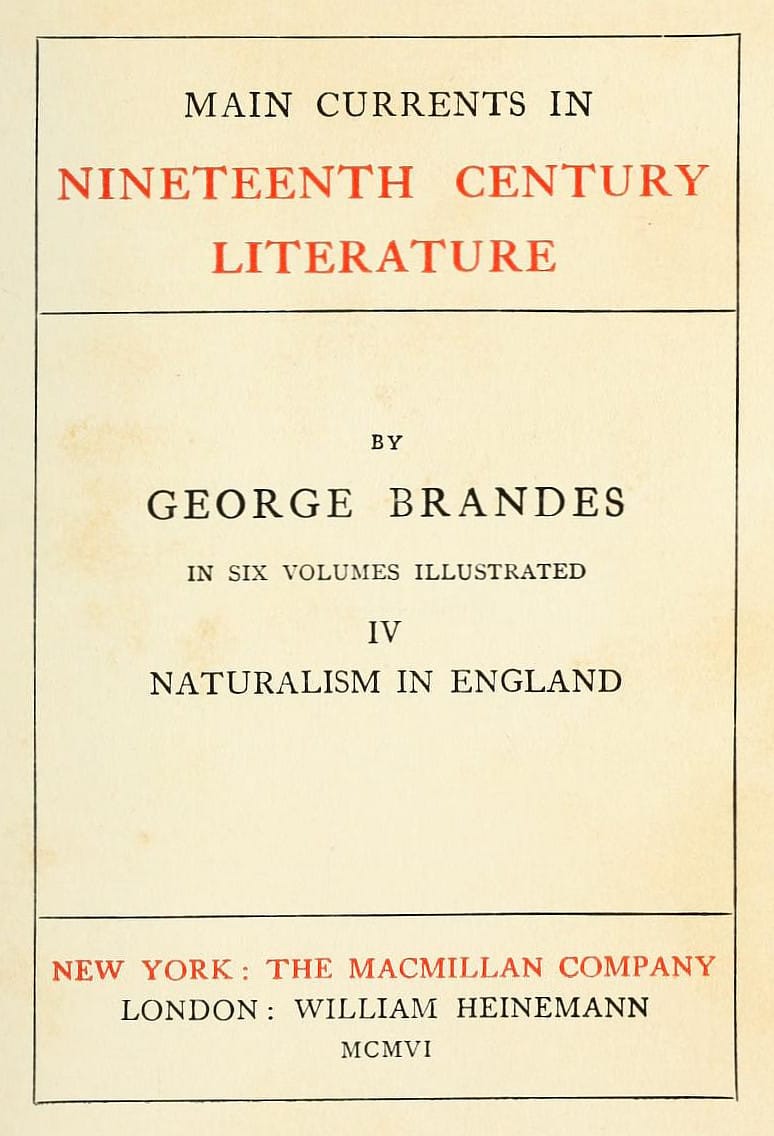
Main Currents in Nineteenth Century Literature - 4. Naturalism in England
1901
Translated by Mary Morison
This is Georg Brandes at his most ambitious: a genealogical account of how English literature shed its eighteenth-century skin and embraced something rawer, truer, more alive. Written in 1901 by the Danish critic who essentially invented the idea of literature as a response to social and political forces, this volume traces Naturalism's emergence in England not as a stylistic preference but as an unavoidable response to historical upheaval. Brandes argues that the French Revolution, the Napoleonic wars, and the industrial transformation of English society cracked the classical mold that had constrained poetry for generations, forcing writers toward a new honesty about nature, class, and human experience. The book culminates in an analysis of Wordsworth and Coleridge's revolutionary Lyrical Ballads (1800), which Brandes reads as a deliberate rupture with convention, a rejection of elevated diction in favor of the language actually spoken by common people. More than a period piece, this is Brandes making the case that literary movements never emerge in isolation: they are born from the collision of ideas, events, and the urgent need to represent a changing world.
Editions

Link to this book
Add a free, dofollow link to Lex on your blog, forum, syllabus, or reading list.

<a href="https://lex-books.com/book/main-currents-in-nineteenth-century-literature-4-naturalism-in-england-da00bbe6-ab27-44d2-8f87-f27ec47e7e8b"><img src="https://lex-books.com/badges/read-on-lex.svg" alt="Read Main Currents in Nineteenth Century Literature - 4. Naturalism in England by Georg Brandes free on Lex" width="160" height="40"></a>[](https://lex-books.com/book/main-currents-in-nineteenth-century-literature-4-naturalism-in-england-da00bbe6-ab27-44d2-8f87-f27ec47e7e8b)[url=https://lex-books.com/book/main-currents-in-nineteenth-century-literature-4-naturalism-in-england-da00bbe6-ab27-44d2-8f87-f27ec47e7e8b][img]https://lex-books.com/badges/read-on-lex.svg[/img][/url]Read Main Currents in Nineteenth Century Literature - 4. Naturalism in England by Georg Brandes free on Lex: https://lex-books.com/book/main-currents-in-nineteenth-century-literature-4-naturalism-in-england-da00bbe6-ab27-44d2-8f87-f27ec47e7e8bCite this book
Reading this edition for a paper or guide? Copy a citation.
Brandes, Georg. Main Currents in Nineteenth Century Literature - 4. Naturalism in England. Lex, lex-books.com/book/main-currents-in-nineteenth-century-literature-4-naturalism-in-england-da00bbe6-ab27-44d2-8f87-f27ec47e7e8b.Brandes, G. (1901). Main Currents in Nineteenth Century Literature - 4. Naturalism in England. Lex. https://lex-books.com/book/main-currents-in-nineteenth-century-literature-4-naturalism-in-england-da00bbe6-ab27-44d2-8f87-f27ec47e7e8bBrandes, Georg. Main Currents in Nineteenth Century Literature - 4. Naturalism in England. Lex. https://lex-books.com/book/main-currents-in-nineteenth-century-literature-4-naturalism-in-england-da00bbe6-ab27-44d2-8f87-f27ec47e7e8b.