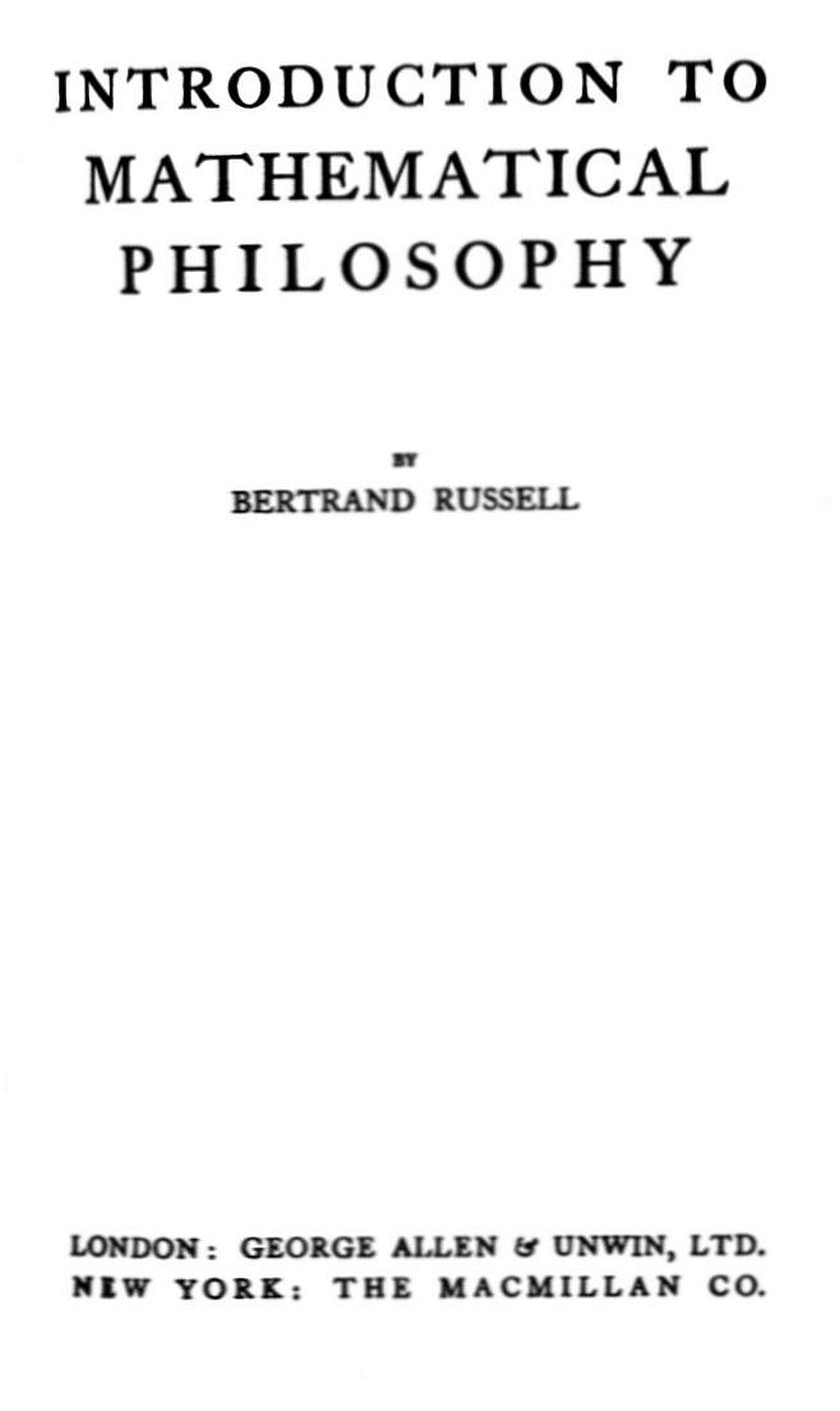
Introduction to Mathematical Philosophy
1919
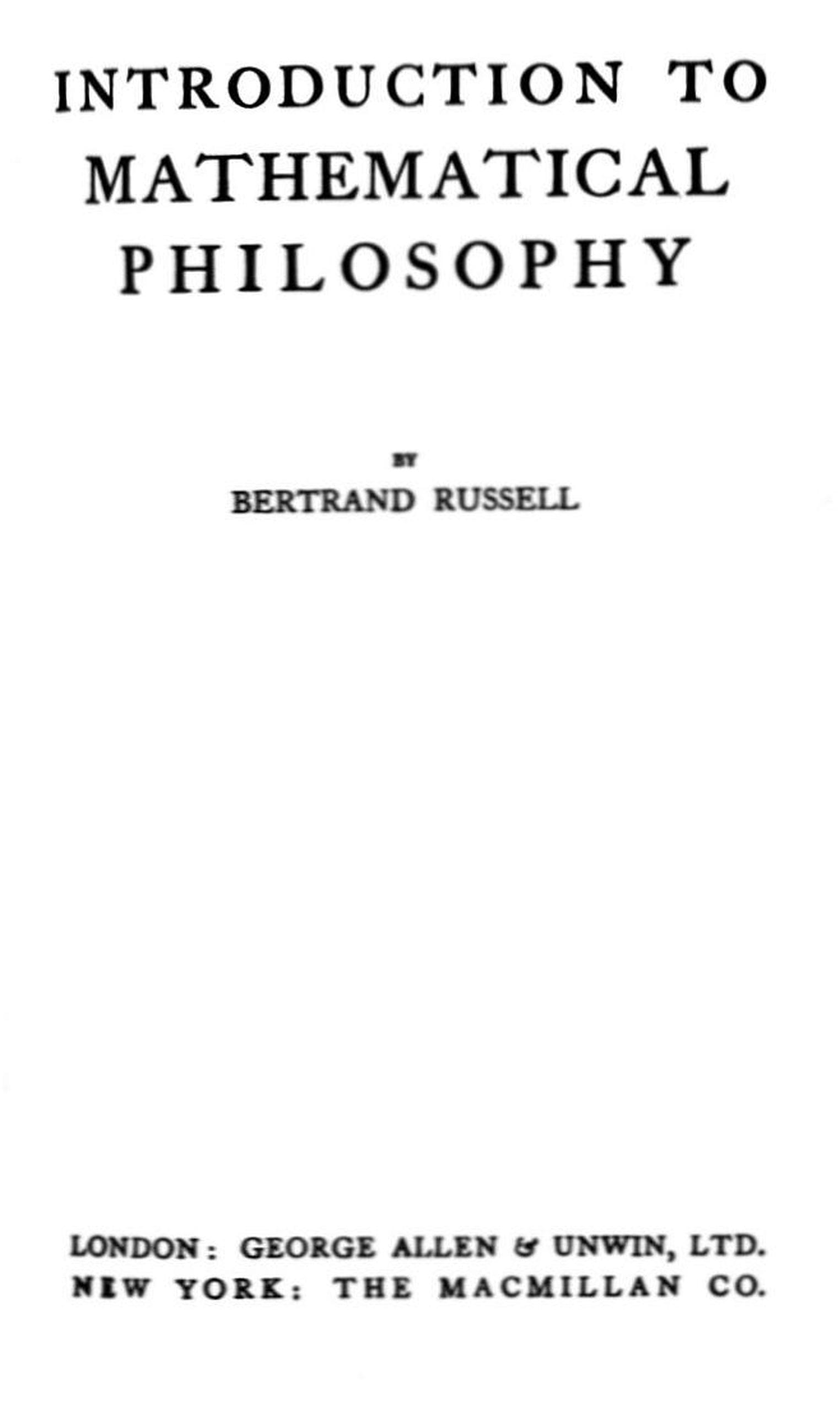
Introduction to Mathematical Philosophy is a book (1919 first edition) by philosopher Bertrand Russell, in which the author seeks to create an accessible introduction to various topics within the foundations of mathematics. According to the preface, the book is intended for those with only limited knowledge of mathematics and no prior experience with the mathematical logic it deals with. Accordingly, it is often used in introductory philosophy of mathematics courses at institutions of higher education.
Editions

X-Ray
“what is work? Work is of two kinds: first, altering the position of matter at or near the earth's surface relatively to other such matter; second, telling other people to do so. The first one is unpleasant and ill paid; the second is pleasant and highly paid.””
— Bertrand Russell
“The method of 'postulating' what we want has many advantages ; they are the same as the advantages of theft over honest toil.””
— Bertrand Russell
“(1) 0 is a number. (2) The successor of any number is a number. (3) No two numbers have the same successor. (page 6) (4) 0 is not the successor of any number. (5) Any property which belongs to 0, and also to the successor of every number which has the property, belongs to all numbers.””
— Bertrand Russell
“it is to be presumed, for example, that there are an infinite collection of trios in the world, for if this were not the case the total number of things in the world would be finite, which, though possible, seems unlikely.””
— Bertrand Russell
“It remains to define "successor." Given any number n, let α be a class which has n members, and let x be a term which is not a member of α. Then the class consisting of α with x added on will have n+1 members.””
— Bertrand Russell
“0 is the class whose only member is the null-class.””
— Bertrand Russell
“The number 0 is the number of terms in a class which has no members, i.e. in the class which is called the "null-class.””
— Bertrand Russell
“The key to our problem lies in mathematical induction. It will be remembered that, in Chapter I., this was the fifth of the five primitive propositions which we laid down about the natural numbers. It stated that any property which belongs to 0, and to the successor of any number which has the property, belongs to all the natural numbers. This was then presented as a principle, but we shall now adopt it as a definition.””
— Bertrand Russell
“every progression verifies Peano's five axioms.””
— Bertrand Russell
Link to this book
Add a free, dofollow link to Lex on your blog, forum, syllabus, or reading list.

<a href="https://lex-books.com/book/introduction-to-mathematical-philosophy-070d210b-ae02-4d84-b5c6-dc1487aed540"><img src="https://lex-books.com/badges/read-on-lex.svg" alt="Read Introduction to Mathematical Philosophy by Bertrand Russell free on Lex" width="160" height="40"></a>[](https://lex-books.com/book/introduction-to-mathematical-philosophy-070d210b-ae02-4d84-b5c6-dc1487aed540)[url=https://lex-books.com/book/introduction-to-mathematical-philosophy-070d210b-ae02-4d84-b5c6-dc1487aed540][img]https://lex-books.com/badges/read-on-lex.svg[/img][/url]Read Introduction to Mathematical Philosophy by Bertrand Russell free on Lex: https://lex-books.com/book/introduction-to-mathematical-philosophy-070d210b-ae02-4d84-b5c6-dc1487aed540Cite this book
Reading this edition for a paper or guide? Copy a citation.
Russell, Bertrand. Introduction to Mathematical Philosophy. Lex, lex-books.com/book/introduction-to-mathematical-philosophy-070d210b-ae02-4d84-b5c6-dc1487aed540.Russell, B. (1919). Introduction to Mathematical Philosophy. Lex. https://lex-books.com/book/introduction-to-mathematical-philosophy-070d210b-ae02-4d84-b5c6-dc1487aed540Russell, Bertrand. Introduction to Mathematical Philosophy. Lex. https://lex-books.com/book/introduction-to-mathematical-philosophy-070d210b-ae02-4d84-b5c6-dc1487aed540.