The Mathematicall Praeface to Elements of Geometrie of Euclid of Megara
1570
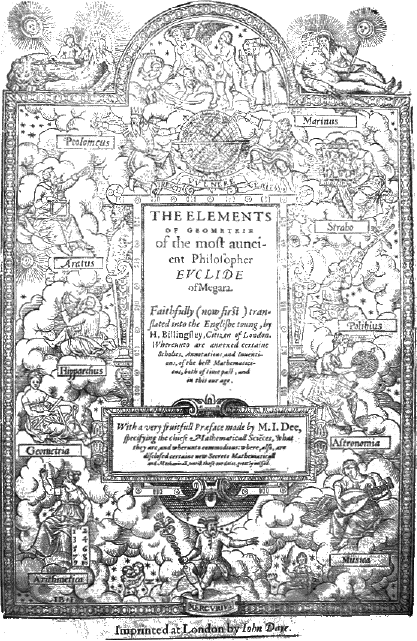
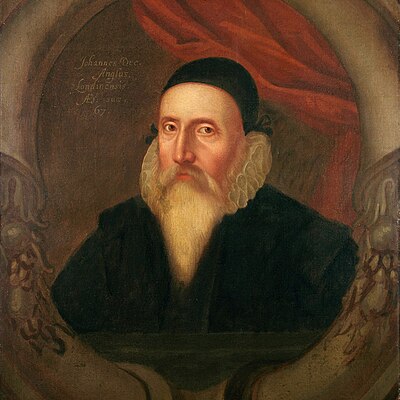
In 1570, the most learned man in England wrote a defense of mathematics that reads like a prayer. John Dee, court magician to Queen Elizabeth I and the era's preeminent mathematician, composed this preface to his translation of Euclid not merely to explain geometry, but to argue that mathematical study opens the door to divine wisdom. Dee believed numbers were the language through which God created the universe, and that rigorous geometric reasoning could lift the human mind toward celestial truths. His preface weaves classical learning, Ptolemaic astronomy, and deep mystical conviction into an argument that mathematics is both useful and sacred. Written in an age when English was still becoming a language of serious learning, Dee champions mathematical arts as essential to a flourishing society and a cultivated soul. The text reveals why geometry mattered to one of history's most fascinating polymaths: not as an abstract exercise, but as a path toward understanding the mind of the Creator.
Editions
Link to this book
Add a free, dofollow link to Lex on your blog, forum, syllabus, or reading list.

<a href="https://lex-books.com/book/the-mathematicall-praeface-to-elements-of-geometrie-of-euclid-of-megara-1a14999d-ac27-4f9a-b647-5cbedc3ac5a5"><img src="https://lex-books.com/badges/read-on-lex.svg" alt="Read The Mathematicall Praeface to Elements of Geometrie of Euclid of Megara by John Dee free on Lex" width="160" height="40"></a>[](https://lex-books.com/book/the-mathematicall-praeface-to-elements-of-geometrie-of-euclid-of-megara-1a14999d-ac27-4f9a-b647-5cbedc3ac5a5)[url=https://lex-books.com/book/the-mathematicall-praeface-to-elements-of-geometrie-of-euclid-of-megara-1a14999d-ac27-4f9a-b647-5cbedc3ac5a5][img]https://lex-books.com/badges/read-on-lex.svg[/img][/url]Read The Mathematicall Praeface to Elements of Geometrie of Euclid of Megara by John Dee free on Lex: https://lex-books.com/book/the-mathematicall-praeface-to-elements-of-geometrie-of-euclid-of-megara-1a14999d-ac27-4f9a-b647-5cbedc3ac5a5Cite this book
Reading this edition for a paper or guide? Copy a citation.
Dee, John. The Mathematicall Praeface to Elements of Geometrie of Euclid of Megara. Lex, lex-books.com/book/the-mathematicall-praeface-to-elements-of-geometrie-of-euclid-of-megara-1a14999d-ac27-4f9a-b647-5cbedc3ac5a5.Dee, J. (1570). The Mathematicall Praeface to Elements of Geometrie of Euclid of Megara. Lex. https://lex-books.com/book/the-mathematicall-praeface-to-elements-of-geometrie-of-euclid-of-megara-1a14999d-ac27-4f9a-b647-5cbedc3ac5a5Dee, John. The Mathematicall Praeface to Elements of Geometrie of Euclid of Megara. Lex. https://lex-books.com/book/the-mathematicall-praeface-to-elements-of-geometrie-of-euclid-of-megara-1a14999d-ac27-4f9a-b647-5cbedc3ac5a5.