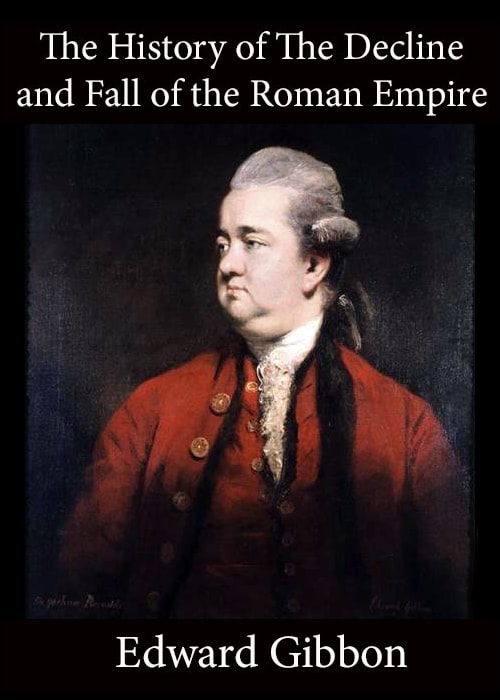
History of the Decline and Fall of the Roman Empire — Volume 5
1788

History of the Decline and Fall of the Roman Empire — Volume 5
1788
Volume 5 of Gibbon's monumental history reaches the crucible where ancient Rome finally died and medieval Europe was born. The narrative opens amid the iconoclastic storm: Byzantine emperors ordering images destroyed, Italian multitudes rising in defense of their sacred pictures, and the church torn between divine devotion and political survival. Gibbon traces the desperate dance between the popes of Rome, the distant Byzantine court, and the rising Frankish kings across the Alps. We witness the pontiffs, long bullied by Byzantine exarchs and Lombard kings, making their fatal calculation: better to crown a new emperor in the north than to kneel to a Constantinople that cannot protect them. The volume builds toward Charlemagne's coronation in 800, when Pope Leo III placed the imperial crown on a Frankish king's head, severing forever the link between Rome and Constantinople. Gibbon's irony remains razor-sharp throughout: the empire that Rome could not defend was nevertheless claimed by Germans, and the faith that began in a manager ended up owning half of Europe.
Editions


X-Ray
“The various modes of worship which prevailed in the Roman world were all considered by the people as equally true; by the philosopher as equally false; and by the magistrate as equally useful.””
— Edward Gibbon
“The most worthless of mankind are not afraid to condemn in others the same disorders which they allow in themselves; and can readily discover some nice difference in age, character, or station, to justify the partial distinction.””
— Edward Gibbon
“Revenge is profitable, gratitude is expensive.””
— Edward Gibbon
“The policy of the emperors and the senate, as far as it concerned religion, was happily seconded by the reflections of the enlightened, and by the habits of the superstitious, part of their subjects. The various modes of worship, which prevailed in the Roman world, were all considered by the people, as equally true; by the philosopher, as equally false; and by the magistrate, as equally useful. And thus toleration produced not only mutual indulgence, but even religious concord.””
— Edward Gibbon
“War, in its fairest form, implies a perpetual violation of humanity and justice.””
— Edward Gibbon
“The theologian may indulge the pleasing task of describing Religion as she descended from Heaven, arrayed in her native purity. A more melancholy duty is imposed on the historian. He must discover the inevitable mixture of error and corruption which she contracted in a long residence upon Earth, among a weak and degenerate race of beings.””
— Edward Gibbon
“The army is the only order of men sufficiently united to concur in the same sentiments, and powerful enough to impose them on the rest of their fellow-citizens; but the temper of soldiers, habituated at once to violence and to slavery, renders them very unfit guardians of a legal, or even a civil constitution.””
— Edward Gibbon
“Edward Gibbon, in his classic work on the fall of the Roman Empire, describes the Roman era's declension as a place where "bizarreness masqueraded as creativity.””
— Edward Gibbon
“The ascent to greatness, however steep and dangerous, may entertain an active spirit with the consciousness and exercise of its own power: but the possession of a throne could never yet afford a lasting satisfaction to an ambitious mind.””
— Edward Gibbon
About History of the Decline and Fall of the Roman Empire — Volume 5
Chapter Summaries
- XLIX
- This chapter covers the iconoclastic controversy initiated by Leo the Isaurian, the revolt of Italy and Rome against Byzantine rule, the rise of papal temporal power, and the Frankish conquest of Italy under Pepin and Charlemagne. It culminates in Charlemagne's coronation as Holy Roman Emperor and the establishment of the Germanic Holy Roman Empire.
- L
- Gibbon provides a comprehensive account of pre-Islamic Arabia, the birth and character of Mahomet, his religious mission, the establishment of Islam, and his death. The chapter also covers the succession disputes and the claims of Ali and his descendants, establishing the foundation for the Sunni-Shiite split.
- LI
- This chapter details the rapid Arab conquests of Persia, Syria, Egypt, Africa, and Spain following Mahomet's death. It describes the military campaigns, the fall of the Sassanian Empire, the conquest of Byzantine territories, and the establishment of the vast Islamic empire under the early caliphs.
Key Themes
- The Decline of Civilizations
- Gibbon explores how great empires fall through internal corruption, loss of civic virtue, and inability to adapt to changing circumstances. The Roman Empire's gradual decay serves as the primary example of this universal historical pattern.
- Religion and Politics
- The complex relationship between religious authority and political power is examined through the rise of Christianity, the iconoclastic controversy, and the emergence of Islam. Religious disputes often mask deeper political conflicts and ambitions.
- Barbarian Transformation
- The transformation of 'barbarian' peoples into civilized rulers is demonstrated through the Franks' evolution from Germanic tribes to the founders of a new Western Empire. This shows how cultural adaptation and political skill can overcome initial disadvantages.
Characters
- Edward Gibbon(major)
- The historian and narrator of this monumental work on the decline and fall of the Roman Empire. He provides scholarly analysis and commentary throughout the text.
- Charlemagne (Charles the Great)(protagonist)
- King of the Franks and later Holy Roman Emperor, crowned in 800 AD. He conquered much of Western Europe and was instrumental in the revival of the Western Roman Empire.
- Pope Leo III(major)
- Roman pontiff who crowned Charlemagne as Holy Roman Emperor on Christmas Day 800 AD. He faced conspiracies and assassination attempts but was protected by Charlemagne.
- Pope Adrian I(major)
- Roman pontiff who formed a close alliance with Charlemagne and helped establish papal temporal power. His reign was marked by significant political and religious achievements.
- Mahomet (Muhammad)(protagonist)
- The Prophet of Islam, born in Mecca around 570 AD. He founded the Islamic religion and united the Arabian tribes under his leadership before his death in 632 AD.
- Ali(major)
- Cousin and son-in-law of Mahomet, husband of Fatima. He became the fourth caliph but faced civil wars and was eventually assassinated. Revered by Shiite Muslims.
Link to this book
Add a free, dofollow link to Lex on your blog, forum, syllabus, or reading list.

<a href="https://lex-books.com/book/history-of-the-decline-and-fall-of-the-roman-empire-volume-5-975c6b36-fd69-445e-bb97-ba9ee087b222"><img src="https://lex-books.com/badges/read-on-lex.svg" alt="Read History of the Decline and Fall of the Roman Empire — Volume 5 by Edward Gibbon free on Lex" width="160" height="40"></a>[](https://lex-books.com/book/history-of-the-decline-and-fall-of-the-roman-empire-volume-5-975c6b36-fd69-445e-bb97-ba9ee087b222)[url=https://lex-books.com/book/history-of-the-decline-and-fall-of-the-roman-empire-volume-5-975c6b36-fd69-445e-bb97-ba9ee087b222][img]https://lex-books.com/badges/read-on-lex.svg[/img][/url]Read History of the Decline and Fall of the Roman Empire — Volume 5 by Edward Gibbon free on Lex: https://lex-books.com/book/history-of-the-decline-and-fall-of-the-roman-empire-volume-5-975c6b36-fd69-445e-bb97-ba9ee087b222Cite this book
Reading this edition for a paper or guide? Copy a citation.
Gibbon, Edward. History of the Decline and Fall of the Roman Empire — Volume 5. Lex, lex-books.com/book/history-of-the-decline-and-fall-of-the-roman-empire-volume-5-975c6b36-fd69-445e-bb97-ba9ee087b222.Gibbon, E. (1788). History of the Decline and Fall of the Roman Empire — Volume 5. Lex. https://lex-books.com/book/history-of-the-decline-and-fall-of-the-roman-empire-volume-5-975c6b36-fd69-445e-bb97-ba9ee087b222Gibbon, Edward. History of the Decline and Fall of the Roman Empire — Volume 5. Lex. https://lex-books.com/book/history-of-the-decline-and-fall-of-the-roman-empire-volume-5-975c6b36-fd69-445e-bb97-ba9ee087b222.