Hard Times
1854
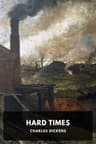
Dickens wrote Hard Times with blood in his eyes. This is his shortest novel, his most furious, and his sharpest indictment of the industrial age that was grinding England into dust. At its center stands Thomas Gradgrind, a man who believes facts are all that matter, who raises his children Louisa and Tom in a house stripped of wonder, color, or love. He has built a philosophy out of numbers, and his children will pay the price for his certainty. In the smoke-choked mill town of Coketown, Dickens maps the human wreckage of a society that measures everything and feels nothing. Louisa is married to a vulgar banker and withers in her loveless life. Tom becomes a thief, framing an innocent man to hide his own crimes. What unfolds is a catastrophe of the spirit, as Gradgrind watches the fruits of his philosophy poison everything he touches. This is Dickens unmasked: not the sentimentalist who gives us happy endings, but the social prophet who saw industrial capitalism's first victims and named the crime. It endures because it asks a question we still haven't answered: what happens to people when we reduce them to what can be measured?
Editions
X-Ray
“There is a wisdom of the head, and... there is a wisdom of the heart.””
— Charles Dickens
“How could you give me life, and take from me all the inappreciable things that raise it from the state of conscious death? Where are the graces of my soul? Where are the sentiments of my heart? What have you done, oh, Father, What have you done with the garden that should have bloomed once, in this great wilderness here? Said louisa as she touched her heart.””
— Charles Dickens
“Do the wise thing and the kind thing too, and make the best of us and not the worst.””
— Charles Dickens
“She was the most wonderful woman for prowling about the house. How she got from one story to another was a mystery beyond solution. A lady so decorous in herself, and so highly connected, was not to be suspected of dropping over the banisters or sliding down them, yet her extraordinary facility of locomotion suggested the wild idea.””
— Charles Dickens
“Now, what I want is Facts. Teach these boys and girls nothing but Facts. Facts alone are wanted in life. Plant nothing else, and root out everything else. You can only form the minds of reasoning animals upon Facts; nothing else will ever be of any service to them.””
— Charles Dickens
“He thought of the number of girls and women she had seen marry, how many homes with children in them she had seen grow up around her, how she had contentedly pursued her own lone quite path-for him.~ Stephen speaking of Rachael””
— Charles Dickens
“It is said that every life has its roses and thorns; there seemed, however, to have been a misadventure or mistake in Stephen’s case, whereby somebody else had become possessed of his roses, and he had become possessed of somebody else’s thorns in addition to his own.””
— Charles Dickens
“Depth answers only to depth .””
— Charles Dickens
“It is known, to the force of a single pound weight, what the engine will do; but, not all the calculators of the National Debt can tell me the capacity for good or evil, for love or hatred, for patriotism or discontent, for the decomposition of virtue into vice, or the reverse.””
— Charles Dickens
Link to this book
Add a free, dofollow link to Lex on your blog, forum, syllabus, or reading list.

<a href="https://lex-books.com/book/hard-times-2750ee0c-1f70-4a00-b63e-c6421a07e44e"><img src="https://lex-books.com/badges/read-on-lex.svg" alt="Read Hard Times by Charles Dickens free on Lex" width="160" height="40"></a>[](https://lex-books.com/book/hard-times-2750ee0c-1f70-4a00-b63e-c6421a07e44e)[url=https://lex-books.com/book/hard-times-2750ee0c-1f70-4a00-b63e-c6421a07e44e][img]https://lex-books.com/badges/read-on-lex.svg[/img][/url]Read Hard Times by Charles Dickens free on Lex: https://lex-books.com/book/hard-times-2750ee0c-1f70-4a00-b63e-c6421a07e44eCite this book
Reading this edition for a paper or guide? Copy a citation.
Dickens, Charles. Hard Times. Lex, lex-books.com/book/hard-times-2750ee0c-1f70-4a00-b63e-c6421a07e44e.Dickens, C. (1854). Hard Times. Lex. https://lex-books.com/book/hard-times-2750ee0c-1f70-4a00-b63e-c6421a07e44eDickens, Charles. Hard Times. Lex. https://lex-books.com/book/hard-times-2750ee0c-1f70-4a00-b63e-c6421a07e44e.