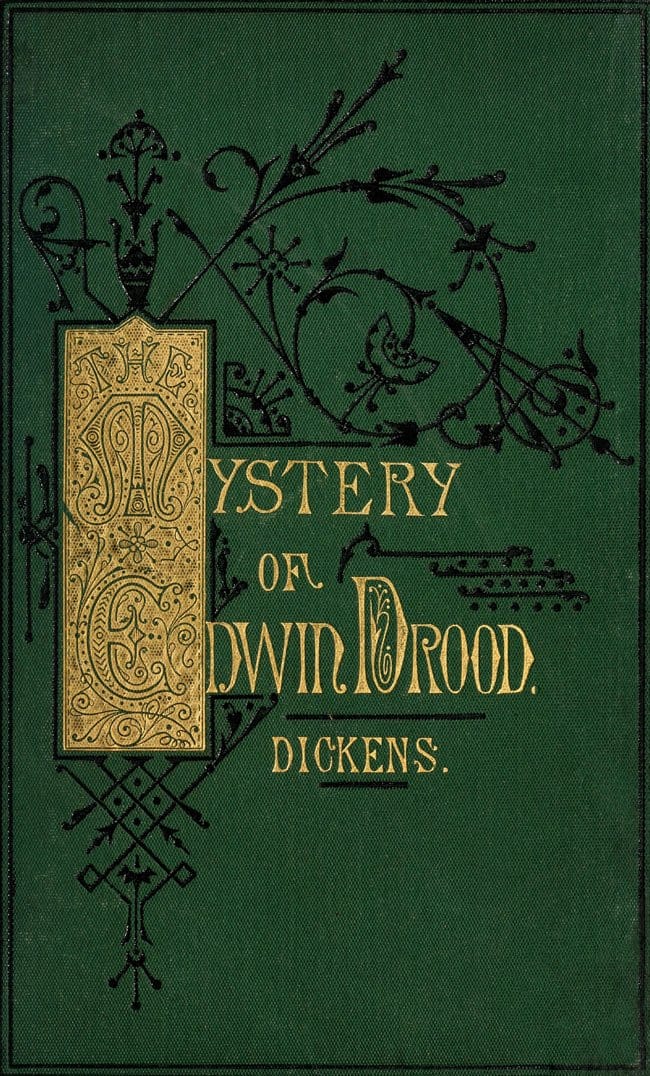
The Mystery of Edwin Drood
1870
This is Dickens' final, forever-unfinished novel, and it haunts. The story opens in the opium dens of Cloisterham, a drowsy cathedral town where respectable choirmaster John Jasper leads a secret life of drug-fueled fantasy and obsessive love for Rosa Bud, his nephew Edwin's fiancée. When Edwin and Rosa mutually agree to break off their engagement, believing duty has replaced feeling, the stage is set for catastrophe. On a stormy Christmas Eve, Edwin vanishes entirely, leaving only his personal effects and a growing suspicion that his jealous uncle is the culprit. Dickens died with only six of twelve planned installments complete, taking the solution to the grave. What remains is a psychological thriller of remarkable darkness: Jasper's dual existence, his possessive fixation on Rosa, the sinister undercurrents beneath Cloisterham's genteel surface. For over 150 years, readers have turned detective, argued in drawing rooms, and written their own endings. The mystery remains. It will always remain.
Editions
X-Ray
“I loved you madly; in the distasteful work of the day, in the wakeful misery of the night, girded by sordid realities, or wandering through Paradises and Hells of visions into which I rushed, carrying your image in my arms, I loved you madly.””
— Charles Dickens
“How beautiful you are! You are more beautiful in anger than in repose. I don't ask you for your love; give me yourself and your hatred; give me yourself and that pretty rage; give me yourself and that enchanting scorn; it will be enough for me.””
— Charles Dickens
“He was simply and staunchly true to his duty alike in the large case and in the small. So all true souls ever are. So every true soul ever was, ever is, and ever will be. There is nothing little to the really great in spirit.””
— Charles Dickens
“But Rosa soon made the discovery that Miss Twinkleton didn't read fairly. She cut the love-scenes, interpolated passages in praise of female celibacy, and was guilty of other glaring pious frauds.””
— Charles Dickens
“For certain, neither of them sees a happy Present, as the gate opens and closes, and one goes in, and the other goes away.””
— Charles Dickens
“Some remote fragment of Main Line to somewhere else, there was, which was going to ruin the Money Market if it failed, and Church and State if it succeeded, and (of course), the Constitution, whether or no;””
— Charles Dickens
“Imagine my not letting him sink, as I was his fag!’ said Mr. Tartar. ””
— Charles Dickens
“Secondly, the Philanthropists had not the good temper of the Pugilists, and used worse language. ””
— Charles Dickens
“Old Time heaved a moldy sigh from tomb and arch and vault; and gloomy shadows began to deepen in corners; and damps began to rise from green patches of stone; and jewels, cast upon the pavement of the nave from stained glass by the declining sun, began to perish. Within the grill-gate of the chancel, up the steps surmounted loomingly by the fast darkening organ, white robes could be dimly seen, and one feeble voice, rising and falling in a cracked monotonous mutter, could at intervals be faintly heard. In the free outer air, the river, the green pastures, and the brown arable lands, the teeming hills and dales, were reddened by the sunset: while the distant little windows in windmills and farm homesteads, shone, patches of bright beaten gold. In the Cathedral, all became gee, murky, and sepulchral, and the cracked monotonous mutter went on like a dying voice, until the organ and the choir burst forth, and drowned it in a sea of music. Then, the sea fell, and the dying voice made another feeble effort, and then the sea rose high, and beat its life out, and lashed the roof, and surged among the arches, and pierced the heights of the great tower; and then the sea was dry, and all was still.””
— Charles Dickens
Link to this book
Add a free, dofollow link to Lex on your blog, forum, syllabus, or reading list.

<a href="https://lex-books.com/book/the-mystery-of-edwin-drood-1e48a92e-792b-4187-9bce-d38a3197b074"><img src="https://lex-books.com/badges/read-on-lex.svg" alt="Read The Mystery of Edwin Drood by Charles Dickens free on Lex" width="160" height="40"></a>[](https://lex-books.com/book/the-mystery-of-edwin-drood-1e48a92e-792b-4187-9bce-d38a3197b074)[url=https://lex-books.com/book/the-mystery-of-edwin-drood-1e48a92e-792b-4187-9bce-d38a3197b074][img]https://lex-books.com/badges/read-on-lex.svg[/img][/url]Read The Mystery of Edwin Drood by Charles Dickens free on Lex: https://lex-books.com/book/the-mystery-of-edwin-drood-1e48a92e-792b-4187-9bce-d38a3197b074Cite this book
Reading this edition for a paper or guide? Copy a citation.
Dickens, Charles. The Mystery of Edwin Drood. Lex, lex-books.com/book/the-mystery-of-edwin-drood-1e48a92e-792b-4187-9bce-d38a3197b074.Dickens, C. (1870). The Mystery of Edwin Drood. Lex. https://lex-books.com/book/the-mystery-of-edwin-drood-1e48a92e-792b-4187-9bce-d38a3197b074Dickens, Charles. The Mystery of Edwin Drood. Lex. https://lex-books.com/book/the-mystery-of-edwin-drood-1e48a92e-792b-4187-9bce-d38a3197b074.