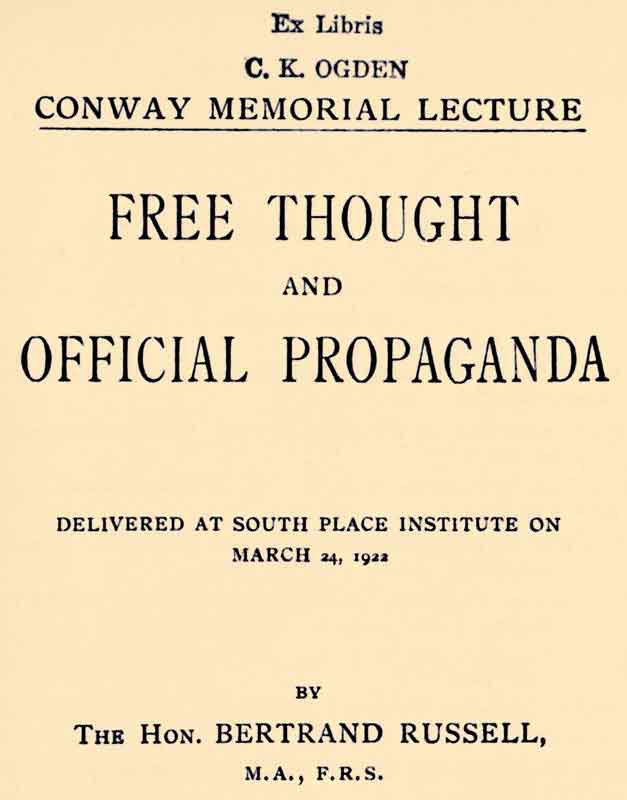
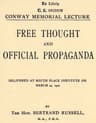
Free Thought and Official Propaganda
1922
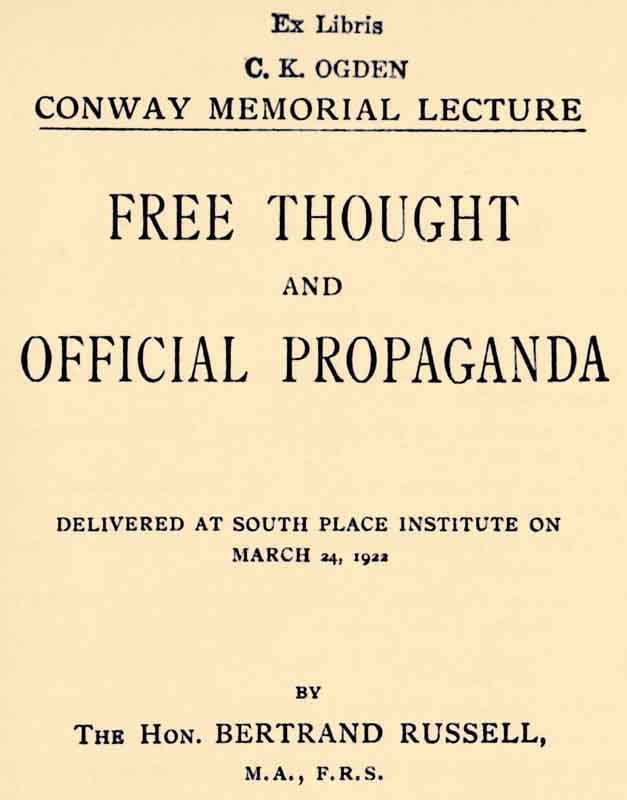
Free Thought and Official Propaganda
1922
Bertrand Russell delivered this lecture in 1922, and it reads like it was written yesterday. With startling prescience, he examines how states, institutions, and economic power structures silence dissent and manufacture consent. Russell distinguishes between free thought in the narrow sense (the freedom to hold unconventional beliefs) and in the broad sense (the capacity for genuine inquiry unclouded by propaganda). He shows how education, rather than liberating minds, often serves as machinery for conformity. Economic penalties, professional exclusion, and the distortion of evidence all function as weapons against independent thinking. Russell's argument is not merely academic. He was advocating for a society where doubt is valued over dogma, where citizens are equipped to evaluate information critically rather than absorb it passively. This is a passionate defense of intellectual honesty in an age of manufactured consensus. A century later, when algorithms curate our reality and state-run media machines spin narratives, Russell's questions have only grown more urgent.
Editions
X-Ray
“Education should have two objects: first, to give definite knowledge”
— Bertrand Russell
“It is clear that the most elementary condition, if thought is to be free, is the absence of legal penalties for the expression of opinions. No great country has yet reached to this level, although most of them think they have.””
— Bertrand Russell
“William James used to preach the “will to believe.” Formy part, I should wish to preach the “will to doubt.” Noneof our beliefs are quite true; all have at least a penumbra ofvagueness and error. The methods of increasing the degree of truth in our beliefs are well known; they consist in hearing allsides, trying to ascertain all the relevant facts, controlling ourown bias by discussion with people who have the oppositebias, and cultivating a readiness to disregard any hypothesiswhich has proved inadequate…In religion and politics, on the contrary, though there isas yet nothing approaching scientific knowledge, everybodyconsiders it de rigueur to have a dogmatic opinion, to bebacked up by inflicting starvation, prison, and war, and tobe carefully guarded from argumentative competition withany different opinion.””
— Bertrand Russell
“It is clear that thought is not free if the profession of certain opinions makes it impossible to earn a living. It is clear also that thought is not free if all the arguments on one side of a controversy are perpetually presented as attractively as possible, while the arguments on the other side can only be discovered by diligent search. Both these obstacles exist in every large country known to me, except China, which is the last refuge of freedom.””
— Bertrand Russell
“If there is to be toleration in the world, one of the things taught in schools must be the habit of weighing evidence, and the practice of not giving full assent to propositions which there is no reason to believe true. For example, the art of reading the newspapers should be taught. The schoolmaster should select some incident which happened a good many years ago, and roused political passions in its day. 41 He should then read to the school children what was said by the newspapers on one side, what was said by those on the other, and some impartial account of what really happened. He should show how, from the biased account of either side, a practised reader could infer what really happened, and he should make them understand that everything in newspapers is more or less untrue. The cynical scepticism which would result from this teaching would make the children in later life immune from those appeals to idealism by which decent people are induced to further the schemes of scoundrels.””
— Bertrand Russell
“Our system of education turns young people out of the schools able to read, but for the most part unable to weigh evidence or to form an independent opinion. They are then assailed, throughout the rest of their lives, by statements designed to make them believe all sorts of absurd propositions, such as that Blank’s pills cure all ills, that Spitzbergen is warm and fertile, and that Germans eat corpses.””
— Bertrand Russell
“methods of increasing the degree of truth in our beliefs are well known; they consist in hearing all sides, trying to ascertain all the relevant facts, controlling our own bias by discussion with people who have the opposite bias, and cultivating a readiness to discard any hypothesis which has proved inadequate.””
— Bertrand Russell
“Religious toleration, to a certain extent, has been wonbecause people have ceased to consider religion so importantas it was once thought to be. But in politics and economics,which have taken the place formerly occupied by religion,there is a growing tendency to persecution, which is not byany means confined to one party. The persecution of opinion in Russia is more severe than in any capitalist country. I metin Petrograd an eminent Russian poet, Alexander Block,who has since died as the result of privations. The Bolsheviksallowed him to teach aesthetics, but he complained that theyinsisted on his teaching the subject “from a Marxian pointof view.” He had been at a loss to discover how the theory ofrhythmics was connected with Marxism, although, to avoidstarvation, he had done his best to find out..The examples of America and Russia illustrate theconclusion to which we seem to be driven”
— Bertrand Russell
“. For example, the art of reading the newspapers should be taught. The schoolmaster should select some incident which happened a good many years ago, and roused political passions in its day. He should then read to the school children what was said by the newspapers on one side, what was said by those on the other, and some impartial account of what really happened. He should show how, from the biased account of either side, a practised reader could infer what really happened, and he should make them understand that everything in newspapers is more or less untrue. The cynical scepticism which would result from this teaching would make the children in later life immune from those appeals to idealism by which decent people are induced to further the schemes of scoundrels.””
— Bertrand Russell
Link to this book
Add a free, dofollow link to Lex on your blog, forum, syllabus, or reading list.

<a href="https://lex-books.com/book/free-thought-and-official-propaganda-d3a9b27b-4f05-4c3b-afa2-e7111a881d14"><img src="https://lex-books.com/badges/read-on-lex.svg" alt="Read Free Thought and Official Propaganda by Bertrand Russell free on Lex" width="160" height="40"></a>[](https://lex-books.com/book/free-thought-and-official-propaganda-d3a9b27b-4f05-4c3b-afa2-e7111a881d14)[url=https://lex-books.com/book/free-thought-and-official-propaganda-d3a9b27b-4f05-4c3b-afa2-e7111a881d14][img]https://lex-books.com/badges/read-on-lex.svg[/img][/url]Read Free Thought and Official Propaganda by Bertrand Russell free on Lex: https://lex-books.com/book/free-thought-and-official-propaganda-d3a9b27b-4f05-4c3b-afa2-e7111a881d14Cite this book
Reading this edition for a paper or guide? Copy a citation.
Russell, Bertrand. Free Thought and Official Propaganda. Lex, lex-books.com/book/free-thought-and-official-propaganda-d3a9b27b-4f05-4c3b-afa2-e7111a881d14.Russell, B. (1922). Free Thought and Official Propaganda. Lex. https://lex-books.com/book/free-thought-and-official-propaganda-d3a9b27b-4f05-4c3b-afa2-e7111a881d14Russell, Bertrand. Free Thought and Official Propaganda. Lex. https://lex-books.com/book/free-thought-and-official-propaganda-d3a9b27b-4f05-4c3b-afa2-e7111a881d14.