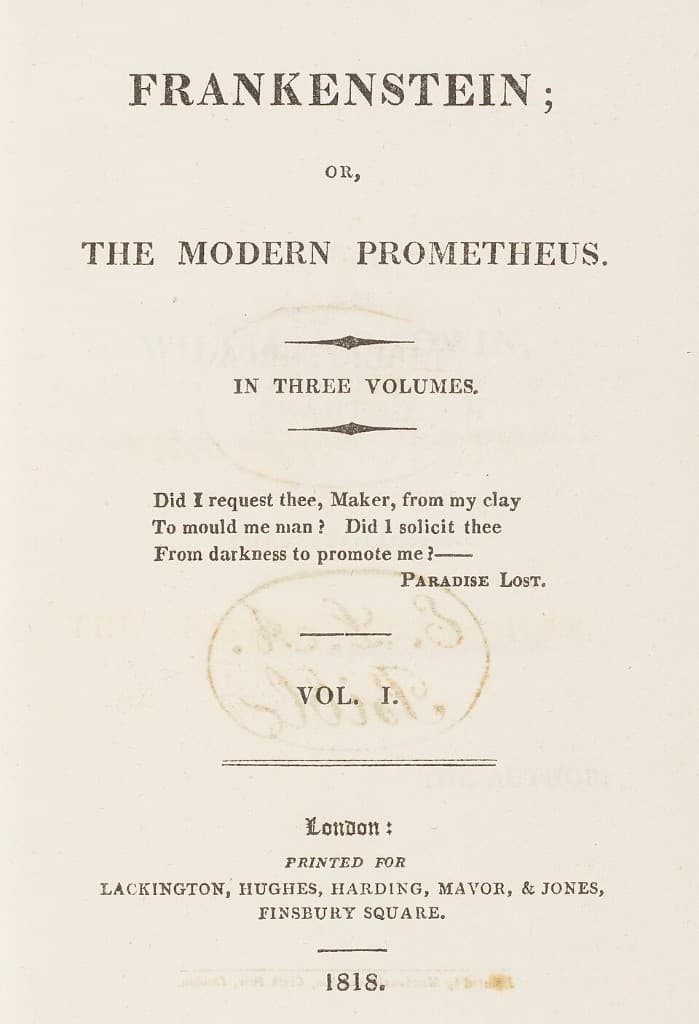
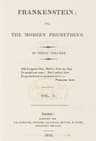
Frankenstein; Or, The Modern Prometheus
1818
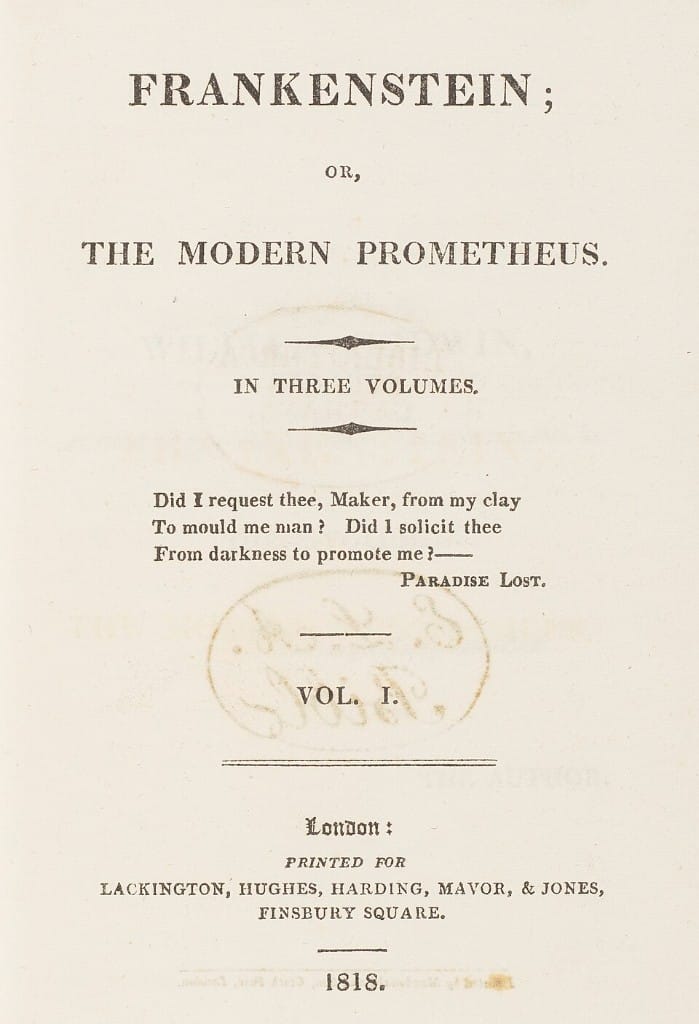
Frankenstein; Or, The Modern Prometheus
1818
Two men frozen at the edge of the world, one dying, one obsessed with glory. This is how Mary Shelley's masterpiece begins: with letters from the Arctic, a ship trapped in ice, and a pale stranger who whispers a confession that will rewire how you think about creation, responsibility, and the monsters we make. Victor Frankenstein, a young scientist from Geneva, has done the impossible: he has animated dead matter, brought a being into the world. But the moment his creature opens its eyes, Victor does what no parent should do. He flees. He abandons his creation to a world that will never accept him. What follows is a loop of rejection and revenge that tears Victor's life apart, while the creature, eloquent and desperate, proves more human than the humans who spurn him. Shelley wrote this at nineteen, grief-stricken and radical, and the 1818 text pulses with her fury at unchecked ambition and the cruelty of abandoning what we bring into existence. This is not a horror story about a monster. It is a tragedy about what happens when we create life and refuse to parent it.
Editions


X-Ray
“Nothing is so painful to the human mind as a great and sudden change.””
— Mary Wollstonecraft Shelley
“Beware; for I am fearless, and therefore powerful.””
— Mary Wollstonecraft Shelley
“Life, although it may only be an accumulation of anguish, is dear to me, and I will defend it.””
— Mary Wollstonecraft Shelley
“I do know that for the sympathy of one living being, I would make peace with all. I have love in me the likes of which you can scarcely imagine and rage the likes of which you would not believe. If I cannot satisfy the one, I will indulge the other.””
— Mary Wollstonecraft Shelley
“There is something at work in my soul, which I do not understand.””
— Mary Wollstonecraft Shelley
“If I cannot inspire love, I will cause fear!””
— Mary Wollstonecraft Shelley
“I ought to be thy Adam, but I am rather the fallen angel...””
— Mary Wollstonecraft Shelley
“Even broken in spirit as he is, no one can feel more deeply than he does the beauties of nature. The starry sky, the sea, and every sight afforded by these wonderful regions, seems still to have the power of elevating his soul from earth. Such a man has a double existence: he may suffer misery, and be overwhelmed by disappointments; yet, when he has retired into himself, he will be like a celestial spirit that has a halo around him, within whose circle no grief or folly ventures.””
— Mary Wollstonecraft Shelley
“I have love in me the likes of which you can scarcely imagine and rage the likes of which you would not believe. If I cannot satisfy the one, I will indulge the other.””
— Mary Wollstonecraft Shelley
Link to this book
Add a free, dofollow link to Lex on your blog, forum, syllabus, or reading list.

<a href="https://lex-books.com/book/frankenstein-or-the-modern-prometheus-83e39ad9-570d-489a-aee0-ffd74d18e6d7"><img src="https://lex-books.com/badges/read-on-lex.svg" alt="Read Frankenstein; Or, The Modern Prometheus by Mary Wollstonecraft Shelley free on Lex" width="160" height="40"></a>[](https://lex-books.com/book/frankenstein-or-the-modern-prometheus-83e39ad9-570d-489a-aee0-ffd74d18e6d7)[url=https://lex-books.com/book/frankenstein-or-the-modern-prometheus-83e39ad9-570d-489a-aee0-ffd74d18e6d7][img]https://lex-books.com/badges/read-on-lex.svg[/img][/url]Read Frankenstein; Or, The Modern Prometheus by Mary Wollstonecraft Shelley free on Lex: https://lex-books.com/book/frankenstein-or-the-modern-prometheus-83e39ad9-570d-489a-aee0-ffd74d18e6d7Cite this book
Reading this edition for a paper or guide? Copy a citation.
Shelley, Mary Wollstonecraft. Frankenstein; Or, The Modern Prometheus. Lex, lex-books.com/book/frankenstein-or-the-modern-prometheus-83e39ad9-570d-489a-aee0-ffd74d18e6d7.Shelley, M. W. (1818). Frankenstein; Or, The Modern Prometheus. Lex. https://lex-books.com/book/frankenstein-or-the-modern-prometheus-83e39ad9-570d-489a-aee0-ffd74d18e6d7Shelley, Mary Wollstonecraft. Frankenstein; Or, The Modern Prometheus. Lex. https://lex-books.com/book/frankenstein-or-the-modern-prometheus-83e39ad9-570d-489a-aee0-ffd74d18e6d7.