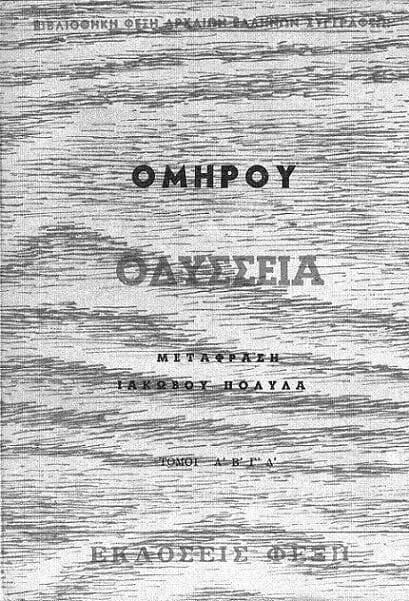
Λουκιανός - Άπαντα, Τόμος Έκτος
1906
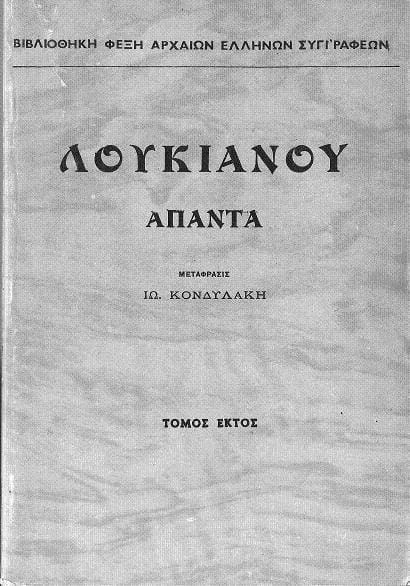
Λουκιανός - Άπαντα, Τόμος Έκτος
1906
Translated by Ioannes Kondylakes
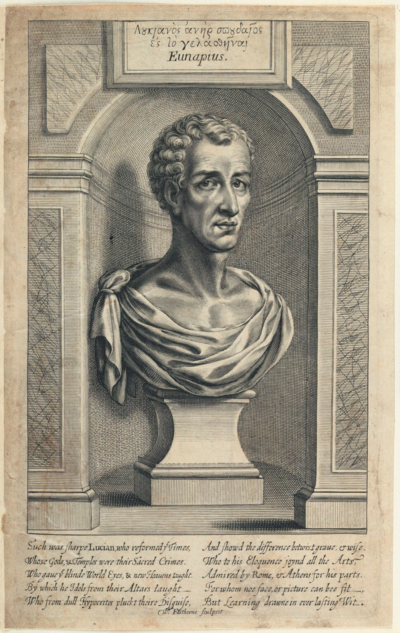
Lucian of Samosata was ancient satire's most vicious wit, and this sixth volume gathers some of his most audacious dialogues. Here you'll find fantastical encounters that blur the line between philosophy and pornography, where beautiful women grow from vines and philosophers debate the nature of goodness with the desperate logic of men trying to impress their dinner companions. Lucian weaponizes dialogue itself, letting his characters expose their own pretensions through the very rhetoric they employ to impress each other. His targets are eternal: the credulous who believe any astonishing tale, the philosophers who profess wisdom while succumbing to the same passions as everyone else, and the cultural arbiters who mistake elaboration for excellence. These are not dusty artifacts but combustion engines of laughter aimed at the absurdities of human self-regard. Reading Lucian feels startlingly modern because the impulses he satirizes have not changed in two millennia. He remains essential for anyone who delights in seeing the powerful, the learned, and the beautiful gently demolished through their own words.
Editions
X-Ray
“The good historian, then, must be thus described: he must be fearless, uncorrupted, free, the friend of truth and of liberty; one who, to use the words of the comic poet, calls a fig a fig, and a skiff a skiff, neither giving nor withholding from any, from favour or from enmity, not influenced by pity, by shame, or by remorse; a just judge, so far benevolent to all as never to give more than is due to any in his work; a stranger to all, of no country, bound only by his own laws, acknowledging no sovereign, never considering what this or that man may say of him, but relating faithfully everything as it happened.””
— of Samosata Lucian
“The only business of the historian is to relate things exactly as they are: this he can never do as long as he is afraid””
— of Samosata Lucian
“Give me a scholar, therefore, who is able to think and to write, to look with an eye of discernment into things, and to do business himself, if called upon, who hath both civil and military knowledge; one, moreover, who has been in camps, and has seen armies in the field and out of it; knows the use of arms, and machines, and warlike engines of every kind; can tell what the front, and what the horn is, how the ranks are to be disposed, how the horse is to be directed, and from whence to advance or to retreat; one, in short, who does not stay at home and trust to the reports of others: but, above all, let him be of a noble and liberal mind; let him neither fear nor hope for anything; otherwise he will only resemble those unjust judges who determine from partiality or prejudice, and give sentence for hire: but, whatever the man is, as such let him be described.””
— of Samosata Lucian
“In size the men were as large as the Colossus of Rhodes from the waist up, and the horses were as large as a great merchantman. Their number, however, I leave unrecorded for fear that someone may think it incredible, it was so great.””
— of Samosata Lucian
Link to this book
Add a free, dofollow link to Lex on your blog, forum, syllabus, or reading list.

<a href="https://lex-books.com/book/-3c5b9b55-c3da-467f-a3c7-7e8b2c6fc641"><img src="https://lex-books.com/badges/read-on-lex.svg" alt="Read Λουκιανός - Άπαντα, Τόμος Έκτος by of Samosata Lucian free on Lex" width="160" height="40"></a>[](https://lex-books.com/book/-3c5b9b55-c3da-467f-a3c7-7e8b2c6fc641)[url=https://lex-books.com/book/-3c5b9b55-c3da-467f-a3c7-7e8b2c6fc641][img]https://lex-books.com/badges/read-on-lex.svg[/img][/url]Read Λουκιανός - Άπαντα, Τόμος Έκτος by of Samosata Lucian free on Lex: https://lex-books.com/book/-3c5b9b55-c3da-467f-a3c7-7e8b2c6fc641Cite this book
Reading this edition for a paper or guide? Copy a citation.
Lucian, of Samosata. Λουκιανός - Άπαντα, Τόμος Έκτος. Lex, lex-books.com/book/-3c5b9b55-c3da-467f-a3c7-7e8b2c6fc641.Lucian, O. S. (1906). Λουκιανός - Άπαντα, Τόμος Έκτος. Lex. https://lex-books.com/book/-3c5b9b55-c3da-467f-a3c7-7e8b2c6fc641Lucian, of Samosata. Λουκιανός - Άπαντα, Τόμος Έκτος. Lex. https://lex-books.com/book/-3c5b9b55-c3da-467f-a3c7-7e8b2c6fc641.