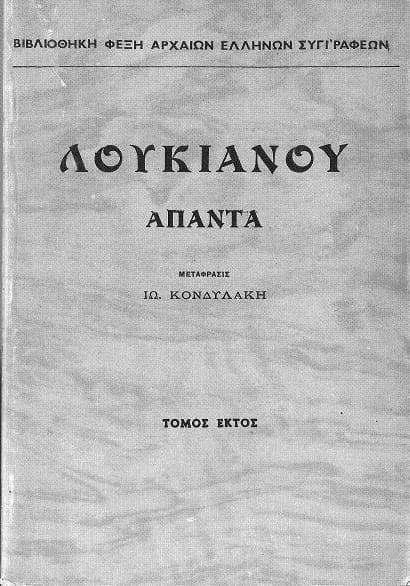
Λουκιανός - Άπαντα, Τόμος Πέμπτος
1906
Λουκιανός - Άπαντα, Τόμος Πέμπτος
1906
Translated by Ioannes Kondylakes
The fifth volume of Lucian's complete works assembles some of the most entertaining and razor-sharp satirical dialogues from the 2nd century AD. Lucian, the Syrian-Greek provocateur, was ancient Rome's great mocker of pomposity, hypocrisy, and false wisdom. This collection showcases his legendary wit through fantastical voyages, philosophical pranks, and biting character studies. The volume opens with a striking architectural treatise praising the bath-designer Hippias, but typical of Lucian, the admiration curdles into satire: he champions practical skill over empty rhetoric, mocking scholars who excel in words but lack real expertise. Elsewhere in this volume, Lucian's famous voyages deliver encounters stranger than any reality: men who transform into horses, resurrected corpses debating philosophy, and the passage quoted here, where wine-bearing women merge with vines, kissing strangers into drunken oblivion and trapping the greedy with roots that grow through their flesh. These are not mere tall tales but weapons of ridicule aimed at human vanity, superstition, and the pretensions of the educated class. For readers who relish irreverent intelligence, Lucian remains endlessly rewarding: he wrote with the malice of a comedian and the precision of a philosopher, and little in human nature has changed enough to make him obsolete.
Editions
X-Ray
“The good historian, then, must be thus described: he must be fearless, uncorrupted, free, the friend of truth and of liberty; one who, to use the words of the comic poet, calls a fig a fig, and a skiff a skiff, neither giving nor withholding from any, from favour or from enmity, not influenced by pity, by shame, or by remorse; a just judge, so far benevolent to all as never to give more than is due to any in his work; a stranger to all, of no country, bound only by his own laws, acknowledging no sovereign, never considering what this or that man may say of him, but relating faithfully everything as it happened.””
— of Samosata Lucian
“The only business of the historian is to relate things exactly as they are: this he can never do as long as he is afraid””
— of Samosata Lucian
“Give me a scholar, therefore, who is able to think and to write, to look with an eye of discernment into things, and to do business himself, if called upon, who hath both civil and military knowledge; one, moreover, who has been in camps, and has seen armies in the field and out of it; knows the use of arms, and machines, and warlike engines of every kind; can tell what the front, and what the horn is, how the ranks are to be disposed, how the horse is to be directed, and from whence to advance or to retreat; one, in short, who does not stay at home and trust to the reports of others: but, above all, let him be of a noble and liberal mind; let him neither fear nor hope for anything; otherwise he will only resemble those unjust judges who determine from partiality or prejudice, and give sentence for hire: but, whatever the man is, as such let him be described.””
— of Samosata Lucian
“In size the men were as large as the Colossus of Rhodes from the waist up, and the horses were as large as a great merchantman. Their number, however, I leave unrecorded for fear that someone may think it incredible, it was so great.””
— of Samosata Lucian
Link to this book
Add a free, dofollow link to Lex on your blog, forum, syllabus, or reading list.

<a href="https://lex-books.com/book/-43af7089-6c22-443c-b43e-3679dbacaeaa"><img src="https://lex-books.com/badges/read-on-lex.svg" alt="Read Λουκιανός - Άπαντα, Τόμος Πέμπτος by of Samosata Lucian free on Lex" width="160" height="40"></a>[](https://lex-books.com/book/-43af7089-6c22-443c-b43e-3679dbacaeaa)[url=https://lex-books.com/book/-43af7089-6c22-443c-b43e-3679dbacaeaa][img]https://lex-books.com/badges/read-on-lex.svg[/img][/url]Read Λουκιανός - Άπαντα, Τόμος Πέμπτος by of Samosata Lucian free on Lex: https://lex-books.com/book/-43af7089-6c22-443c-b43e-3679dbacaeaaCite this book
Reading this edition for a paper or guide? Copy a citation.
Lucian, of Samosata. Λουκιανός - Άπαντα, Τόμος Πέμπτος. Lex, lex-books.com/book/-43af7089-6c22-443c-b43e-3679dbacaeaa.Lucian, O. S. (1906). Λουκιανός - Άπαντα, Τόμος Πέμπτος. Lex. https://lex-books.com/book/-43af7089-6c22-443c-b43e-3679dbacaeaaLucian, of Samosata. Λουκιανός - Άπαντα, Τόμος Πέμπτος. Lex. https://lex-books.com/book/-43af7089-6c22-443c-b43e-3679dbacaeaa.