Lex

Browse

GenresShelvesPremiumBlog

Company

AboutJobsPartnersSell on LexAffiliates

Audio

Lex StudioVoicesFirst chapter freeAudiobook pricingAudiobook samplesAudiobook guidesAudio blog

Resources

DocsInvite FriendsFAQ

Legal

Terms of ServicePrivacy Policygeneral@lex-books.com+1 951-551-2243WhatsApp (international)

© 2026 LexBooks, Inc. All rights reserved.

T. B. Murray

T. B. Murray was a 19th-century author known for his work that explored themes of faith and cultural interaction. His notable work, 'Kalli, the Esquimaux Christian: A Memoir,' presents a compelling narrative about the life of an Inuit man who converts to Christianity. This memoir not only sheds light on the spiritual journey of Kalli but also provides insights into the cultural dynamics between European missionaries and Indigenous peoples during a time of significant change in the Arctic regions. Murray's writing is characterized by its earnest portrayal of the challenges and triumphs faced by Kalli, reflecting broader themes of identity and belief in the face of colonial influence. Murray's contributions are significant as they offer a rare glimpse into the lives of Indigenous individuals during the 19th century, a perspective often overlooked in literature of the time. His work serves as an early example of cross-cultural narratives, emphasizing the complexities of faith and cultural exchange. Through 'Kalli,' Murray not only tells a personal story but also engages with the larger discourse on the impacts of missionary work, making his memoir a valuable piece in understanding the historical context of Indigenous experiences in North America.

Famous Quotes

View all 11 quotes

“Hobbies provide more examples. If you are a gardener, what you see when you visit Sissinghurst Castle is different from what a non-gardener sees. Your judgment of the quality of the garden has an element of the objective that goes beyond sentiments about how pretty the flowers are. If you are a stamp collector, the reasons you value a particular stamp involve aspects of it that someone who isn’t a stamp collector overlooks. If you are an oenophile, your judgment of the quality of a wine has an element of the objective that goes beyond sentiments of how good it tastes. Expertise changes the quality of the experience, and also introduces an element of the objective.””

Human Accomplishment: The Pursuit of Excellence in the Arts and Sciences, 800 B.C. to 1950

“YOUR OPINION OF EXPERTISE IN YOUR OWN FIELD OF EXPERTISE Experts are in bad odor these days. In courtrooms, expert witnesses flatly contradict each other. In the media, experts analyze the news in ways that reflect Hume’s concept of sentiment rather than his concept of judgment. But away from the spotlight, expertise still has a meaning that virtually all readers can understand for themselves because virtually all of you can call upon something in your life on which you are an expert. Now ask yourself whether you share this common tendency: On topics about which we know little, we are dismissive of the importance of expertise (“I don’t know much about art, but I know what I like”). On topics about which we know a great deal, we are dismissive of amateur opinions. The difference between these two reactions is that one has an empirical basis and the other doesn’t. On topics about which we know little, we by definition have no way of knowing that expertise is unimportant. On topics about which we know a lot, we have concrete reasons for concluding that amateur observations are either wrong or boringly obvious.””

Human Accomplishment: The Pursuit of Excellence in the Arts and Sciences, 800 B.C. to 1950

“If one person is to be singled out as the one who took that step, it should be Édouard Manet (1832–1883). The painting is not a window on the world, Manet announced. It consists of patches of color on a two-dimensional surface. You don’t look through a painting but at it. Manet proclaimed further that “realism” does not consist of a Kalf-like fidelity to the way things look when they are minutely inspected. When people observe a scene in real life, they perceive it as a whole, focusing on some objects and not on others; seeing motion, with all its blurriness, rather than movement frozen in time; seeing light and shapes rather than specific clouds and shadows.””

Human Accomplishment: The Pursuit of Excellence in the Arts and Sciences, 800 B.C. to 1950

Books from the author
right arrow

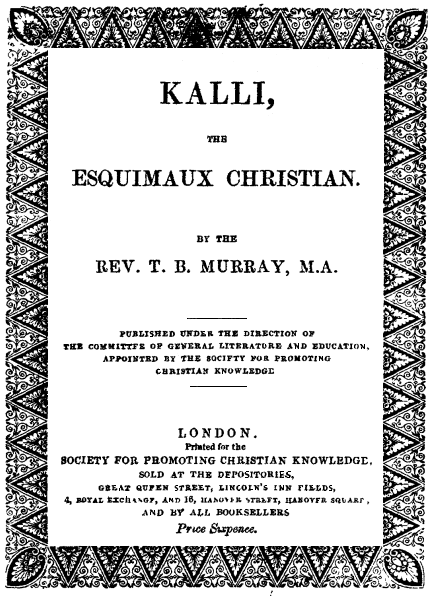
Kalli, theEsquimauxChristian: AMemoir

T. B. Murray

Kalli, the Esquimaux Christian: A Memoir

More authors like this

right arrow
François Guizot
François Guizot
1787-1874
Samuel Smiles
Samuel Smiles
1812-1904
J. Church
J. Church
1780-1825
Louis Constant Wairy
1778-1845
Alexander Maclaren
Alexander Maclaren
1826-1910
Louis Antoine Fauvelet de Bourrienne
1769-1834
Annie Besant
Annie Besant
1847-1933
Jules Michelet
Jules Michelet
1798-1874
Adolphe Thiers
Adolphe Thiers
1797-1877
Ida Pfeiffer
Ida Pfeiffer
1797-1858
John Henry Newman
John Henry Newman
1801-1890
Thomas Carlyle
Thomas Carlyle
1795-1881
Hector Berlioz
Hector Berlioz
1803-1869
Jacob Abbott
Jacob Abbott
1803-1879
Ralph Waldo Emerson
Ralph Waldo Emerson
1803-1882
Susanna Moodie
Susanna Moodie
1803-1885

Link to this page

Add a free, dofollow link to Lex on your blog, forum, syllabus, or reading list.

T. B. Murray on Lex
HTML
<a href="https://lex-books.com/author/t-b-murray"><img src="https://lex-books.com/badges/read-on-lex.svg" alt="T. B. Murray on Lex" width="160" height="40"></a>
Markdown
[![T. B. Murray on Lex](https://lex-books.com/badges/read-on-lex.svg)](https://lex-books.com/author/t-b-murray)
BBCode
[url=https://lex-books.com/author/t-b-murray][img]https://lex-books.com/badges/read-on-lex.svg[/img][/url]
Plain link
T. B. Murray on Lex: https://lex-books.com/author/t-b-murray