
Richard Garbe
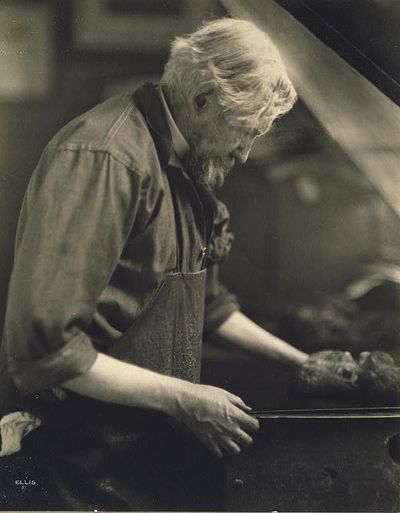
Richard Garbe was a prominent British sculptor known for his mastery in wood and stone carving. Born in Dalston, London, he was the son of a Prussian ivory carver, which influenced his artistic direction from an early age. Garbe honed his skills at the Central School of Arts and Crafts and quickly gained recognition, winning prizes for his wood carvings in the early 1890s. His career flourished as he became a significant figure in British sculpture, teaching at the Central School and later serving as Head of Sculpture at the Royal College of Art. His contributions to the field were recognized with his election as an Academician at the Royal Academy of Arts in 1929 and as a Fellow of the Royal British Society of Sculptors in 1929, solidifying his status in the art community. Garbe's work is notable for its blend of traditional techniques and contemporary themes, often reflecting a deep understanding of form and material. He exhibited regularly at the Royal Academy Summer Exhibition for nearly six decades, showcasing his evolving style and commitment to the craft. His legacy is marked not only by his sculptures but also by his influence on generations of artists through his teaching and leadership roles. Garbe's impact on British sculpture remains significant, as he helped shape the direction of modern sculptural practices in the early 20th century.
Famous Quotes
View all 3 quotes“They learn about a volunteer encampment in the muddy fields of a sympathetic retired fisherman, not far from Solace. The bivouac swarms with more activity than coherence. Quick young people, loud in their devotion, call across the tent-dotted meadow. Their noses, ears, and eyebrows flash with hardware. Dreadlocks tangle in the fibers of their multicolored garb. They stink of soil, sweat, idealism, patchouli oil, and the sweet sinsemilla grown all through these woods. Some stay for two days. Some, judging from their microflora, have been in this base camp for more than a few seasons.””
“Tailoring allowed for clothing that skimmed the body, emphasizing the individual morphology of the wearer”
“The church retried Jehanne posthumously and reversed her conviction in 1456, citing Saint Thomas Aquinas who allowed an exception to the biblical ban on cross-dressing: “Nevertheless, this [cross-dressing] may at times be done without sin due to some necessity, either for the purpose of concealing oneself from enemies, or due to a lack of other clothing.…” Similarly, Saint Hildegard von Bingen had written, “Men and women should not wear each other’s clothing except in necessity. A man should never put on feminine dress or a woman use male attire… unless a man’s life or a woman’s chastity is in danger.…” The new tribunal concluded that Jehanne had worn male garb out of necessity.””
Books from the author




Link to this page
Add a free, dofollow link to Lex on your blog, forum, syllabus, or reading list.

<a href="https://lex-books.com/author/richard-garbe"><img src="https://lex-books.com/badges/read-on-lex.svg" alt="Richard Garbe on Lex" width="160" height="40"></a>[](https://lex-books.com/author/richard-garbe)[url=https://lex-books.com/author/richard-garbe][img]https://lex-books.com/badges/read-on-lex.svg[/img][/url]Richard Garbe on Lex: https://lex-books.com/author/richard-garbe