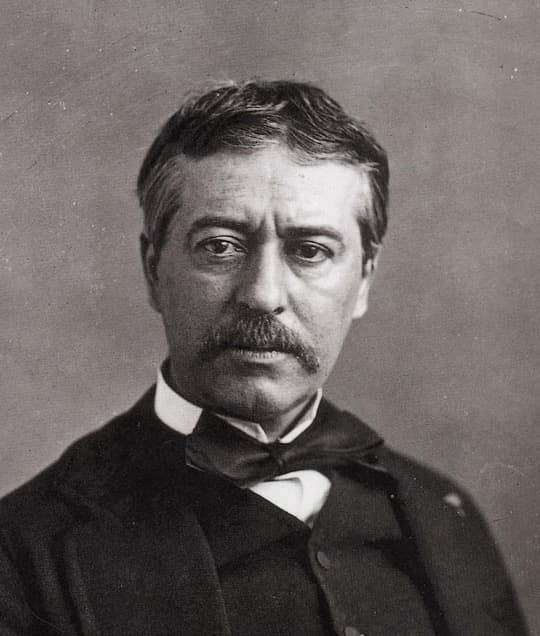
Maurice Sand
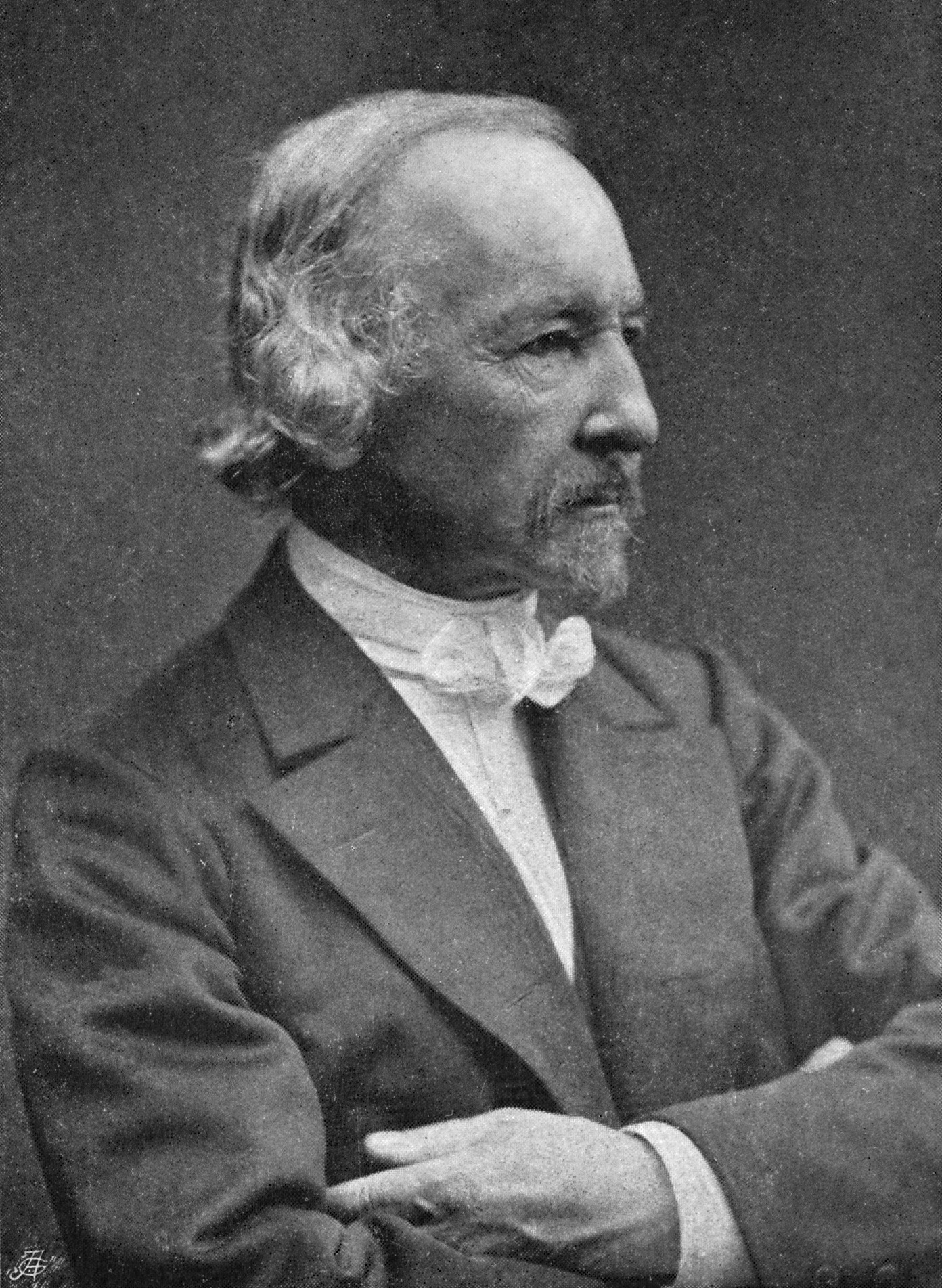
Jean-François-Maurice-Arnauld Dudevant, known as Baron Dudevant but better known by the pseudonym Maurice Sand (30 June 1823 – 4 September 1889), was a French writer, artist and entomologist. He studied art under Eugène Delacroix and also experimented in various other subjects, including geology and biology. He was the elder child and only son of George Sand, a French novelist and feminist, and her husband, Baron François Casimir Dudevant. In addition to his numerous novels, he is best remembered for his monumental study of commedia dell'arte – Masques et bouffons (comédie italienne), 1860.
Famous Quotes
View all 3 quotes“If I walk along a shore towards a ship which has run aground, and the funnel or masts merge into the forest bordering on the sand dune, there will be a moment when these details suddenly become part of the ship, and indissolubly fused with it. As I approached, I did not perceive resemblances or proximities which finally came together to form a continuous picture of the upper part of the ship. I merely felt that the look of the object was on the point of altering, that something was imminent in this tension, as a storm is imminent in storm clouds.Suddenly the sight before me was recast in a manner satisfying to my vague expectation. Only afterwards did I recognize, as justifications for the change, the resemblance and contiguity of what I call ‘stimuli’”
“My good aunt Lucie was on the eve of marriage with an officer who was a friend of my father, and they were all celebrating in the intimacy of the family. My mother was wearing a pretty dress the color of roses. They were dancing a quadrille composed by my father, as he played on his faithful Cremona violin. . . . My mother, feeling a slight malaise, left the dance and went to her bedroom. Since she showed no signs of indisposition and had left so quietly, the dancing continued. My aunt Lucie, as it was ending, went to my mother's bedroom, and almost immediately she was heard to cry, "Come, come quickly, Maurice, you have a daughter!""She shall be called Aurore," said my father, "after my poor, dear mother, who is not here to bless her, but who will someday!"And he took me in his arms. . . ."She was born to the sound of music and in the color ofroses," said my aunt. "She will know happiness.””
“From the perspective of the objective world with its opaque qualities, or from the objective body with its isolated organs, the phenomenon of synesthesia is paradoxical...For the subject does not tell us merely that he has a sound and a color at the same time: it is the sound itself that he sees, at the place where colors form. This formula is literally rendered meaningless if vision is defined by the visual quale, or sound by the sonorous quale. But...the vision of sounds or the hearing of colors exist as phenomena. And they are hardly exceptional phenomena. Synesthetic perception is the rule and, if we do not notice it, this is because scientific knowledge displaces experience and we have unlearned seeing, hearing, and sensing in general in order to deduce what we ought to see, hear, or sense from our bodily organization and from the world as it is conceived by the physicist...In fact...by opening itself up to the structure of the thing, the senses communicate among themselves. We see the rigidity and the fragility of the glass, and, when it breaks with a crystal-clear sound, this sound is borne by the visible glass. We see the elasticity of steel, the ductility of molten steel, the hardness of the blade in a plane, and the softness of its shaving...The form of a fold in a fabric of linen or of cotton shows us the softness or the dryness of the fiber, and the coolness or the warmth of the fabric...In the movement of the branch from which a bird has just left, we read its flexibility and its elasticity, and this is how the branch of an apple tree and the branch of a birch are immediately distinguished. We see the weight of a block of cast iron that sinks into the sand, the fluidity of the water, and the viscosity of the syrup. Likewise, I hear the hardness and the unevenness if the cobblestones in the sound of a car, and we are right to speak of a 'soft,' 'dull' or 'dry' sound.””
Books from the author







Link to this page
Add a free, dofollow link to Lex on your blog, forum, syllabus, or reading list.

<a href="https://lex-books.com/author/maurice-sand"><img src="https://lex-books.com/badges/read-on-lex.svg" alt="Maurice Sand on Lex" width="160" height="40"></a>[](https://lex-books.com/author/maurice-sand)[url=https://lex-books.com/author/maurice-sand][img]https://lex-books.com/badges/read-on-lex.svg[/img][/url]Maurice Sand on Lex: https://lex-books.com/author/maurice-sand