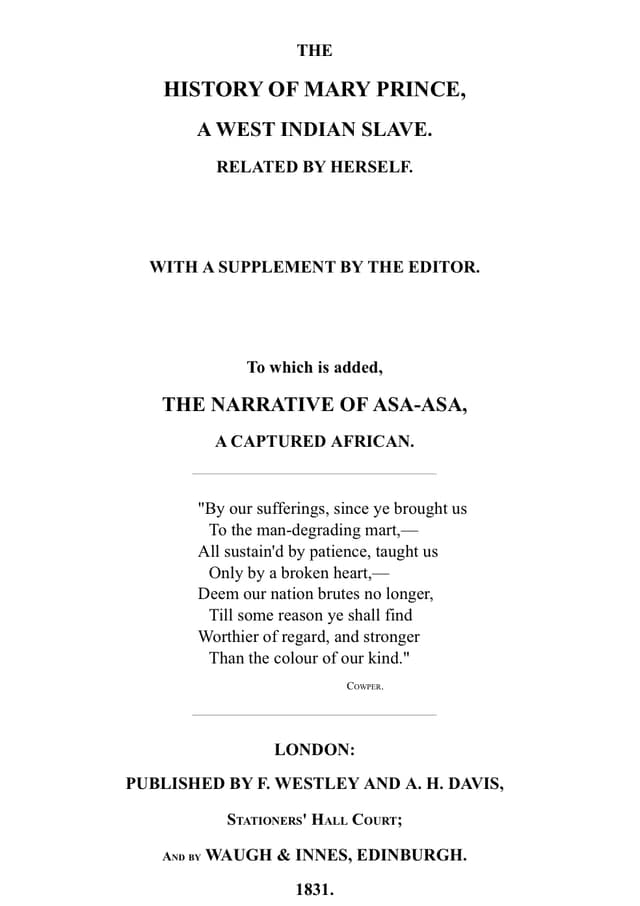
Mary Prince
Mary Prince was a pioneering figure in the abolitionist movement, recognized as the first black woman to publish an autobiography detailing her harrowing experiences as a slave. Born into slavery in Bermuda around 1788, she endured a life marked by brutality and displacement, being sold multiple times and moved throughout the Caribbean. In 1828, she was brought to England as a servant, where she eventually escaped from her enslaver. Despite being illiterate, Prince dictated her life story to Susanna Strickland, who transcribed it under the guidance of Thomas Pringle, secretary of the Anti-Slavery Society. The resulting work, 'The History of Mary Prince,' was published in 1831 and stands as a groundbreaking account of the life of a Black enslaved woman in the United Kingdom. Prince's narrative provided a powerful first-hand account of the harsh realities of enslavement, significantly influencing public opinion and energizing the British anti-slavery movement at a time when slavery was still legal in many British territories. The book was met with immediate acclaim, being reprinted twice in its first year alone, and it remains a crucial text in the history of abolitionism. Mary Prince's legacy endures as a testament to the resilience of enslaved individuals and the importance of their voices in the fight for freedom and justice.
Famous Quotes
View all 3 quotes“There is many a monster who wears the form of a man; it is better of the two to have the heart of a man and the form of a monster. ””
“He consumed me in a different way- the way his eyes made everything jump inside of me when I looked into them, his laughter, temper, the way he sometimes struggled for words, the way his jaw twitched when he was angry, the thoughtful way he listened to me, his incredible restraint and resolve in the face of overwhelming odds. When I looked at him, I saw the easygoing farmer he could have been, but I also saw the soldier and prince that he was.””
“Who was this girl who thumbed her nose at two kingdoms and did as she pleased?””
Books from the author





Link to this page
Add a free, dofollow link to Lex on your blog, forum, syllabus, or reading list.

<a href="https://lex-books.com/author/mary-prince"><img src="https://lex-books.com/badges/read-on-lex.svg" alt="Mary Prince on Lex" width="160" height="40"></a>[](https://lex-books.com/author/mary-prince)[url=https://lex-books.com/author/mary-prince][img]https://lex-books.com/badges/read-on-lex.svg[/img][/url]Mary Prince on Lex: https://lex-books.com/author/mary-prince