
Madame de Staël
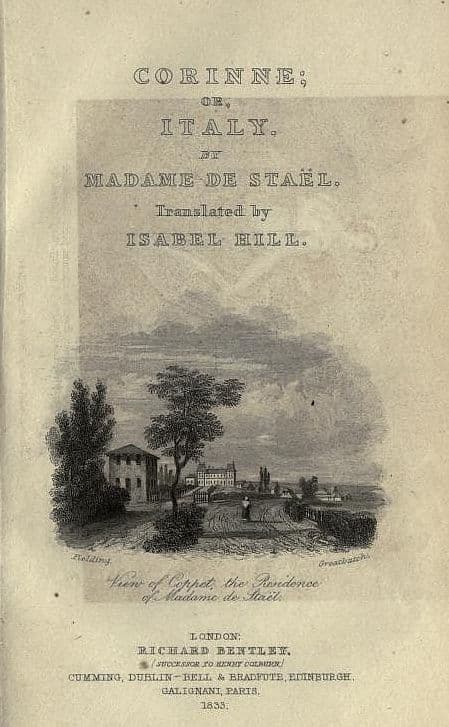
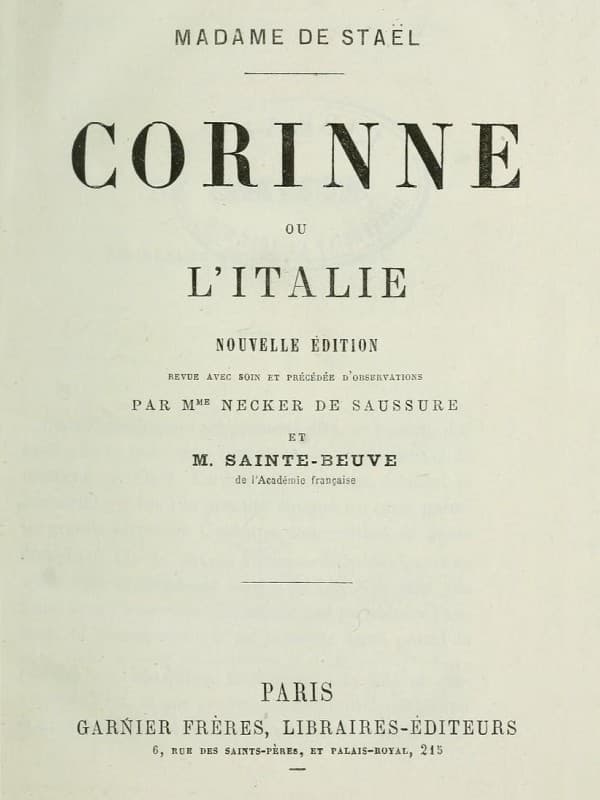
Madame de Staël was a prominent French-Swiss writer and intellectual whose works significantly influenced the literary and political landscape of her time. Born in Paris to a wealthy family, she was well-educated and became an ardent supporter of the Enlightenment ideals. Her most notable works include 'Delphine' and 'Corinne', which explored themes of individualism, passion, and the role of women in society. In 'On Germany', she introduced French readers to German Romanticism, emphasizing the importance of emotion and nature in literature, which contrasted sharply with the rationalism of the Enlightenment. De Staël's salons became a hub for intellectual discourse, attracting notable figures such as Goethe and Napoleon. Her outspoken criticism of Napoleon's regime and her advocacy for liberal ideas led to her exile from France, yet she continued to write and engage with European intellectual circles. Her legacy lies in her pioneering exploration of women's roles in literature and her contributions to the Romantic movement, making her a key figure in the transition from Enlightenment thought to Romantic sensibilities in Europe.
Famous Quotes
View all 10 quotes“The desire of the man is for the woman, but the desire of the woman is for the desire of the man.””
“The more we know the better we forgive. Whoever feels deeply, feels for all who live.””
“Laissons au temps, laissons au hasard, interrompit Corinne, à décider si cette impression d'un jour que j'ai produite sur vous durera plus d'un jour. Si nos âmes s'entendent, notre affection mutuelle ne sera point passagère””
Books from the author







Link to this page
Add a free, dofollow link to Lex on your blog, forum, syllabus, or reading list.

<a href="https://lex-books.com/author/madame-de-staël"><img src="https://lex-books.com/badges/read-on-lex.svg" alt="Madame de Staël on Lex" width="160" height="40"></a>[](https://lex-books.com/author/madame-de-staël)[url=https://lex-books.com/author/madame-de-staël][img]https://lex-books.com/badges/read-on-lex.svg[/img][/url]Madame de Staël on Lex: https://lex-books.com/author/madame-de-staël