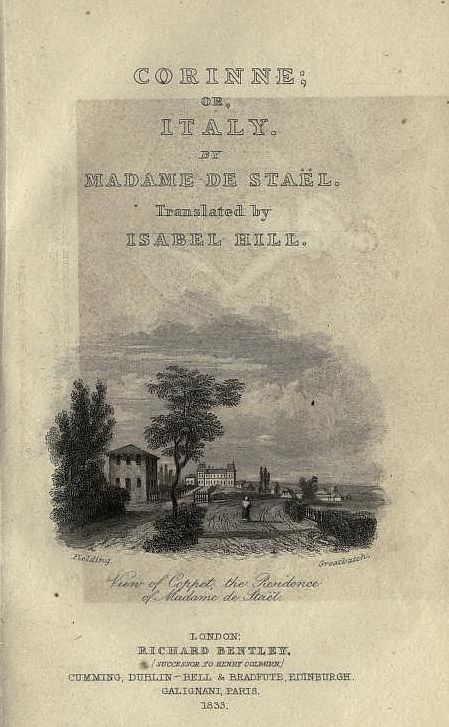
Corinne; Or, Italy
1807
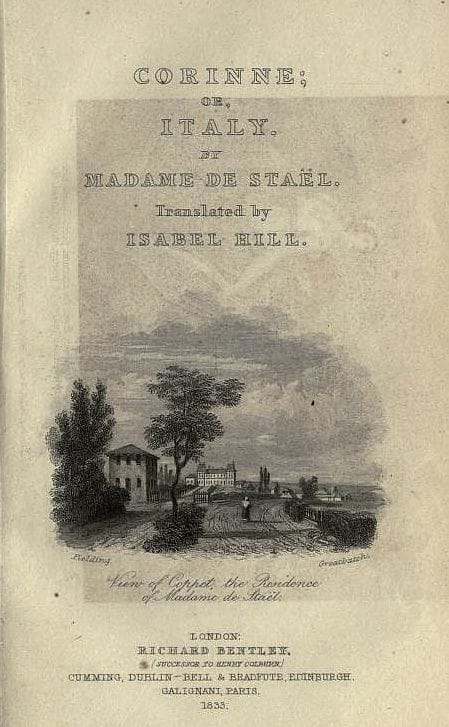
In 1807, Madame de Staël dared to write the novel Napoleon couldn't bear. Corinne, a celebrated poet and improviser, rules Rome's intellectual circles with her brilliance and charisma until she encounters Lord Oswald Nelvil, a grief-stricken Scottish nobleman seeking healing in Italy's sun-drenched landscapes. Their love unfolds against the ruins of ancient empires and the vibrancy of a culture in artistic revival, but Staël's romance carries a dangerous sting: Corinne's very existence, her independence, her gifts, her passion, represents everything patriarchal Europe fears. When Oswald must choose between his heart and his dead father's will, the novel asks whether civilization can truly accommodate a woman of extraordinary mind and feeling, or whether it will demand her destruction. This is European Romanticism's founding text, a passionate argument for emotional truth over social constraint, and a devastating portrait of genius condemned by the very world that admires it. Napoleon exiled Staël for writing it. The exile was the highest compliment.
Editions
X-Ray
“We live in an age when selfinterest alone seems to determine all of man’s acts”
— Madame de Staël
“I left in one of those moments when you give in to fate, when everything seems better than servitude, distaste, and dullness, when thoughtless youth has faith in the future and sees it in the heavens like a brilliant star promising a happy lot.””
— Madame de Staël
“Travelling, say what we will, is one of the saddest pleasures in life.””
— Madame de Staël
“Cette magie de l'univers que vous m'apprenez à connaître ne m'offrira jamais rien de plus beau que votre regard, de plus touchant que votre voix. Puisse ce sentiment que je vous inspire aujourd'hui durer autant que ma vie, dit Corinne, ou du moins puisse ma vie ne pas durer plus que lui !””
— Madame de Staël
“Je suis née pour le bonheur, mon caractère est confiant, mon imagination est animée ; mais la peine excite en moi je ne sais quelle impétuosité qui peut troubler ma raison ou me donner la mort.””
— Madame de Staël
“Laissons au temps, laissons au hasard, interrompit Corinne, à décider si cette impression d'un jour que j'ai produite sur vous durera plus d'un jour. Si nos âmes s'entendent, notre affection mutuelle ne sera point passagère””
— Madame de Staël
“Dragostea se află la o răscruce când ai izbutit s-o învingi întâia oară; iluzia atotputerniciei ei a murit.””
— Madame de Staël
“[...] dintre toate însușirile mele, cea mai puternică e însușirea de a suferi. Sunt născută pentru fericire, am o fire încrezătoare, o imaginație înflăcărată; dar suferința trezește în mine o pornire aprigă și fără nume, care mă poate duce la nebunie sau la moarte””
— Madame de Staël
“Nu cred că inima e făcută să simtă ori o totală indiferență, ori o patimă de neînvins. Există sentimente care abia se nasc și pe care o cercetare mai adâncă le poate risipi. Îți închipui un lucru, apoi vezi că te-ai înșelat, și același entuziasm care te face să te înflăcărezi foarte repede poate să te ducă tot atât de repede la nepăsare.””
— Madame de Staël
Link to this book
Add a free, dofollow link to Lex on your blog, forum, syllabus, or reading list.

<a href="https://lex-books.com/book/corinne-or-italy-5ecaf641-fd77-47cd-a893-2466fad50535"><img src="https://lex-books.com/badges/read-on-lex.svg" alt="Read Corinne; Or, Italy by Madame de Staël free on Lex" width="160" height="40"></a>[](https://lex-books.com/book/corinne-or-italy-5ecaf641-fd77-47cd-a893-2466fad50535)[url=https://lex-books.com/book/corinne-or-italy-5ecaf641-fd77-47cd-a893-2466fad50535][img]https://lex-books.com/badges/read-on-lex.svg[/img][/url]Read Corinne; Or, Italy by Madame de Staël free on Lex: https://lex-books.com/book/corinne-or-italy-5ecaf641-fd77-47cd-a893-2466fad50535Cite this book
Reading this edition for a paper or guide? Copy a citation.
Staël, Madame de. Corinne; Or, Italy. Lex, lex-books.com/book/corinne-or-italy-5ecaf641-fd77-47cd-a893-2466fad50535.Staël, M. D. (1807). Corinne; Or, Italy. Lex. https://lex-books.com/book/corinne-or-italy-5ecaf641-fd77-47cd-a893-2466fad50535Staël, Madame de. Corinne; Or, Italy. Lex. https://lex-books.com/book/corinne-or-italy-5ecaf641-fd77-47cd-a893-2466fad50535.