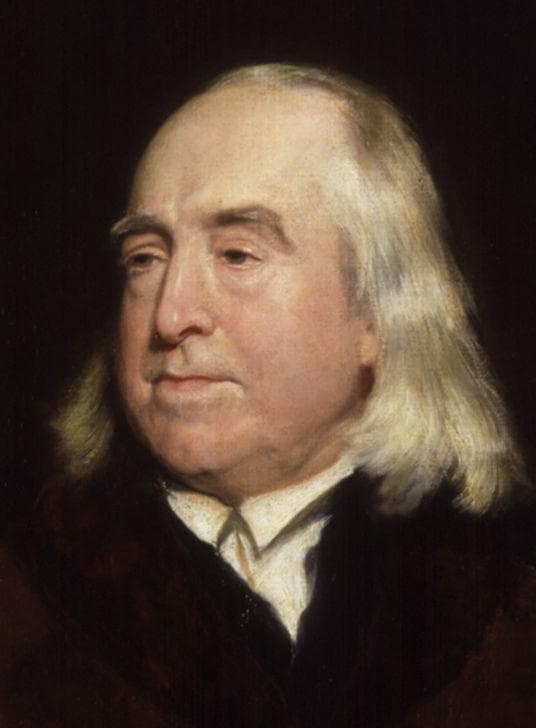
Jeremy Bentham
Jeremy Bentham was an English philosopher, jurist, and social reformer who is best known as the founder of modern utilitarianism. He articulated the principle that the measure of right and wrong is determined by the greatest happiness of the greatest number, a concept that became central to his philosophical and legal theories. Bentham's radical ideas extended beyond utilitarianism; he championed individual and economic freedoms, advocated for the separation of church and state, and called for equal rights for women, the right to divorce, and the abolition of slavery and capital punishment. His progressive stance on issues such as the decriminalization of homosexual acts and animal rights marked him as a forward-thinking reformer in his time. Bentham's influence reached into various domains, including the reform of prisons, schools, and legal systems. He was a prominent critic of natural law and natural rights, which he dismissed as 'nonsense upon stilts,' and instead emphasized the importance of legal rights grounded in societal welfare. His ideas significantly shaped Anglo-American legal philosophy and inspired notable figures such as John Stuart Mill and John Austin. Bentham's legacy endures in contemporary discussions of ethics, law, and social reform, reflecting his commitment to a more just and equitable society.
Famous Quotes
View all 3 quotes“The question is not, "Can they reason?" nor, "Can they talk?" but "Can they suffer?”
“Create all the happiness you are able to create; remove all the misery you are able to remove. Every day will allow you, --will invite you to add something to the pleasure of others, --or to diminish something of their pains.”
“...the rarest of all human qualities is consistency.”
Books from the author















Link to this page
Add a free, dofollow link to Lex on your blog, forum, syllabus, or reading list.

<a href="https://lex-books.com/author/jeremy-bentham"><img src="https://lex-books.com/badges/read-on-lex.svg" alt="Jeremy Bentham on Lex" width="160" height="40"></a>[](https://lex-books.com/author/jeremy-bentham)[url=https://lex-books.com/author/jeremy-bentham][img]https://lex-books.com/badges/read-on-lex.svg[/img][/url]Jeremy Bentham on Lex: https://lex-books.com/author/jeremy-bentham