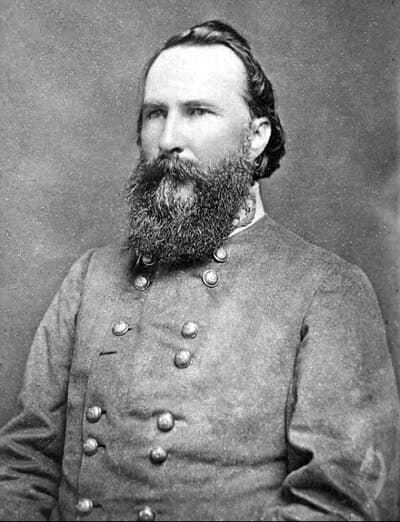
James Longstreet
James Longstreet was a prominent Confederate general during the American Civil War, known for his role as a principal subordinate to General Robert E. Lee, who referred to him as his "Old War Horse." A graduate of the United States Military Academy at West Point, Longstreet began his military career serving in the U.S. Army during the Mexican-American War, where he was wounded at the Battle of Chapultepec. After resigning his commission in June 1861, he joined the Confederate Army and quickly established himself as a key commander, contributing to significant victories in the Eastern Theater, including the Seven Days Battles and the Second Battle of Bull Run. However, his performance was not without controversy, particularly during the Battle of Gettysburg, where he disagreed with Lee's tactics and oversaw several failed assaults on Union positions. Longstreet's military career was marked by both triumph and turmoil. After Gettysburg, he was reassigned to the Western Theater, where he achieved a notable victory at the Battle of Chickamauga but faced challenges during the Knoxville campaign. His later service included commanding troops at the Battle of the Wilderness, where he was severely wounded by friendly fire. Despite the controversies surrounding his decisions and the conflicts with fellow Confederate generals, Longstreet's contributions to the Confederate military efforts were significant, and his legacy remains a subject of study for historians examining the complexities of Civil War leadership and strategy.
Famous Quotes
View all 2 quotes“The heavy fumes of gunpowder hanging about our ranks, as stimulating as sparkling wine, charged the atmosphere with the light and splendor of battle. Time was culminating under a flowing tide.”
“His game of hide-and-seek about Bull Bun, Centreville, and Manassas Plains was grand, but marred in completeness by the failure of General A. P. Hill to meet his orders for the afternoon of the 28th. As a leader he was fine; as a wheel-horse, he was not always just to himself. He was fond of the picturesque.”
Books from the author

Link to this page
Add a free, dofollow link to Lex on your blog, forum, syllabus, or reading list.

<a href="https://lex-books.com/author/james-longstreet"><img src="https://lex-books.com/badges/read-on-lex.svg" alt="James Longstreet on Lex" width="160" height="40"></a>[](https://lex-books.com/author/james-longstreet)[url=https://lex-books.com/author/james-longstreet][img]https://lex-books.com/badges/read-on-lex.svg[/img][/url]James Longstreet on Lex: https://lex-books.com/author/james-longstreet