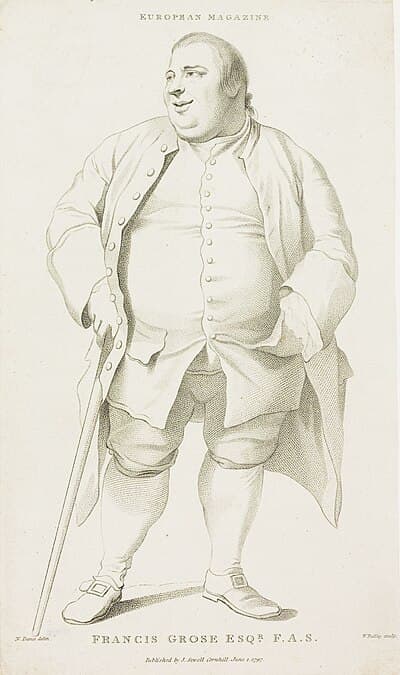
Francis Grose
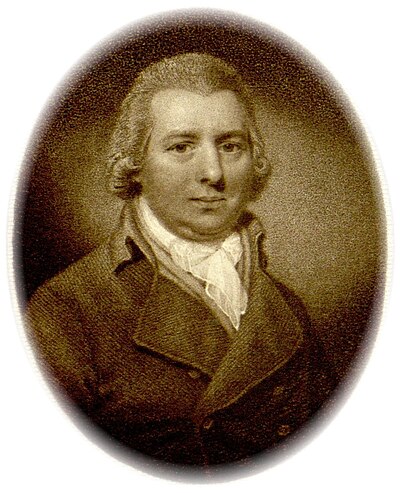
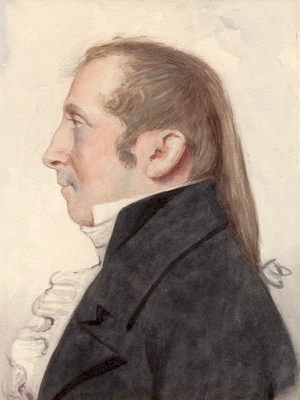
Francis Grose was an English antiquary, draughtsman, and lexicographer, known for his significant contributions to the study of language and culture in 18th-century England. His most notable works include 'A Classical Dictionary of the Vulgar Tongue' published in 1785, which provided insights into the colloquial language of the time, and 'A Provincial Glossary, with a Collection of Local Proverbs, and Popular Superstitions' released in 1787. These works not only documented the vernacular but also reflected the social and cultural nuances of English life during his era. Grose's lexicographical efforts were pioneering, as they captured the richness of regional dialects and the evolving nature of English. His focus on the vernacular and local superstitions offered a unique perspective on the customs and beliefs of the time, making his contributions invaluable to the fields of linguistics and cultural history. Through his meticulous documentation, Grose helped preserve aspects of English heritage that might otherwise have been lost, solidifying his legacy as a key figure in the study of language and folklore.
Famous Quotes
View all 9 quotes“HUGOTONTHEONBIQUIFFINARIANS.””
“MARE'S NEST. He has found a mare's nest, and is laughing at the eggs; said of one who laughs without any apparent cause.””
“GALLEY. Building the galley; a game formerly used at sea, in order to put a trick upon a landsman, or fresh-water sailor. It being agreed to play at that game, one sailor personates the builder, and another the merchant or contractor: the builder first begins by laying the keel, which consists of a number of men laid all along on their backs, one after another, that is, head to foot; he next puts in the ribs or knees, by making a number of men sit feet to feet, at right angles to, and on each side of, the keel: he now fixing on the person intended to be the object of the joke, observes he is a fierce-looking fellow, and fit for the lion; he accordingly places him at the head, his arms being held or locked in by the two persons next to him, representing the ribs. After several other dispositions, the builder delivers over the galley to the contractor as complete: but he, among other faults and objections, observes the lion is not gilt, on which the builder or one of his assistants, runs to the head, and dipping a mop in the excrement, thrusts it into the face of the lion. GALLEY FOIST.””
Books from the author




Link to this page
Add a free, dofollow link to Lex on your blog, forum, syllabus, or reading list.

<a href="https://lex-books.com/author/francis-grose"><img src="https://lex-books.com/badges/read-on-lex.svg" alt="Francis Grose on Lex" width="160" height="40"></a>[](https://lex-books.com/author/francis-grose)[url=https://lex-books.com/author/francis-grose][img]https://lex-books.com/badges/read-on-lex.svg[/img][/url]Francis Grose on Lex: https://lex-books.com/author/francis-grose