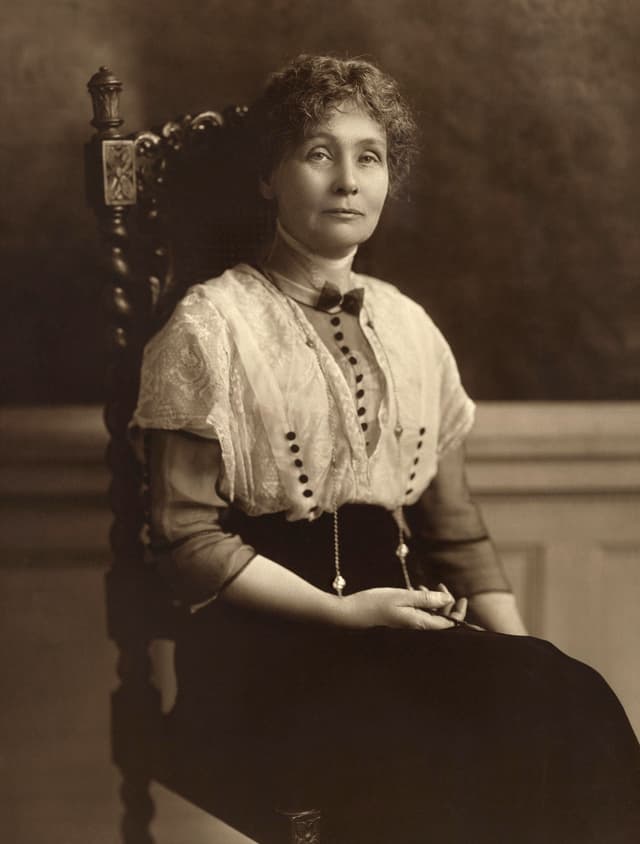
Emmeline Pankhurst
Emmeline Pankhurst was a pioneering British political activist who played a central role in the suffragette movement, advocating fiercely for women's right to vote in the United Kingdom. Born in Manchester to politically engaged parents, Pankhurst became involved in the suffrage movement at the age of 16. She founded the Women's Social and Political Union (WSPU) in 1903, an organization known for its militant tactics and commitment to 'deeds, not words.' Under her leadership, the WSPU became notorious for its confrontational approach, which included window smashing and hunger strikes, drawing both admiration and criticism. Pankhurst's activism was instrumental in the eventual passage of the Representation of the People Act in 1918, which granted voting rights to women over the age of 30 in Britain and Ireland. Despite the controversies surrounding her methods, Pankhurst's legacy as a champion for women's rights remains significant. Her approach to activism, which often placed her at odds with more moderate suffrage organizations, highlighted the urgency and desperation felt by many women of her time. Pankhurst's family dynamics were also affected by her activism; her relationships with her daughters became strained as they diverged in their political beliefs. Nevertheless, her relentless pursuit of equality and her role in shaping the suffragette movement have cemented her place in history as a key figure in the fight for women's suffrage.
Famous Quotes
View all 3 quotes“Men make the moral code and they expect women to accept it. They have decided that it is entirely right and proper for men to fight for their liberties and their rights, but that it is not right and proper for women to fight for theirs.”
“Governments have always tried to crush reform movements, to destroy ideas, to kill the thing that cannot die. Without regard to history, which shows that no Government have ever succeeded in doing this, they go on trying in the old, senseless way.”
“There is something that Governments care for far more than human life, and that is the security of property, and so it is through property that we shall strike the enemy. Be militant each in your own way. I incite this meeting to rebellion.”
Audiobooks from the author








Link to this page
Add a free, dofollow link to Lex on your blog, forum, syllabus, or reading list.

<a href="https://lex-books.com/author/emmeline-pankhurst"><img src="https://lex-books.com/badges/read-on-lex.svg" alt="Emmeline Pankhurst on Lex" width="160" height="40"></a>[](https://lex-books.com/author/emmeline-pankhurst)[url=https://lex-books.com/author/emmeline-pankhurst][img]https://lex-books.com/badges/read-on-lex.svg[/img][/url]Emmeline Pankhurst on Lex: https://lex-books.com/author/emmeline-pankhurst