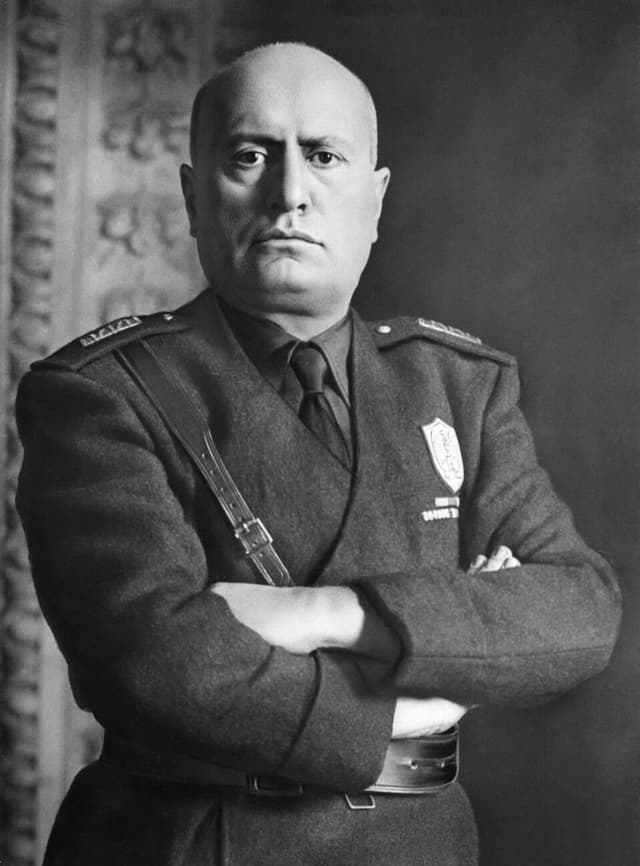
Benito Mussolini
Benito Mussolini was an Italian politician and journalist who became the central figure of Italian fascism and ruled Italy as a dictator from 1922 until his overthrow in 1943. Initially a socialist, he shifted his political stance after World War I, founding the National Fascist Party (PNF) and establishing a totalitarian regime characterized by aggressive nationalism and the suppression of dissent. Mussolini's rise to power was marked by the March on Rome in 1922, where he was appointed Prime Minister by King Victor Emmanuel III. He consolidated his authority through a combination of legal and illegal means, transforming Italy into a one-party state and employing secret police to eliminate opposition. His regime was notable for its militaristic foreign policy, which sought to expand Italian territories and influence, leading to invasions in Libya, Ethiopia, and Albania. Mussolini's impact extended beyond Italy, as he became a model for fascist movements across Europe during the interwar period. His ideology, which rejected egalitarianism and class conflict in favor of a revolutionary nationalism, inspired similar regimes and contributed to the rise of totalitarianism in the 20th century. The Lateran Treaty of 1929, which established Vatican City, marked a significant moment in his governance, reflecting his efforts to align the Catholic Church with his regime. However, his alliance with Nazi Germany and involvement in World War II ultimately led to his downfall and execution in 1945, leaving a controversial legacy that continues to provoke debate about fascism and authoritarianism in modern history.
Famous Quotes
View all 3 quotes“It is better to live one day as a lion than 100 years as a sheep.”
“Fascism should more appropriately be called Corporatism because it is a merger of state and corporate power”
“We become strongest, I feel, when we have no friends upon whom to lean, or to look for moral gudance”
Books from the author





Link to this page
Add a free, dofollow link to Lex on your blog, forum, syllabus, or reading list.

<a href="https://lex-books.com/author/benito-mussolini"><img src="https://lex-books.com/badges/read-on-lex.svg" alt="Benito Mussolini on Lex" width="160" height="40"></a>[](https://lex-books.com/author/benito-mussolini)[url=https://lex-books.com/author/benito-mussolini][img]https://lex-books.com/badges/read-on-lex.svg[/img][/url]Benito Mussolini on Lex: https://lex-books.com/author/benito-mussolini