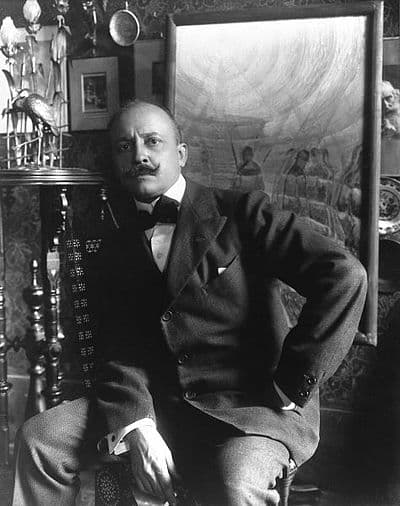
F. T. Marinetti
Filippo Tommaso Emilio Marinetti was an influential Italian poet, editor, and art theorist, best known as the founder of the Futurist movement. His early involvement with the Abbaye de Créteil community from 1907 to 1908 helped shape his avant-garde vision, which sought to break away from the past and embrace modernity. In 1909, he published the 'Manifesto of Futurism,' a bold declaration that celebrated technology, speed, and violence, positioning art as a catalyst for social change. This manifesto not only defined the principles of Futurism but also ignited a cultural revolution in Italy and beyond, influencing various artistic disciplines, including literature, painting, and architecture. Marinetti's later works included his contributions to the 'Fascist Manifesto' in 1919, which aligned his artistic ideals with the political movements of his time. His writings often embodied a sense of nationalism and a rejection of traditional aesthetics, making him a controversial figure in the literary world. Despite the complexities of his legacy, Marinetti's impact on modern art and literature is undeniable, as he challenged conventions and inspired future generations of artists and writers to explore new forms of expression.
Famous Quotes
View all 3 quotes“We declare that the splendor of the world has been enriched by a new beauty: the beauty of speed. A racing automobile with its bonnet adorned with great tubes like serpents with explosive breath...a roaring motor car which seems to run on machine-gun fire, is more beautiful than the Victory of Samothrace.””
“We must shake the gates of life to test the hinges and the locks.””
“after having, for instance, reproduced in a picture the right shoulder or the right ear of a figure, we deem it totally vain and useless to reproduce the left shoulder or the left ear. We do not draw sounds, but their vibrating invervals. We do not paint diseases, but their symtoms and their consequences.””
Books from the author







Link to this page
Add a free, dofollow link to Lex on your blog, forum, syllabus, or reading list.

<a href="https://lex-books.com/author/f-t-marinetti"><img src="https://lex-books.com/badges/read-on-lex.svg" alt="F. T. Marinetti on Lex" width="160" height="40"></a>[](https://lex-books.com/author/f-t-marinetti)[url=https://lex-books.com/author/f-t-marinetti][img]https://lex-books.com/badges/read-on-lex.svg[/img][/url]F. T. Marinetti on Lex: https://lex-books.com/author/f-t-marinetti