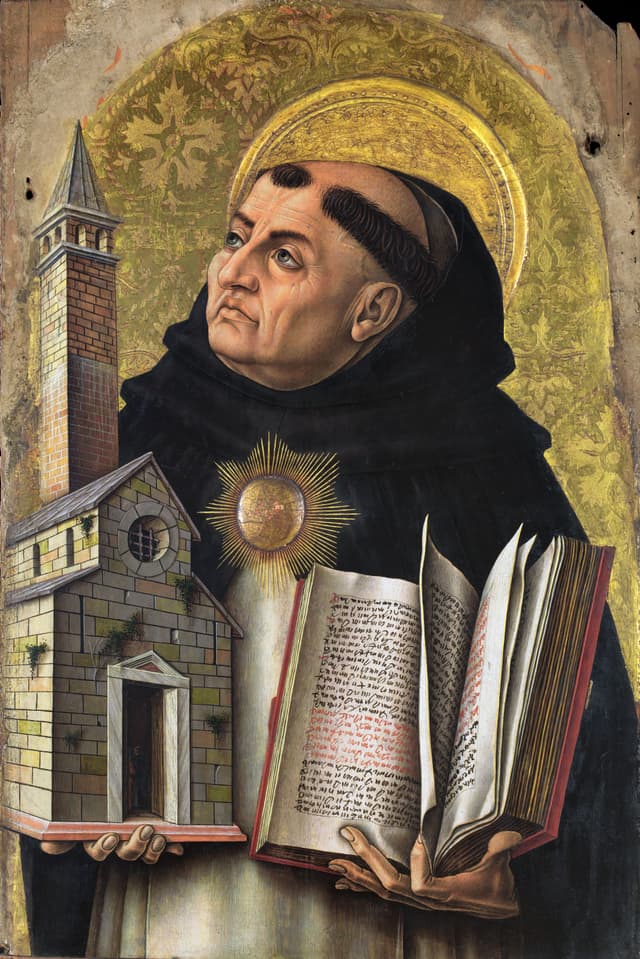
Aquinas, Saint Thomas
Saint Thomas Aquinas was a medieval philosopher and theologian whose works laid the foundation for much of Western thought. Born around 1225 in Italy, he became a prominent figure in the Scholastic tradition, synthesizing Aristotelian philosophy with Christian doctrine. His most notable works include 'Summa Theologica' and 'Summa Contra Gentiles,' where he explored the relationship between faith and reason, ethics, and the nature of God. Aquinas's arguments for the existence of God, particularly the Five Ways, have had a lasting impact on theology and philosophy. Aquinas's influence extended beyond his lifetime, shaping the teachings of the Catholic Church and the development of Western philosophy. His integration of reason and faith offered a framework that would dominate theological discourse for centuries. Recognized as a Doctor of the Church, his thoughts continue to be studied and revered, making him a pivotal figure in both religious and philosophical contexts. His legacy endures in the realms of ethics, metaphysics, and political theory, establishing him as one of the most significant thinkers of the Middle Ages.
Famous Quotes
View all 8 quotes“Most men seem to live according to sense rather than reason.””
“Rarely affirm, seldom deny, always distinguish.””
“To love is to will the good of the other.””
Books from the author




Link to this page
Add a free, dofollow link to Lex on your blog, forum, syllabus, or reading list.

<a href="https://lex-books.com/author/aquinas-saint-thomas"><img src="https://lex-books.com/badges/read-on-lex.svg" alt="Aquinas, Saint Thomas on Lex" width="160" height="40"></a>[](https://lex-books.com/author/aquinas-saint-thomas)[url=https://lex-books.com/author/aquinas-saint-thomas][img]https://lex-books.com/badges/read-on-lex.svg[/img][/url]Aquinas, Saint Thomas on Lex: https://lex-books.com/author/aquinas-saint-thomas