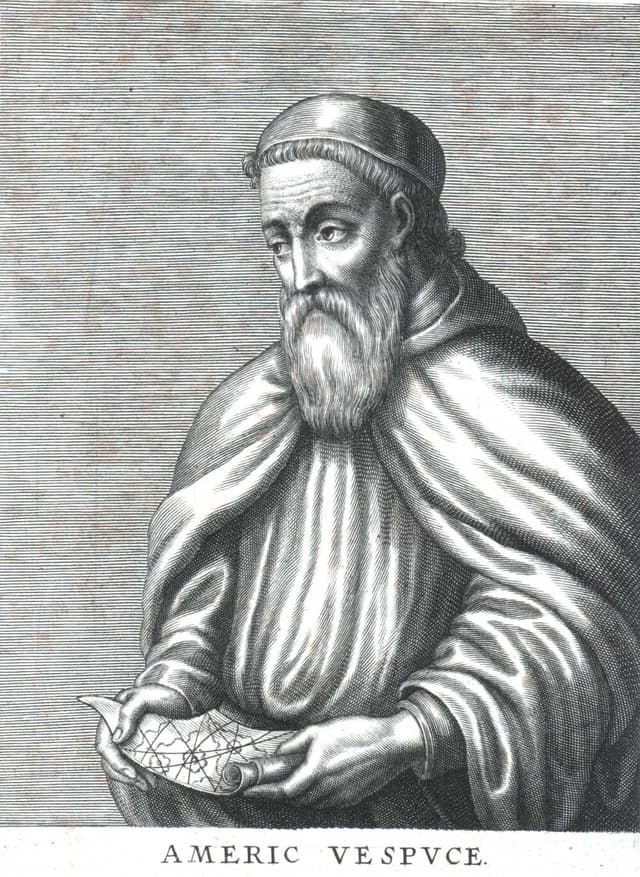
Amerigo Vespucci
Amerigo Vespucci was an Italian explorer and navigator from the Republic of Florence, renowned for his pivotal role during the Age of Discovery. He embarked on at least two significant voyages between 1497 and 1504, first sailing under the Spanish flag and later for Portugal. His explorations contributed to the European understanding of the New World, particularly his assertion that Brazil was part of a previously unknown continent. This insight was revolutionary, as it helped distinguish the New World from Asia, a common misconception of the time. Vespucci's literary contributions, particularly two widely circulated booklets published in 1503 and 1505, provided vivid accounts of his journeys and the lands he encountered. These publications not only captivated European audiences but also played a crucial role in enhancing his reputation as an explorer. Although the authenticity of some of his writings has been debated by historians, they were instrumental in popularizing the term 'America,' which was first applied to the continent by cartographer Martin Waldseemüller in 1507. Vespucci's legacy endures through this nomenclature, marking him as a key figure in the history of exploration and cartography.
Famous Quotes
View all 1 quotes“All of both (Native American) sexes go about naked…They (women) have another custom, very shameful and beyond all human belief. For their women, being very lustful, cause the private parts of their husbands to swell up to such a huge size that they appear deformed…They (men) marry as many wives as they please; and son cohabits with mother, male cousin with female, and any man with the first woman he meets. They dissolve their marriages as often as they please…The women as I have said go about naked and are very libidinous, yet they have tolerably beautiful bodies and cleanly…When they had the opportunity of copulating with Christians, urged by excessive lust, they defiled and prostituted themselves.”
Books from the author




Link to this page
Add a free, dofollow link to Lex on your blog, forum, syllabus, or reading list.

<a href="https://lex-books.com/author/amerigo-vespucci"><img src="https://lex-books.com/badges/read-on-lex.svg" alt="Amerigo Vespucci on Lex" width="160" height="40"></a>[](https://lex-books.com/author/amerigo-vespucci)[url=https://lex-books.com/author/amerigo-vespucci][img]https://lex-books.com/badges/read-on-lex.svg[/img][/url]Amerigo Vespucci on Lex: https://lex-books.com/author/amerigo-vespucci