Vikram and the Vampire; Or, Tales of Hindu Devilry
1870
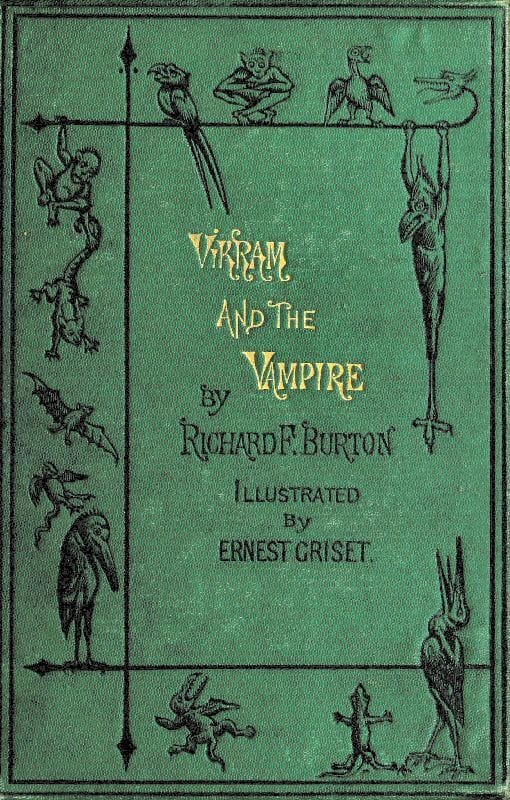
Here is a riddle: a king must capture a vampire who hangs from a tree, carrying him on his back across vast distances without speaking a word. For every mile traveled, the vampire tells a story and asks a question. Answer correctly, and the vampire remains silent. Speak, and he escapes. This is the ancient game at the heart of the Baital-Pachisi, the twenty-five tales within these pages, which some scholars believe inspired One Thousand and One Nights. Sir Richard Francis Burton, that most Victorian of explorers, brought these Hindu folk tales to English readers in 1870, rendering them in prose that swirls with the exotic and the eerie. King Vikramaditya, semi-legendary ruler of ancient India, is no simple hero. He is proud, stubborn, and perpetually outwitted by the mischievous Baital, whose stories range from comic farce to dark moral fable. The vampire is no mere monster; he is a philosopher, a trickster, and a relentless tester of human wisdom. These tales pulse with the strange logic of dream logic, where ghosts argue theology and serpents grant wishes that should never have been asked for. Burton's introduction and annotations add another layer, framing these stories as specimens of Eastern folklore for the edification of Western readers. The result is a book that feels like overhearing a conversation between worlds.
Editions

X-Ray
“The Baital-Pachisi, or Twenty-five Tales of a Baital is the history of a huge Bat, Vampire, or Evil Spirit which””
— Sir Richard Francis Burton
“The wise man knows himself, and is, therefore, neither unduly humble nor elated, because he had no more to do with making himself than with the cut of his cloak, or with the fitness of his loin-cloth. But the fool either loses his head by comparing himself with still greater fools, or is prostrated when he finds himself inferior to other and lesser fools. This shyness he calls modesty, humility, and so forth.””
— Sir Richard Francis Burton
“absorption, where fables will be no longer required. He then teaches us how Vikramaditya the Brave became King of Ujjayani. Some nineteen centuries ago, the renowned city of Ujjayani witnessed the birth of a prince to whom was given the gigantic name Vikramaditya. Even the Sanskrit-speaking people, who are not usually pressed for time, shortened it to "Vikram", and a little further West it would infallibly have been docked down to "Vik". Vikram was the second son of an old king Gandharba-Sena, concerning whom little favourable has reached posterity, except that he became an ass, married four queens, and had by them six sons, each of whom was more learned and powerful than the other. It so happened that in course of time the father died. Thereupon his eldest heir, who was known as Shank, succeeded to the carpet of Rajaship, and was instantly””
— Sir Richard Francis Burton
“this book is a string of fine pearls to be hung round the neck of human intelligence; a fragrant flower to be borne on the turband of mental wisdom; a jewel of pure gold, which becomes the brow of all supreme minds; and a handful of powdered rubies, whose tonic effects will appear palpably upon the mental digestion of every patient.””
— Sir Richard Francis Burton
“the great maritime city of Asiatic Ionia, was of old the meeting-place of the East and the West. Here the Phoenician trader from the Baltic would meet the Hindu wandering to Intra, from Extra, Gangem; and the Hyperborean would step on shore side by side with the Nubian and the Aethiop.””
— Sir Richard Francis Burton
“her an account of your cleverness, and when she heard it she gave me permission to go and see you, and sent these sweetmeats for you: eat them and””
— Sir Richard Francis Burton
Link to this book
Add a free, dofollow link to Lex on your blog, forum, syllabus, or reading list.

<a href="https://lex-books.com/book/vikram-and-the-vampire-or-tales-of-hindu-devilry-06856341-f449-4f5b-b097-789433b35206"><img src="https://lex-books.com/badges/read-on-lex.svg" alt="Read Vikram and the Vampire; Or, Tales of Hindu Devilry by Sir Richard Francis Burton free on Lex" width="160" height="40"></a>[](https://lex-books.com/book/vikram-and-the-vampire-or-tales-of-hindu-devilry-06856341-f449-4f5b-b097-789433b35206)[url=https://lex-books.com/book/vikram-and-the-vampire-or-tales-of-hindu-devilry-06856341-f449-4f5b-b097-789433b35206][img]https://lex-books.com/badges/read-on-lex.svg[/img][/url]Read Vikram and the Vampire; Or, Tales of Hindu Devilry by Sir Richard Francis Burton free on Lex: https://lex-books.com/book/vikram-and-the-vampire-or-tales-of-hindu-devilry-06856341-f449-4f5b-b097-789433b35206Cite this book
Reading this edition for a paper or guide? Copy a citation.
Burton, Sir Richard Francis. Vikram and the Vampire; Or, Tales of Hindu Devilry. Lex, lex-books.com/book/vikram-and-the-vampire-or-tales-of-hindu-devilry-06856341-f449-4f5b-b097-789433b35206.Burton, S. R. F. (1870). Vikram and the Vampire; Or, Tales of Hindu Devilry. Lex. https://lex-books.com/book/vikram-and-the-vampire-or-tales-of-hindu-devilry-06856341-f449-4f5b-b097-789433b35206Burton, Sir Richard Francis. Vikram and the Vampire; Or, Tales of Hindu Devilry. Lex. https://lex-books.com/book/vikram-and-the-vampire-or-tales-of-hindu-devilry-06856341-f449-4f5b-b097-789433b35206.

![Night Watches [complete]](/_next/image?url=https%3A%2F%2Fd3b2n8gj62qnwr.cloudfront.net%2FCOVERS%2Fgutenberg_covers75k%2Febook-12161.png&w=3840&q=75)