Through the Looking-Glass
1871
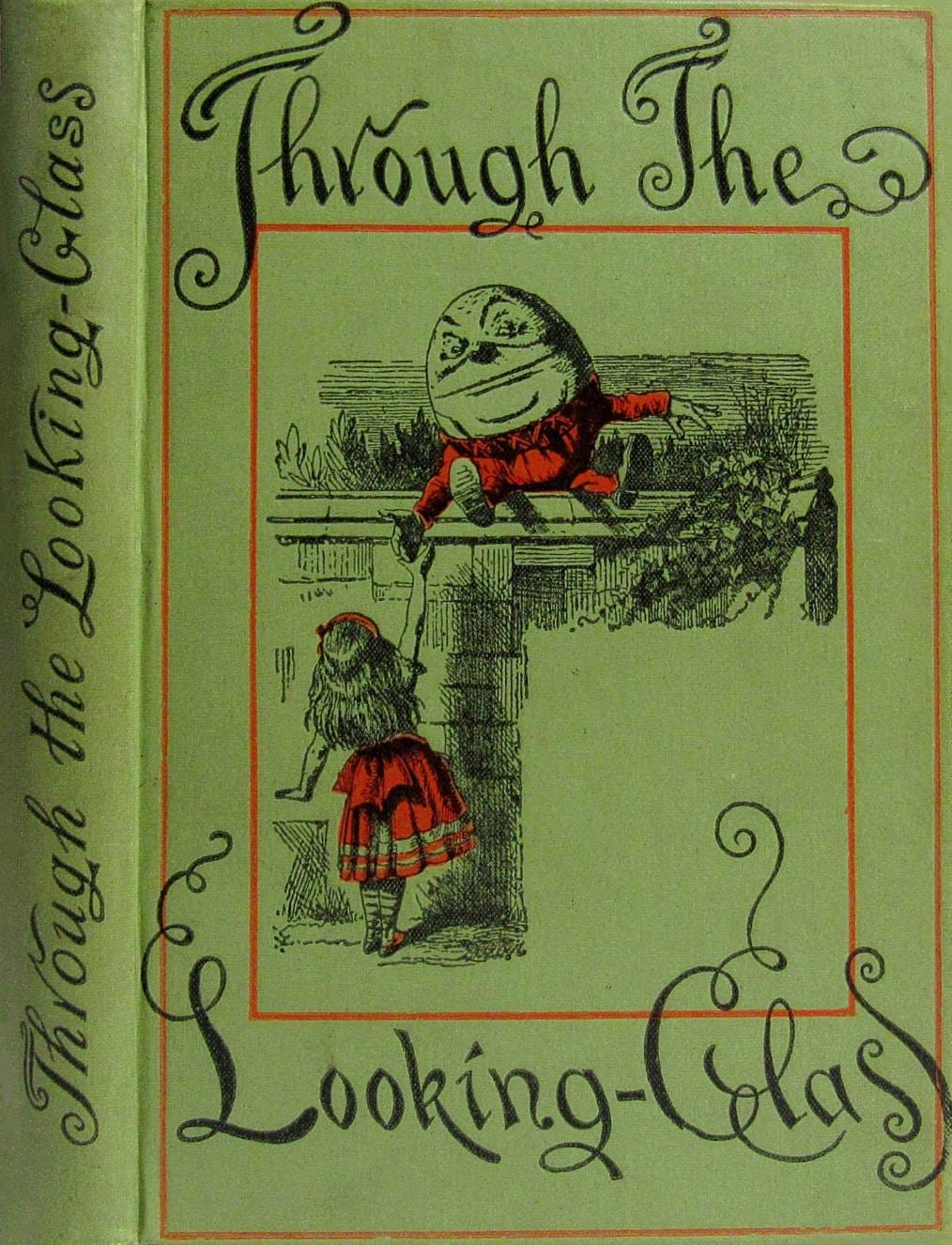
Through the Looking-Glass
1871
Alice steps through the drawing-room mirror into a world where everything is reversed, where running keeps you in place and walking away somehow brings you closer. This is Looking-Glass House: a kingdom of chess pieces and living flowers, where logic itself has been turned inside out and the only rule is that there are no rules. Carroll's sequel to Wonderland is structured as a game of chess, with Alice as a pawn advancing across an enormous checkerboard toward the eighth square, where she will become a queen. She meets the imperious Red Queen and her gentle opposite, the flustered White Queen; the twin warriors Tweedledum and Tweedledee, who argue before battling; Humpty Dumpty, who deconstructs language with infuriating confidence; and the White Knight, perpetually falling from his horse. She encounters verses that reorder reality itself, including the immortal "Jabberwocky" and its devastating final stanza. What elevates Looking-Glass beyond children's fantasy is its radical proposition: that language is a living thing, that logic is a convention subject to inversion, and that believing in six impossible things before breakfast might be the most sensible thing anyone can do. It is a book that rewards each rereading, revealing new layers of wordplay, mathematical allusion, and dark philosophical humor.
Editions

X-Ray
“In a Wonderland they lie, Dreaming as the days go by, Dreaming as the summers die: Ever drifting down the stream- Lingering in the golden gleam- Life, what is it but a dream?””
— Lewis Carroll
“Speak in French when you can’t think of the English for a thing--turn your toes out when you walk---And remember who you are!””
— Lewis Carroll
“Now, here, you see, it takes all the running you can do, to keep in the same place. If you want to get somewhere else, you must run at least twice as fast as that!””
— Lewis Carroll
“When I use a word,’ Humpty Dumpty said in rather a scornful tone, ‘it means just what I choose it to mean”
— Lewis Carroll
“The rule is, jam to-morrow and jam yesterday”
— Lewis Carroll
“When I was your age, I always did it for half an hour a day. Why, sometimes, I've believed as many as six impossible things before breakfast.””
— Lewis Carroll
“Well, now that we have seen each other," said the unicorn, "if you'll believe in me, I'll believe in you.””
— Lewis Carroll
“It is a very inconvenient habit of kittens (Alice had once made the remark) that whatever you say to them, they always purr.””
— Lewis Carroll
“Consider anything, only don’t cry!””
— Lewis Carroll
Link to this book
Add a free, dofollow link to Lex on your blog, forum, syllabus, or reading list.

<a href="https://lex-books.com/book/through-the-looking-glass-aa1e62fa-94a6-4610-a8af-61f6f3af43dc"><img src="https://lex-books.com/badges/read-on-lex.svg" alt="Read Through the Looking-Glass by Lewis Carroll free on Lex" width="160" height="40"></a>[](https://lex-books.com/book/through-the-looking-glass-aa1e62fa-94a6-4610-a8af-61f6f3af43dc)[url=https://lex-books.com/book/through-the-looking-glass-aa1e62fa-94a6-4610-a8af-61f6f3af43dc][img]https://lex-books.com/badges/read-on-lex.svg[/img][/url]Read Through the Looking-Glass by Lewis Carroll free on Lex: https://lex-books.com/book/through-the-looking-glass-aa1e62fa-94a6-4610-a8af-61f6f3af43dcCite this book
Reading this edition for a paper or guide? Copy a citation.
Carroll, Lewis. Through the Looking-Glass. Lex, lex-books.com/book/through-the-looking-glass-aa1e62fa-94a6-4610-a8af-61f6f3af43dc.Carroll, L. (1871). Through the Looking-Glass. Lex. https://lex-books.com/book/through-the-looking-glass-aa1e62fa-94a6-4610-a8af-61f6f3af43dcCarroll, Lewis. Through the Looking-Glass. Lex. https://lex-books.com/book/through-the-looking-glass-aa1e62fa-94a6-4610-a8af-61f6f3af43dc.