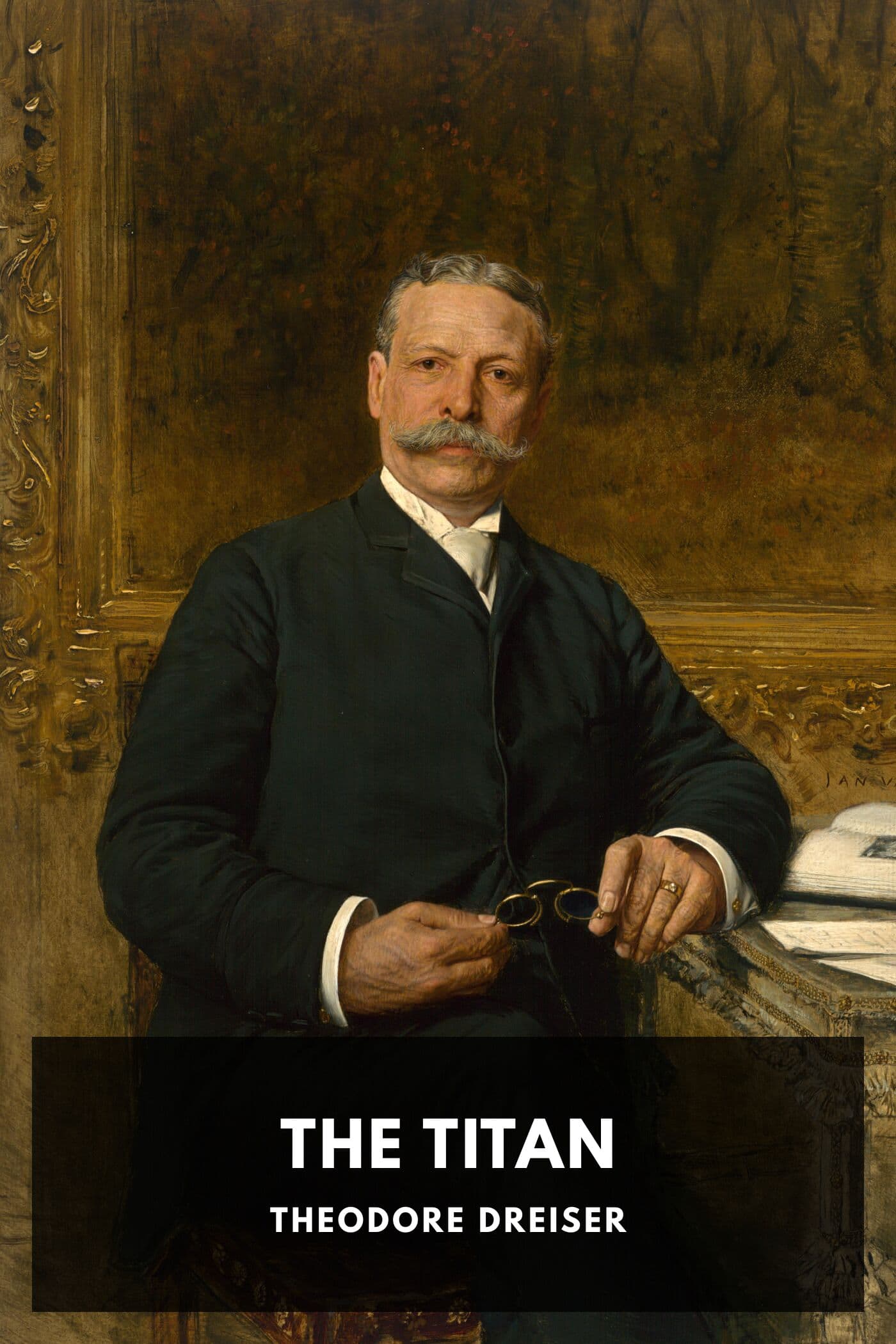
The Titan
1914

Frank Cowperwood emerges from prison with nothing but his hunger and his mind for finance. He arrives in Chicago in 1890, a city raw with opportunity, and sets his sights on the streetcar system, that most public and profitable of civic prizes. What follows is a masterwork of American naturalism: a man without conventional morality builds an empire through political deals, strategic bankruptcies, and the ruthless exploitation of everyone in his path. Dreiser grants his protagonist no redemption arc, no moment of conscience. Cowperwood simply persists, and in his persistence, he becomes terrifying. The novel pulses with the energy of a young America where money is the only god and the rules are written by those with the power to break them. Aileen, his wife, drifts into infidelity; allies become enemies; the public turns. Yet Cowperwood endures, because endurance is all he knows. The Titan is not a cautionary tale. It is a mirror held up to the American appetite itself.
Editions

X-Ray
“Raw, glittering force, however, compounded of the cruel Machiavellianism of nature, if it is to be but Machiavellian, seems to exercise a profound attraction for the conventionally rooted. Your cautious citizen of average means, looking out through the eye of his dull world of seeming fact, is often the first to forgive or condone the grim butcheries of theory by which the strong rise.””
— Theodore Dreiser
“It is thus that life at its topmost toss irks and pains. Beyond is ever the unattainable, the lure of the infinite with its infinite ache. - Oh, life! oh, youth! of, hope! oh, years! Oh pain-winged fancy, beating forth with fears.””
— Theodore Dreiser
Link to this book
Add a free, dofollow link to Lex on your blog, forum, syllabus, or reading list.

<a href="https://lex-books.com/book/the-titan-5412d99a-1f5f-4517-8fbe-2f29dd1e4c85"><img src="https://lex-books.com/badges/read-on-lex.svg" alt="Read The Titan by Theodore Dreiser free on Lex" width="160" height="40"></a>[](https://lex-books.com/book/the-titan-5412d99a-1f5f-4517-8fbe-2f29dd1e4c85)[url=https://lex-books.com/book/the-titan-5412d99a-1f5f-4517-8fbe-2f29dd1e4c85][img]https://lex-books.com/badges/read-on-lex.svg[/img][/url]Read The Titan by Theodore Dreiser free on Lex: https://lex-books.com/book/the-titan-5412d99a-1f5f-4517-8fbe-2f29dd1e4c85Cite this book
Reading this edition for a paper or guide? Copy a citation.
Dreiser, Theodore. The Titan. Lex, lex-books.com/book/the-titan-5412d99a-1f5f-4517-8fbe-2f29dd1e4c85.Dreiser, T. (1914). The Titan. Lex. https://lex-books.com/book/the-titan-5412d99a-1f5f-4517-8fbe-2f29dd1e4c85Dreiser, Theodore. The Titan. Lex. https://lex-books.com/book/the-titan-5412d99a-1f5f-4517-8fbe-2f29dd1e4c85.