Sister Carrie: A Novel
1900
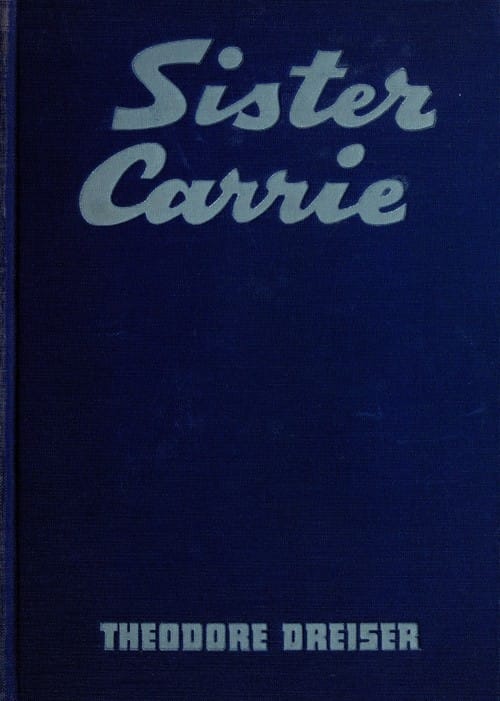
She arrives in Chicago with four dollars, a new dress, and hunger that has nothing to do with food. Carrie Meeber is eighteen, beautiful, and utterly unprepared for what the city will demand of her - and what she will come to demand from it. Theodore Dreiser's masterpiece follows her from the warehouses and boarding houses of the Midwest to the bright, brutal machinery of New York, where ambition becomes its own kind of vice. Sister Carrie was never a tale of ruin or redemption. It was something far more dangerous: a story about a woman who reaches, takes, and survives - without paying the price Victorian fiction insisted she owed. Dreiser writes with relentless precision about the seductions of wanting: the way a dress can feel like power, the way a stage light can feel like being seen. Published in 1900, the novel scandalized a nation that expected its fallen women to fall further. Today it stands as the definitive portrait of American hunger - the restless, restless need for more that still defines us.
Editions
X-Ray
“How true it is that words are but the vague shadows of the volumes we mean. Little audible links, they are, chaining together great inaudible feelings and purposes.””
— Theodore Dreiser
“People in general attach too much importance to words. They are under the illusion that talking effects great results. As a matter of fact, words are, as a rule, the shallowest portion of all the argument. They but dimly represent the great surging feelings and desires which lie behind. When the distraction of the tongue is removed, the heart listens.””
— Theodore Dreiser
“How true it is that words are but the vague shadows of the volumes we mean.””
— Theodore Dreiser
“Many individuals are so constituted that their only thought is to obtain pleasure and shun responsibility. They would like, butterfly-like, to wing forever in a summer garden, flitting from flower to flower, and sipping honey for their sole delight. They have no feeling that any result which might flow from their action should concern them. They have no conception of the necessity of a well-organized society wherein all shall accept a certain quota of responsibility and all realize a reasonable amount of happiness. They think only of themselves because they have not yet been taught to think of society. For them pain and necessity are the great taskmasters. Laws are but the fences which circumscribe the sphere of their operations. When, after error, pain falls as a lash, they do not comprehend that their suffering is due to misbehavior. Many such an individual is so lashed by necessity and law that he falls fainting to the ground, dies hungry in the gutter or rotting in the jail and it never once flashes across his mind that he has been lashed only in so far as he has persisted in attempting to trespass the boundaries which necessity sets. A prisoner of fate, held enchained for his own delight, he does not know that the walls are tall, that the sentinels of life are forever pacing, musket in hand. He cannot perceive that all joy is within and not without. He must be for scaling the bounds of society, for overpowering the sentinel. When we hear the cries of the individual strung up by the thumbs, when we hear the ominous shot which marks the end of another victim who has thought to break loose, we may be sure that in another instance life has been misunderstood--we may be sure that society has been struggled against until death alone would stop the individual from contention and evil.””
— Theodore Dreiser
“When a man, however passively, becomes an obstacle to the fulfillment of a woman's desires, he becomes an odious thing in her eyes, - or will, given time enough.””
— Theodore Dreiser
“When a girl leaves her home at eighteen, she does one of two things. Either she falls into saving hands and becomes better, or she rapidly assumes the cosmopolitan standard of virtue and becomes worse””
— Theodore Dreiser
“A real flame of love is a subtle thing. It burns as a will-o'-the-wisp, dancing onward to fairy lands of delight. It roars as a furnace. Too often jealousy is the quality upon which it feeds.””
— Theodore Dreiser
“A thought will color a world for us.””
— Theodore Dreiser
“Our civilisation is still in a middle stage, scarcely beast, in that it is no longer wholly guided by instinct; scarcely human, in that it is not yet wholly guided by reason. On the tiger no responsibility rests. We see him aligned by nature with the forces of life - he is born into their keeping and without thought he is protected. We see man far removed from the lairs of the jungles, his innate instincts dulled by too near an approach to free-will, his free-will not sufficiently developed to replace his instincts and afford him perfect guidance... In this intermediate stage he wavers - neither drawn in harmony with nature by his instincts nor yet wisely putting himself into harmony by his own free-will... We have the consolation of knowing that evolution is ever in action, that the ideal is a light that cannot fail. He will not forever balance thus between good and evil. When this jangle of free-will and instinct shall have been adjusted, when perfect understanding has given the former the power to replace the latter entirely, man will no longer vary. The needle of understanding will yet point steadfast and unwavering to the distant pole of truth.””
— Theodore Dreiser
Link to this book
Add a free, dofollow link to Lex on your blog, forum, syllabus, or reading list.

<a href="https://lex-books.com/book/sister-carrie-a-novel-b71c63f1-1d5c-4ede-a2e9-da9b7ae4b3aa"><img src="https://lex-books.com/badges/read-on-lex.svg" alt="Read Sister Carrie: A Novel by Theodore Dreiser free on Lex" width="160" height="40"></a>[](https://lex-books.com/book/sister-carrie-a-novel-b71c63f1-1d5c-4ede-a2e9-da9b7ae4b3aa)[url=https://lex-books.com/book/sister-carrie-a-novel-b71c63f1-1d5c-4ede-a2e9-da9b7ae4b3aa][img]https://lex-books.com/badges/read-on-lex.svg[/img][/url]Read Sister Carrie: A Novel by Theodore Dreiser free on Lex: https://lex-books.com/book/sister-carrie-a-novel-b71c63f1-1d5c-4ede-a2e9-da9b7ae4b3aaCite this book
Reading this edition for a paper or guide? Copy a citation.
Dreiser, Theodore. Sister Carrie: A Novel. Lex, lex-books.com/book/sister-carrie-a-novel-b71c63f1-1d5c-4ede-a2e9-da9b7ae4b3aa.Dreiser, T. (1900). Sister Carrie: A Novel. Lex. https://lex-books.com/book/sister-carrie-a-novel-b71c63f1-1d5c-4ede-a2e9-da9b7ae4b3aaDreiser, Theodore. Sister Carrie: A Novel. Lex. https://lex-books.com/book/sister-carrie-a-novel-b71c63f1-1d5c-4ede-a2e9-da9b7ae4b3aa.