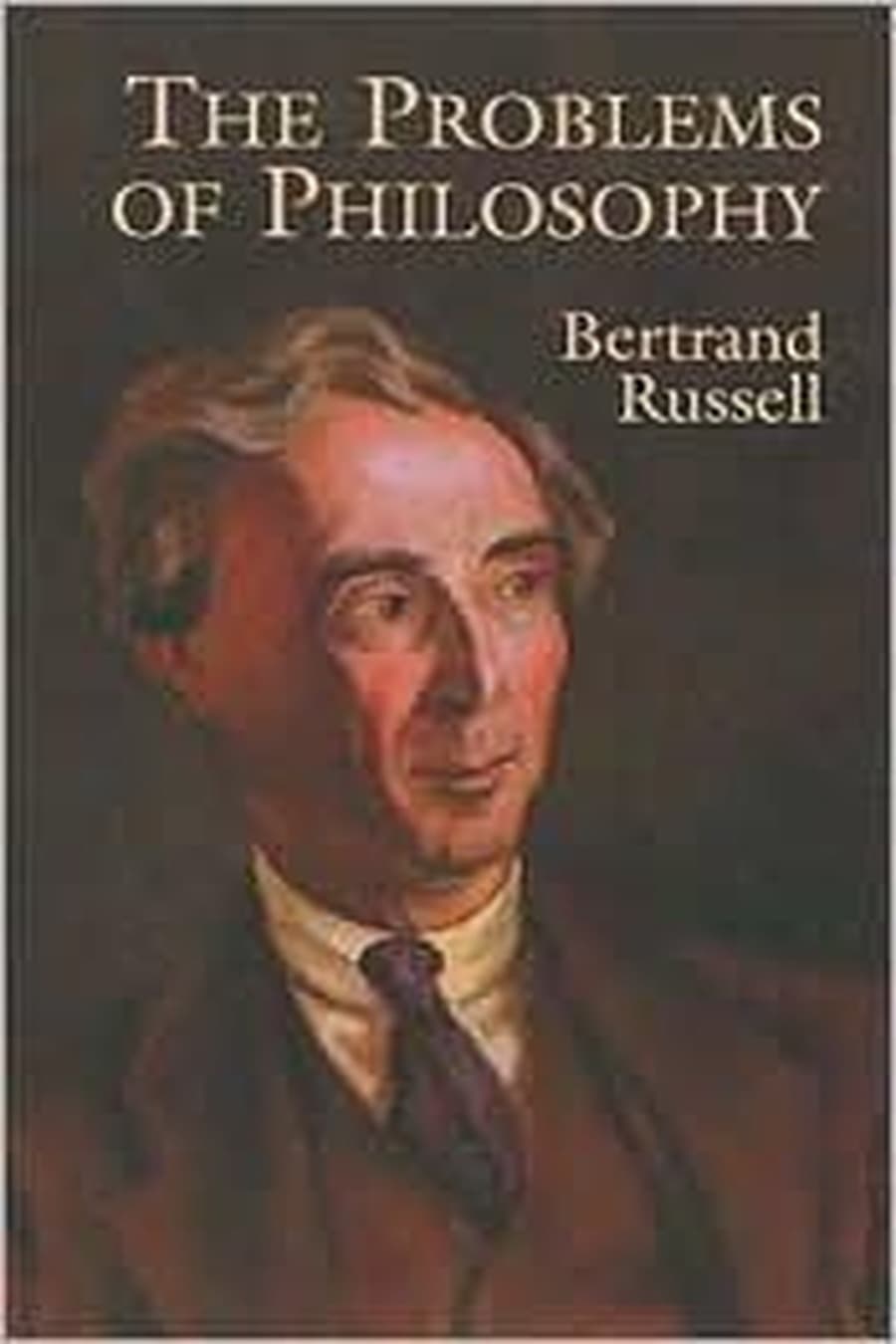
The Problems of Philosophy
1912
Bertrand Russell invites you to doubt everything. In this slender, electrifying book, he poses questions that seem simple until you try to answer them: How do you know the table in front of you actually exists? Can you prove the external world is real, or is everything just sense-data bouncing around your mind? Is cause and effect fact or habit? Russell doesn't pretend to have final answers. Instead, he maps the territory where philosophy has failed for centuries, then asks: if we can't prove these things, what can we know at all? His famous distinction between knowing things directly (acquaintance) and knowing them only by description becomes a tool for rethinking everything you take for granted. Written for a general audience in 1912, it remains the clearest gateway into how philosophers think. Not because it teaches you names and dates, but because it makes you feel the vertigo of uncertainty and teaches you to think precisely in that void. If you've ever wondered whether your perceptions lie to you, this book has been waiting.
Editions

X-Ray
“Some care is needed in using Descartes' argument. "I think, therefore I am" says rather more than is strictly certain. It might seem as though we are quite sure of being the same person to-day as we were yesterday, and this is no doubt true in some sense. But the real Self is as hard to arrive at as the real table, and does not seem to have that absolute, convincing certainty that belongs to particular experiences.””
— Bertrand Russell
“Is there any knowledge in the world which is so certain that no reasonable man could doubt it?””
— Bertrand Russell
“Philosophy, though unable to tell us with certainty what is the true answer to the doubts which it raises, is able to suggest many possiblities which enlarge our thoughts and free them from the tyranny of custom. Thus, while diminishing our feeling of certainty as to what things are, it greatly increases our knowledge as to what the may be; it removes the somewhat arrogant dogmatism of those who have never travelled into the region of liberating doubt, and it keeps alive our sense of wonder by showing familar things in an unfamilar aspect””
— Bertrand Russell
“Whoever wishes to become a philosopher must learn not to be frightened by absurdities.””
— Bertrand Russell
“The man who has no tincture of philosophy goes through life imprisoned in the prejudices derived from common sense, from the habitual beliefs of his age or his nation, and from convictions which have grown up in his mind without the cooperation or consent of his deliberate reason.””
— Bertrand Russell
“Philosophy, if it cannot so many questions as we could wish, has at least the power of questions which increase the interest of the world, and show the strangeness and wonder lying just below the surface even in the commonest things of daily life.””
— Bertrand Russell
“The man who has fed the chicken every day throughout its life at last wrings its neck instead, showing that more refined views as to the uniformity of nature would have been useful to the chicken.””
— Bertrand Russell
“The value of philosophy is, in fact, to be sought largely in its very uncertainty. The man who has no tincture of philosophy goes through life imprisoned in the prejudices derived from common sense, from the habitual beliefs of his age or his nation, and from convictions which have grown up in his mind without the co-operation or consent of his deliberate reason. To such a man the world tends to become definite, finite, obvious; common objects rouse no questions, and unfamiliar possibilities are contemptuously rejected. As soon as we begin to philosophize, on the contrary, we find, as we saw in our opening chapters, that even the most everyday things lead to problems to which only very incomplete answers can be given….””
— Bertrand Russell
“Has the universe any unity of plan or purpose, or is it a fortuitous concourse of atoms? Is conciousness a permanent part of the universe, giving hope of indefinite growth in wisdom, or is it a transitory accident on a small planet on which life must ultimately become impossible? Are good and evil of importance to the universe or only to man?””
— Bertrand Russell
Link to this book
Add a free, dofollow link to Lex on your blog, forum, syllabus, or reading list.

<a href="https://lex-books.com/book/the-problems-of-philosophy-9a876ad3-aae6-487c-961b-b726b0e48e8f"><img src="https://lex-books.com/badges/read-on-lex.svg" alt="Read The Problems of Philosophy by Bertrand Russell free on Lex" width="160" height="40"></a>[](https://lex-books.com/book/the-problems-of-philosophy-9a876ad3-aae6-487c-961b-b726b0e48e8f)[url=https://lex-books.com/book/the-problems-of-philosophy-9a876ad3-aae6-487c-961b-b726b0e48e8f][img]https://lex-books.com/badges/read-on-lex.svg[/img][/url]Read The Problems of Philosophy by Bertrand Russell free on Lex: https://lex-books.com/book/the-problems-of-philosophy-9a876ad3-aae6-487c-961b-b726b0e48e8fCite this book
Reading this edition for a paper or guide? Copy a citation.
Russell, Bertrand. The Problems of Philosophy. Lex, lex-books.com/book/the-problems-of-philosophy-9a876ad3-aae6-487c-961b-b726b0e48e8f.Russell, B. (1912). The Problems of Philosophy. Lex. https://lex-books.com/book/the-problems-of-philosophy-9a876ad3-aae6-487c-961b-b726b0e48e8fRussell, Bertrand. The Problems of Philosophy. Lex. https://lex-books.com/book/the-problems-of-philosophy-9a876ad3-aae6-487c-961b-b726b0e48e8f.