The Ladies' Paradise
1883
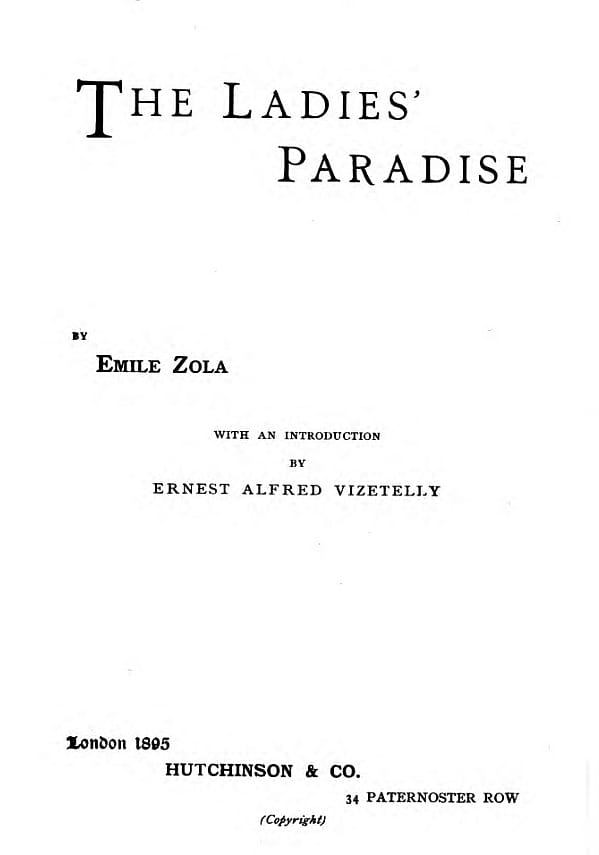
Zola wrote this in 1883 about the birth of consumer culture, and it feels terrifyingly prescient today. The Ladies' Paradise is a department store that consumes everything in its path, small shops, traditional values, the people who work within its gleaming halls. At its heart stands Denise, a young woman from the provinces who arrives in Paris with nothing but two young brothers to care for. She's caught between her uncle Baudu's failing traditional shop and the glittering, ruthless empire that threatens to destroy it. The novel pulses with the energy of modernity: credit systems, window displays, seasonal fashions, the orchestrated seduction of consumption. As Denise rises, from homeless and desperate to a powerful position within the store, Zola asks what women gain and lose when they enter the economic arena. The cost of success remains deliberately ambiguous. It's a portrait of a city being remade, a story about women navigating new forms of independence, and a clear-eyed examination of capitalism's endless appetite. Zola's prose is vivid, urgent, sometimes brutal, and it makes you see shopping differently forever.
Editions
X-Ray
“I would rather die of passion than of boredom.””
— Emile Zola
“Crever pour crever, je préfère crever de passion que de crever d'ennui !””
— Emile Zola
“Very well, sir. A woman's opinion, however humble she may be, is always worth listening to, if she's got any sense...If you put yourself in my hands, I shall certainly make a decent man of you.””
— Emile Zola
“His creation was a sort of new religion; the churches, gradually deserted by a wavering faith, were replaced by this bazaar, in the minds of the idle women of Paris. Women now came and spent their leisure time in his establishment, the shivering and anxious hours they formerly passed in churches: a necessary consumption of nervous passion, a growing struggle of the god of dress against the husband, the incessantly renewed religion of the body with the divine future of beauty.””
— Emile Zola
“Never subject to the rules, believing that the correct judgement and healthy nature keep her in the honesty she lived in.””
— Emile Zola
“Mais il avait oublié l’inventaire, il ne voyait pas son empire, ces magasins crevant de richesses. Tout avait disparu, les victoires bruyantes d’hier, la fortune colossale de demain. D’un regard désespéré, il suivait Denise, et quand elle eut passé la porte, il n’y eut plus rien, la maison devint noire.””
— Emile Zola
“La certitude d'avoir empêche de désirer.””
— Emile Zola
“Denise était venue à pied de la gare Saint-Lazare, où un train de Cherbourg l’avait débarquée avec ses deux frères, après une nuit passée sur la dure banquette d’un wagon de troisième classe. Elle tenait par la main Pépé, et Jean la suivait, tous les trois brisés du voyage, effarés et perdus, au milieu du vaste Paris, le nez levé sur les maisons, demandant à chaque carrefour la rue de la Michodière, dans laquelle leur oncle Baudu demeurait. Mais, comme elle débouchait enfin sur la place Gaillon, la jeune fille s’arrêta net de surprise.””
— Emile Zola
“¿Pero es que no ve lo que estoy sufriendo?... Que estupidez, ¿verdad? ¡Sufro como un niño!””
— Emile Zola
Link to this book
Add a free, dofollow link to Lex on your blog, forum, syllabus, or reading list.

<a href="https://lex-books.com/book/the-ladies-paradise-c21c7a9f-5892-4616-b4da-d515e4d1ad77"><img src="https://lex-books.com/badges/read-on-lex.svg" alt="Read The Ladies' Paradise by Emile Zola free on Lex" width="160" height="40"></a>[](https://lex-books.com/book/the-ladies-paradise-c21c7a9f-5892-4616-b4da-d515e4d1ad77)[url=https://lex-books.com/book/the-ladies-paradise-c21c7a9f-5892-4616-b4da-d515e4d1ad77][img]https://lex-books.com/badges/read-on-lex.svg[/img][/url]Read The Ladies' Paradise by Emile Zola free on Lex: https://lex-books.com/book/the-ladies-paradise-c21c7a9f-5892-4616-b4da-d515e4d1ad77Cite this book
Reading this edition for a paper or guide? Copy a citation.
Zola, Emile. The Ladies' Paradise. Lex, lex-books.com/book/the-ladies-paradise-c21c7a9f-5892-4616-b4da-d515e4d1ad77.Zola, E. (1883). The Ladies' Paradise. Lex. https://lex-books.com/book/the-ladies-paradise-c21c7a9f-5892-4616-b4da-d515e4d1ad77Zola, Emile. The Ladies' Paradise. Lex. https://lex-books.com/book/the-ladies-paradise-c21c7a9f-5892-4616-b4da-d515e4d1ad77.