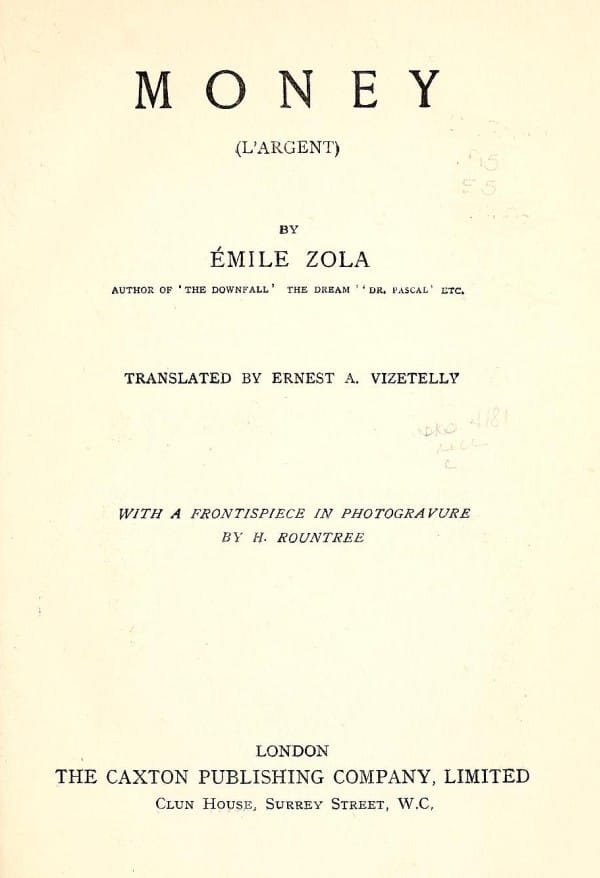
Money (l'argent)
1891
Paris, 1860s. The Bourse trembles at the name of Saccard. Aristide Rougon has returned from ruin, more hungry than before, and he intends to drag himself back to the top of the financial heap by any means necessary. His scheme: a grand new bank funded by wild speculation, venture capital in the Holy Land, and the unshakeable belief that money is the only god worth worshipping. Zola maps the anatomy of a man who sees people as capital and morality as an obstacle. The novel crackles with the electricity of the trading floor, where fortunes are made and destroyed before lunch, where journalists can be bought, where wives are assets and mistresses are investments. This is Zola at his most cinematic, following one man's relentless ascent through the corrupt machinery of Second Empire finance. The result reads less like a Victorian novel and more like a heist film in period costume. It is also terrifyingly prescient: the crash that ends Saccard's empire anticipates every bubble from the Great Depression to the 2008 financial crisis. Money is a propulsive, ruthless study of what happens when ambition has no guardrails and desire is measured in francs.
Editions
X-Ray
“Since the same human mire remains beneath, does not all civilisation reduce itself to the superiority of smelling nice and living well?””
— Emile Zola
“Why then should money be blamed for all the dirt and crimes it causes? For is love less filthy - love which creates life?””
— Emile Zola
“At the street corner, a one-storey house built of freestone, but repulsively decrepit and filthy, seemed to command the entrance, like a gaol. And here, indeed, lived La Méchain, like a vigilant proprietess, ever on the watch, exploiting in person her little population of starving tenants.””
— Emile Zola
“Speculation, speculation!' she [Caroline Hamelin] mechanically repeated, struggling with her doubts. 'Ah! the idea of it fills my heart with disturbing anguish.””
— Emile Zola
“In love as as in speculation there is much filth; in love also, people think only of their own gratification; yet without love there would be no life, and the world would come to an end.””
— Emile Zola
“he’d sell us both, you, me, anyone at all, if we were part of some deal. And he would do all that quite unthinkingly, as a man of quality, for he really is the poet of the million, money simply makes him mad, makes him a scoundrel”
— Emile Zola
Link to this book
Add a free, dofollow link to Lex on your blog, forum, syllabus, or reading list.

<a href="https://lex-books.com/book/money-l-argent-396cd3e5-61d2-432d-af9d-7ed7ea5a2e72"><img src="https://lex-books.com/badges/read-on-lex.svg" alt="Read Money (l'argent) by Emile Zola free on Lex" width="160" height="40"></a>[](https://lex-books.com/book/money-l-argent-396cd3e5-61d2-432d-af9d-7ed7ea5a2e72)[url=https://lex-books.com/book/money-l-argent-396cd3e5-61d2-432d-af9d-7ed7ea5a2e72][img]https://lex-books.com/badges/read-on-lex.svg[/img][/url]Read Money (l'argent) by Emile Zola free on Lex: https://lex-books.com/book/money-l-argent-396cd3e5-61d2-432d-af9d-7ed7ea5a2e72Cite this book
Reading this edition for a paper or guide? Copy a citation.
Zola, Emile. Money (l'argent). Lex, lex-books.com/book/money-l-argent-396cd3e5-61d2-432d-af9d-7ed7ea5a2e72.Zola, E. (1891). Money (l'argent). Lex. https://lex-books.com/book/money-l-argent-396cd3e5-61d2-432d-af9d-7ed7ea5a2e72Zola, Emile. Money (l'argent). Lex. https://lex-books.com/book/money-l-argent-396cd3e5-61d2-432d-af9d-7ed7ea5a2e72.