Piping Hot! (pot-Bouille): A Realistic Novel
1882
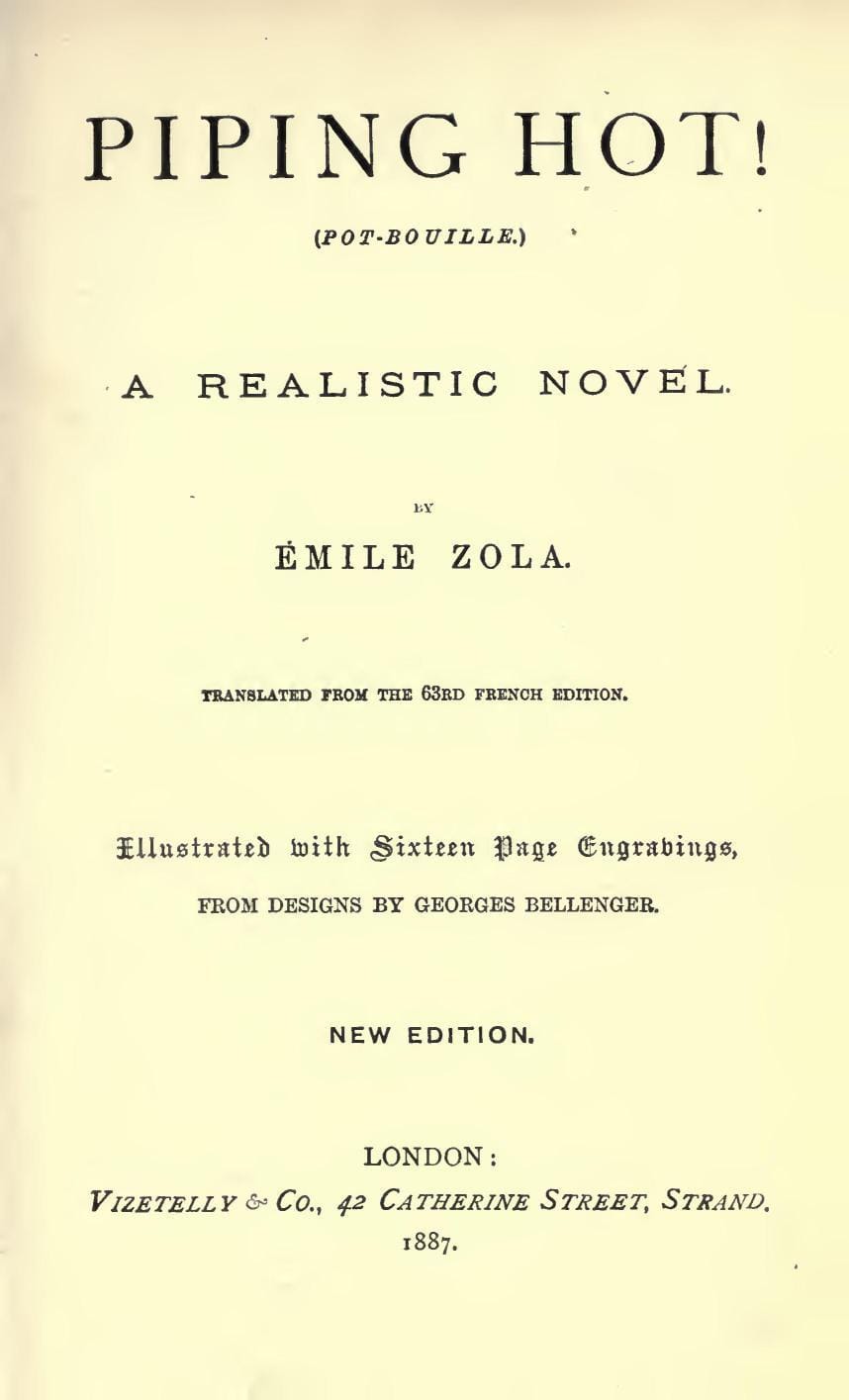
A young man arrives in Paris with ambitions and a fresh face. He rents a room in a respectable bourgeois building on the Rue de la Chaîne, expecting a launchpad for success. What he finds instead is a closed ecosystem of scheming wives, desperate daughters, lecherous husbands, and neighbors who perform virtue while orchestrating affairs and financial maneuvers behind closed doors. Émile Zola's seventh Rougon-Macquart novel dissects the Second Empire's middle class with surgical precision, revealing the animalistic urges lurking beneath corsets and polite conversation. Octave Mouret navigates this minefield with charm and calculated self-interest, learning the rules of a game where marriage is transaction, reputation is performance, and everyone pretends their desires are dignified. The building becomes a crucible where social climbing, sexual politics, and hypocrisy combust into something darker than mere comedy. Zola doesn't mock from above; he observes like a naturalist documenting a species in its natural habitat. The result is a portrait of bourgeois life that feels almost uncomfortably intimate, as if you've been given a key to apartments you were never meant to enter.
Editions
X-Ray
“She was cold by nature, self-love predominating over passion; rather than being virtuous, she preferred to have her pleasures all to herself.””
— Emile Zola
“Her anger was rekindled.'You see, I keep it to myself, but, oh! it's more than I can stand. Don't say anything, sir; don't say anything , or I'll explode!'He said nothing, and she exploded all the same.””
— Emile Zola
“He wept for truth which was dead, for heaven which was void. Beyond the marble walls and gleaming jewelled altars, the huge plaster Christ had no longer a single drop of blood in its veins.””
— Emile Zola
“When younger, he had been fun-loving to the point of tedium.””
— Emile Zola
“Monsieur Josserand died very quietly - a victim of his own honesty. He had lived a useless life, and he went off, worthy to the last, weary of all the petty things in life, done to death by the heartless conduct of the only human beings that he had ever loved.””
— Emile Zola
“Hortense and Berthe nodded, as though profoundly impressed by the wisdom of their mother's pronouncements. She had long since convinced them of the absolute inferiority of men, whose sole function was to marry and to pay.””
— Emile Zola
“És Mauduit abbé tekintetét a Kálváriára emelve, zokogásban tört ki. Sírt, mint Mária és Magdolna, sírt, mert az igazság halott, az ég üres. A márványlapok és ötvösremekek mögött magasló keresztre feszített gipsz-Krisztus testében nincs már egy cseppnyi vér sem.””
— Emile Zola
“Először egymás képébe köpnek, azután mosakszanak vele, hogy megmutassák, milyen tiszták!””
— Emile Zola
“Josserand egyébként nagyon szerényen halt meg. Megölte a becsületessége. Élete hiábavalóan telt el, úgy távozott, mint derék ember, aki belefáradt az élet csúfságaiba, megfojtotta azoknak a teremtéseknek kíméletlen önzése, akiket valaha is szeretett. Nyolc órakor Saturnin nevét suttogta, a fal felé fordult, és mindörökre elaludt.””
— Emile Zola
Link to this book
Add a free, dofollow link to Lex on your blog, forum, syllabus, or reading list.

<a href="https://lex-books.com/book/piping-hot-pot-bouille-a-realistic-novel-5d30aaf4-a998-4c7f-82ab-69741498d767"><img src="https://lex-books.com/badges/read-on-lex.svg" alt="Read Piping Hot! (pot-Bouille): A Realistic Novel by Emile Zola free on Lex" width="160" height="40"></a>[](https://lex-books.com/book/piping-hot-pot-bouille-a-realistic-novel-5d30aaf4-a998-4c7f-82ab-69741498d767)[url=https://lex-books.com/book/piping-hot-pot-bouille-a-realistic-novel-5d30aaf4-a998-4c7f-82ab-69741498d767][img]https://lex-books.com/badges/read-on-lex.svg[/img][/url]Read Piping Hot! (pot-Bouille): A Realistic Novel by Emile Zola free on Lex: https://lex-books.com/book/piping-hot-pot-bouille-a-realistic-novel-5d30aaf4-a998-4c7f-82ab-69741498d767Cite this book
Reading this edition for a paper or guide? Copy a citation.
Zola, Emile. Piping Hot! (pot-Bouille): A Realistic Novel. Lex, lex-books.com/book/piping-hot-pot-bouille-a-realistic-novel-5d30aaf4-a998-4c7f-82ab-69741498d767.Zola, E. (1882). Piping Hot! (pot-Bouille): A Realistic Novel. Lex. https://lex-books.com/book/piping-hot-pot-bouille-a-realistic-novel-5d30aaf4-a998-4c7f-82ab-69741498d767Zola, Emile. Piping Hot! (pot-Bouille): A Realistic Novel. Lex. https://lex-books.com/book/piping-hot-pot-bouille-a-realistic-novel-5d30aaf4-a998-4c7f-82ab-69741498d767.