The Jacket (the Star-Rover)
1915
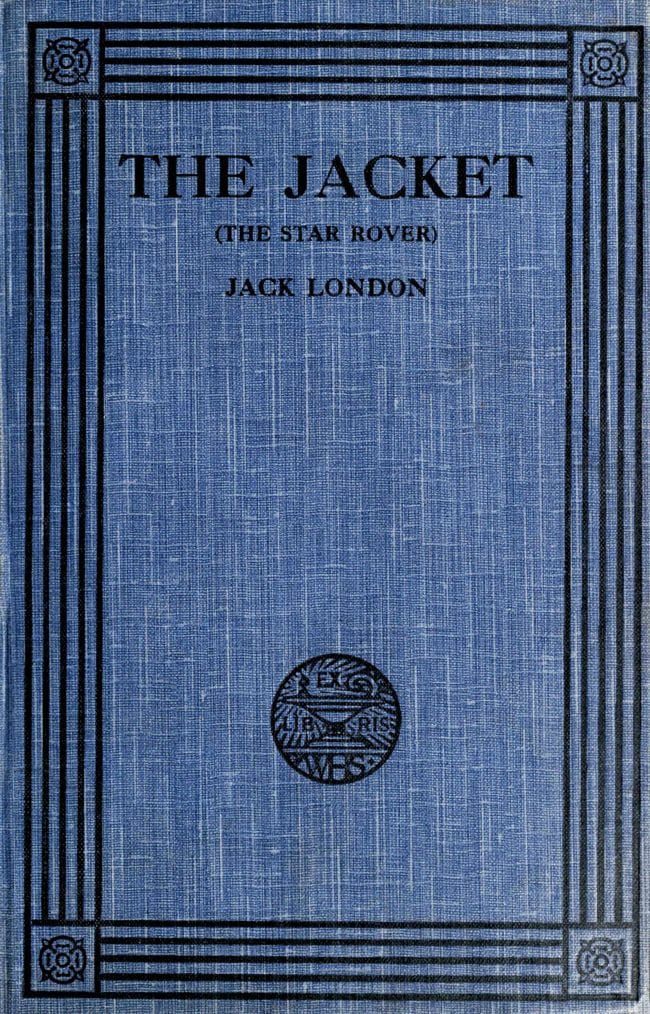
Darrell Standing, a professor convicted of murdering his colleague, sits on death row in San Quentin, awaiting execution. But in the suffocating darkness of solitary confinement, strapped into a torture jacket that leaves him paralyzed, Standing discovers an impossible escape: he can remember past lives. These aren't fantasies but vivid recollections of existence as a French nobleman, an Englishman wandering medieval Korea, a Viking raider, a caveman bracing against prehistoric cold. Each life bleeds into the next, and Standing begins to understand that identity is not a single self but a relay race of souls. Jack London, drawing from his friend Ed Morrell's real imprisonment, builds a visceral nightmare of early California prisons: the starvation, the brutality, the systematic destruction of hope. Yet the novel transcends its grim setting to ask something staggering: if consciousness survives across centuries, what truly dies? This is London at his most experimental and philosophical, a book that refuses easy answers about time, memory, and the nature of being.
Editions
X-Ray
“To be able to forget means sanity.””
— Jack London
“Intelligent men are cruel. Stupid men are monstrously cruel. ””
— Jack London
“As one grows weaker one is less susceptible to suffering. There is less hurt because there is less to hurt.””
— Jack London
“No; I did not hate him. The word is too weak. There is no word in the language strong enough to describe my feelings. I can say only that I knew the gnawing of a desire for vengeance on him that was a pain in itself and that exceeded all the bounds of language. ””
— Jack London
“Always has woman crouched close to earth like a partridge hen mothering her young; always has my wantonness of roving led me out on the shining ways; and always have my star paths returned me to her, the figure everlasting, the woman, the one woman, for whose arms I had such need that clasped in them I have forgotten the stars.For her I accomplished Odysseys scaled mountains crossed deserts; for her I led the hunt and was forward in battle; and for her end' to her I sang my songs of the things I had done. All ecstasies of life and rhapsodies of delight have been mine because of her. And here, at the end, I can say that I have known no sweeter, deeper madness of being than to drown in the fragrant glory and forgetfulness of her hair.””
— Jack London
“There is such a thing as anesthesia of pain, engendered by pain too exquisite to be borne. ””
— Jack London
“I did not begin when I was born, nor when I was conceived. I have been growing, developing, through incalculable myriads of millenniums. All my previous selves have their voices, echoes, promptings in me. Oh, incalculable times again shall I be born.””
— Jack London
“I could never live out completely one full experience, one point of consciousness in time and space. My dreams, if dreams they may be called, were rhymeless and reasonless.””
— Jack London
“I trod interstellar space, exalted by the knowledge that I was bound on vast adventure, where, at the end, I would find all the cosmic formulae and have made clear to me the ultimate secret of the universe. In my hand I carried a long glass wand. It was borne in upon me that with the tip of this wand I must touch each star in passing. And I knew, in all absoluteness, that did I but miss one star I should be precipitated into some unplummeted abyss of unthinkable and eternal punishment and guilt””
— Jack London
Link to this book
Add a free, dofollow link to Lex on your blog, forum, syllabus, or reading list.

<a href="https://lex-books.com/book/the-jacket-the-star-rover-cd5dce05-ec24-4f5e-9eb7-bfe58978e07f"><img src="https://lex-books.com/badges/read-on-lex.svg" alt="Read The Jacket (the Star-Rover) by Jack London free on Lex" width="160" height="40"></a>[](https://lex-books.com/book/the-jacket-the-star-rover-cd5dce05-ec24-4f5e-9eb7-bfe58978e07f)[url=https://lex-books.com/book/the-jacket-the-star-rover-cd5dce05-ec24-4f5e-9eb7-bfe58978e07f][img]https://lex-books.com/badges/read-on-lex.svg[/img][/url]Read The Jacket (the Star-Rover) by Jack London free on Lex: https://lex-books.com/book/the-jacket-the-star-rover-cd5dce05-ec24-4f5e-9eb7-bfe58978e07fCite this book
Reading this edition for a paper or guide? Copy a citation.
London, Jack. The Jacket (the Star-Rover). Lex, lex-books.com/book/the-jacket-the-star-rover-cd5dce05-ec24-4f5e-9eb7-bfe58978e07f.London, J. (1915). The Jacket (the Star-Rover). Lex. https://lex-books.com/book/the-jacket-the-star-rover-cd5dce05-ec24-4f5e-9eb7-bfe58978e07fLondon, Jack. The Jacket (the Star-Rover). Lex. https://lex-books.com/book/the-jacket-the-star-rover-cd5dce05-ec24-4f5e-9eb7-bfe58978e07f.