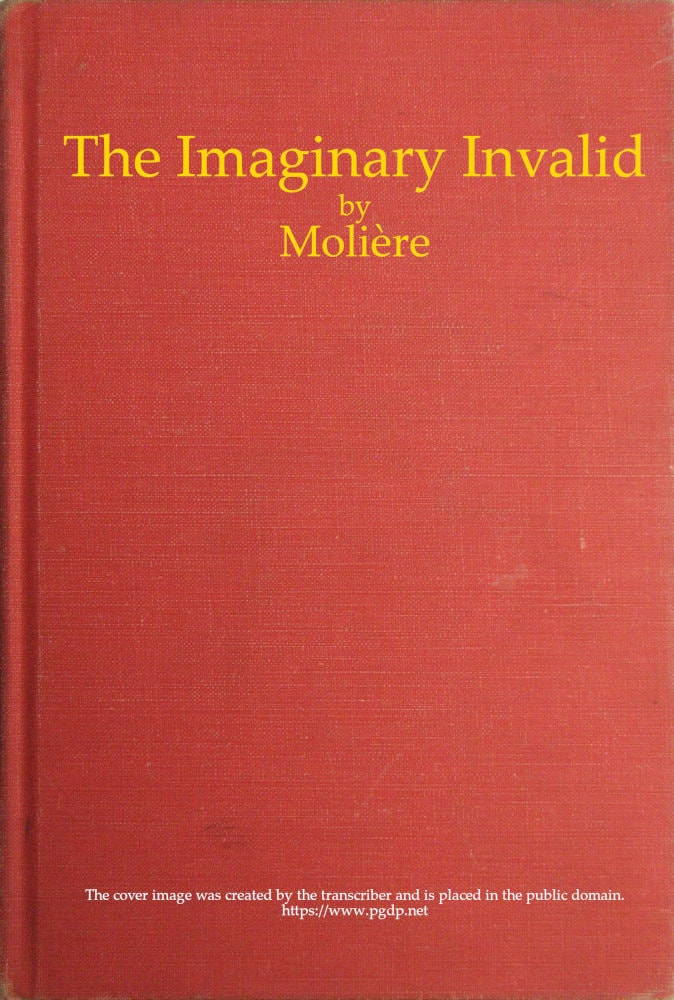
The Imaginary Invalid
1673
The Imaginary Invalid
1673
Translated by Charles Heron Wall
Molière died performing his own final play. He collapsed onstage during the fourth presentation of this comedy and never recovered, making "The Imaginary Invalid" an extraordinary testament to his belief that the show must go on. The play centers on Argan, a spectacularly wealthy hypochondriac so convinced he's dying that he keeps detailed records of his doctors' fees and has decided to marry his daughter Angelica to a young physician purely for the free medical consultations. Angelica, however, is already in love with Cléante. What follows is a gleefully intricate scheme engineered by Toinette, Argan's sharp-tongued maid, to expose the lies surrounding her master and free Angelica to follow her heart. The comedy ruthlessly satirizes 17th-century medicine, the credulous patients who fund charlatans, and the way families exploit each other's obsessions. But beneath the farcical surface lies something darker: a man so terrified of death that he's forgotten how to live. The play retains its power because hypochondria hasn't vanished; we've simply found new ways to quantify our anxieties. This is Molière at his most vicious and his most humane.
Editions
X-Ray
“Presque tous les hommes meurent de leurs remèdes, et non pas de leurs maladies.””
— Molière
“Mais la grande marque d'amour, c'est d'être soumis aux volontés de celle qu'on aime.””
— Molière
“La nature, d'elle-même, quand nous la laissons faire, se tire doucement du désordre où elle est tombée.””
— Molière
“« Par ma foi ! il y a plus de quarante ans que je dis de la prose sans que j'en susse rien, et je vous suis le plus obligé du monde de m'avoir appris cela. »””
— Molière
“si vous m'aimez, monsieur, vous devez vouloir tout ce que je veux.””
— Molière
“Il faut qu'il ait tué bien des gens pour s'être fait si riche.””
— Molière
“Un homme incommode à tout le monde, malpropre, dégoûtant, sans cesse un lavement ou une médecine dans le ventre, mouchant, toussant, crachant toujours ; sans esprit, ennuyeux, de mauvaise humeur, fatiguant sans cesse les gens, et grondant jour et nuit servantes et valets.””
— Molière
“Songez que les principes de votre vie sont en vous-même, et que le courroux de Monsieur Purgon est aussi peu capable de vous faire mourir que ses remèdes de vous faire vivre.””
— Molière
“La musique est accoutumée à ne point faire ce qu'on veut.””
— Molière
Link to this book
Add a free, dofollow link to Lex on your blog, forum, syllabus, or reading list.

<a href="https://lex-books.com/book/the-imaginary-invalid-15d66383-2b05-4a7d-95c0-1dc94990fac0"><img src="https://lex-books.com/badges/read-on-lex.svg" alt="Read The Imaginary Invalid by Molière free on Lex" width="160" height="40"></a>[](https://lex-books.com/book/the-imaginary-invalid-15d66383-2b05-4a7d-95c0-1dc94990fac0)[url=https://lex-books.com/book/the-imaginary-invalid-15d66383-2b05-4a7d-95c0-1dc94990fac0][img]https://lex-books.com/badges/read-on-lex.svg[/img][/url]Read The Imaginary Invalid by Molière free on Lex: https://lex-books.com/book/the-imaginary-invalid-15d66383-2b05-4a7d-95c0-1dc94990fac0Cite this book
Reading this edition for a paper or guide? Copy a citation.
Molière. The Imaginary Invalid. Lex, lex-books.com/book/the-imaginary-invalid-15d66383-2b05-4a7d-95c0-1dc94990fac0.Molière (1673). The Imaginary Invalid. Lex. https://lex-books.com/book/the-imaginary-invalid-15d66383-2b05-4a7d-95c0-1dc94990fac0Molière. The Imaginary Invalid. Lex. https://lex-books.com/book/the-imaginary-invalid-15d66383-2b05-4a7d-95c0-1dc94990fac0.