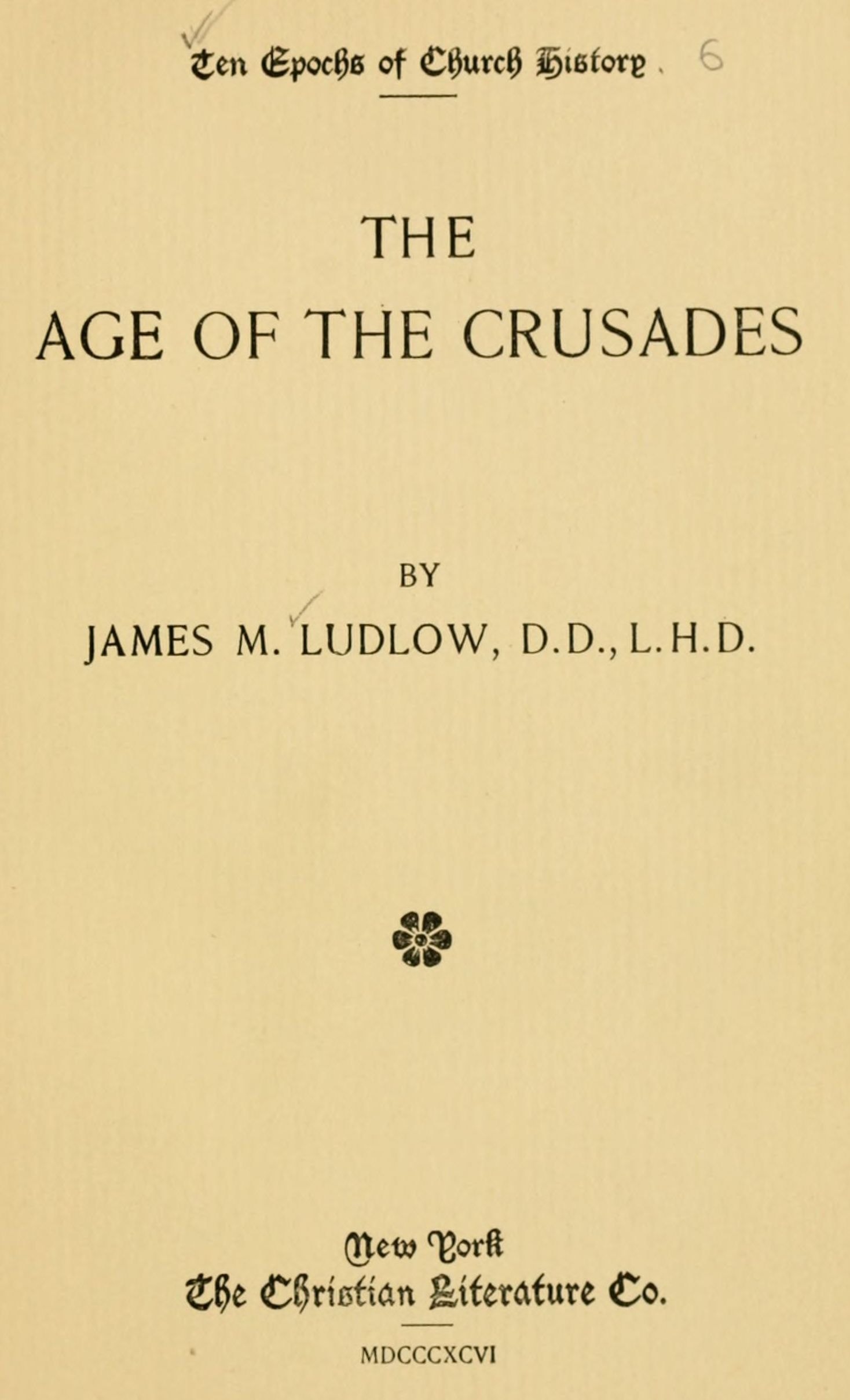
The Age of the Crusades
1897
The Age of the Crusades
1897
The Crusades remain one of history's most staggering spectacles of mass mobilization, and Ludlow treats them not as simple piety but as a collision of faith, violence, and imperial ambition. Written in 1897, this work situates the Crusades within the raw social fabric of medieval Europe, examining how the church's expanding power, the feudal system's violent contradictions, and the prevailing ignorance of the 11th century created the conditions for mass mobilization. Ludlow shows how papal authority, knightly greed, and peasant desperation intertwined into a force that sent armies marching toward a land most could barely locate on a map. The book excavates the psychological landscape of the age, demonstrating that the Crusades were not merely military campaigns but expressions of a civilization working through its deepest impulses. For readers seeking to understand how medieval Christians justified holy war, and why so many answered the call, Ludlow offers a rigorous and occasionally revisionist account that resists both celebration and simple condemnation.
Editions
X-Ray
An astute and ambitious Pope who laid the groundwork for the Crusades by seeking to consolidate papal power and universalize the ecclesiastical empire.
A charismatic French priest whose fiery eloquence roused popular enthusiasm for the First Crusade, though his direct impact on its initiation is debated.
The Pope who officially launched the First Crusade at the Council of Clermont, capitalizing on existing religious fervor and political opportunities.
A prominent and chivalrous leader of the First Crusade, known for his bravery and piety, who became the first Baron of the Holy Sepulchre.
About The Age of the Crusades
Chapter Summaries
- 1
- This chapter introduces the Crusades as a fascinating and complex period of history, highlighting their romantic appeal and the difficulty of defining their true causes. It outlines seven key conditions in the 11th century that facilitated these movements, including the state of society, chivalry, feudalism, Europe's impoverished condition, papal policy, the Mohammedan menace, and prevailing superstition.
- 2
- The chapter describes 11th-century Europe as the 'Dark Ages,' marked by widespread ignorance, limited industries, and a narrow, brutal quality of life. Despite sporadic culture and great men like Gerbert and Anselm, society was characterized by superstition, a low sense of justice (private combat, ordeals), and pervasive cruelty and love for war, even among Greeks.
- 3
- Chivalry is presented as a budding noble sentiment amidst the age's grossness, with rules emphasizing faith, service, and defense of the weak, alongside warrior pride. The education and elaborate ceremonies of knighthood are detailed, though the institution's chief defect was its focus on personal renown rather than altruism, ultimately preparing the way for the Crusades.
Key Themes
- Religious Zeal and Fanaticism
- The book extensively details how religious fervor, often mixed with superstition, drove millions to undertake the perilous Crusades, promising remission of sins and eternal rewards. This zeal, however, frequently led to extreme cruelty and intolerance against both non-Christians and fellow Christians, highlighting the dark side of religious extremism.
- Political Ambition and Power Struggles
- Beyond religious motives, the Crusades were deeply influenced by the political aspirations of popes, emperors, kings, and feudal lords. These leaders sought to expand their temporal power, consolidate their domains, and gain prestige, often at the expense of allies or rivals, demonstrating that secular power was a constant undercurrent to the holy war.
- Brutality and Cruelty
- The narrative repeatedly highlights the extreme violence, massacres, pillage, and torture perpetrated by both Christian and Moslem forces. This pervasive brutality reveals the harshness of medieval warfare and the moral degradation that often accompanied religious conflict, with atrocities frequently celebrated by contemporary chroniclers.
Characters
- Hildebrand (Pope Gregory VII)(supporting)
- An astute and ambitious Pope who laid the groundwork for the Crusades by seeking to consolidate papal power and universalize the ecclesiastical empire.
- Peter the Hermit(protagonist)
- A charismatic French priest whose fiery eloquence roused popular enthusiasm for the First Crusade, though his direct impact on its initiation is debated.
- Pope Urban II(protagonist)
- The Pope who officially launched the First Crusade at the Council of Clermont, capitalizing on existing religious fervor and political opportunities.
- Godfrey of Bouillon(protagonist)
- A prominent and chivalrous leader of the First Crusade, known for his bravery and piety, who became the first Baron of the Holy Sepulchre.
- Raymond of Toulouse(supporting)
- An opulent and haughty chieftain of the First Crusade, experienced in war, who led a large army from Languedoc.
- Bohemond of Taranto(supporting)
- An ambitious and cunning Norman prince and First Crusade leader who became the Prince of Antioch through treachery and strategic maneuvering.
Link to this book
Add a free, dofollow link to Lex on your blog, forum, syllabus, or reading list.

<a href="https://lex-books.com/book/the-age-of-the-crusades-4e5788e5-2d78-4d38-8977-edb71e59e4b3"><img src="https://lex-books.com/badges/read-on-lex.svg" alt="Read The Age of the Crusades by James M. Ludlow free on Lex" width="160" height="40"></a>[](https://lex-books.com/book/the-age-of-the-crusades-4e5788e5-2d78-4d38-8977-edb71e59e4b3)[url=https://lex-books.com/book/the-age-of-the-crusades-4e5788e5-2d78-4d38-8977-edb71e59e4b3][img]https://lex-books.com/badges/read-on-lex.svg[/img][/url]Read The Age of the Crusades by James M. Ludlow free on Lex: https://lex-books.com/book/the-age-of-the-crusades-4e5788e5-2d78-4d38-8977-edb71e59e4b3Cite this book
Reading this edition for a paper or guide? Copy a citation.
Ludlow, James M.. The Age of the Crusades. Lex, lex-books.com/book/the-age-of-the-crusades-4e5788e5-2d78-4d38-8977-edb71e59e4b3.Ludlow, J. M. (1897). The Age of the Crusades. Lex. https://lex-books.com/book/the-age-of-the-crusades-4e5788e5-2d78-4d38-8977-edb71e59e4b3Ludlow, James M.. The Age of the Crusades. Lex. https://lex-books.com/book/the-age-of-the-crusades-4e5788e5-2d78-4d38-8977-edb71e59e4b3.