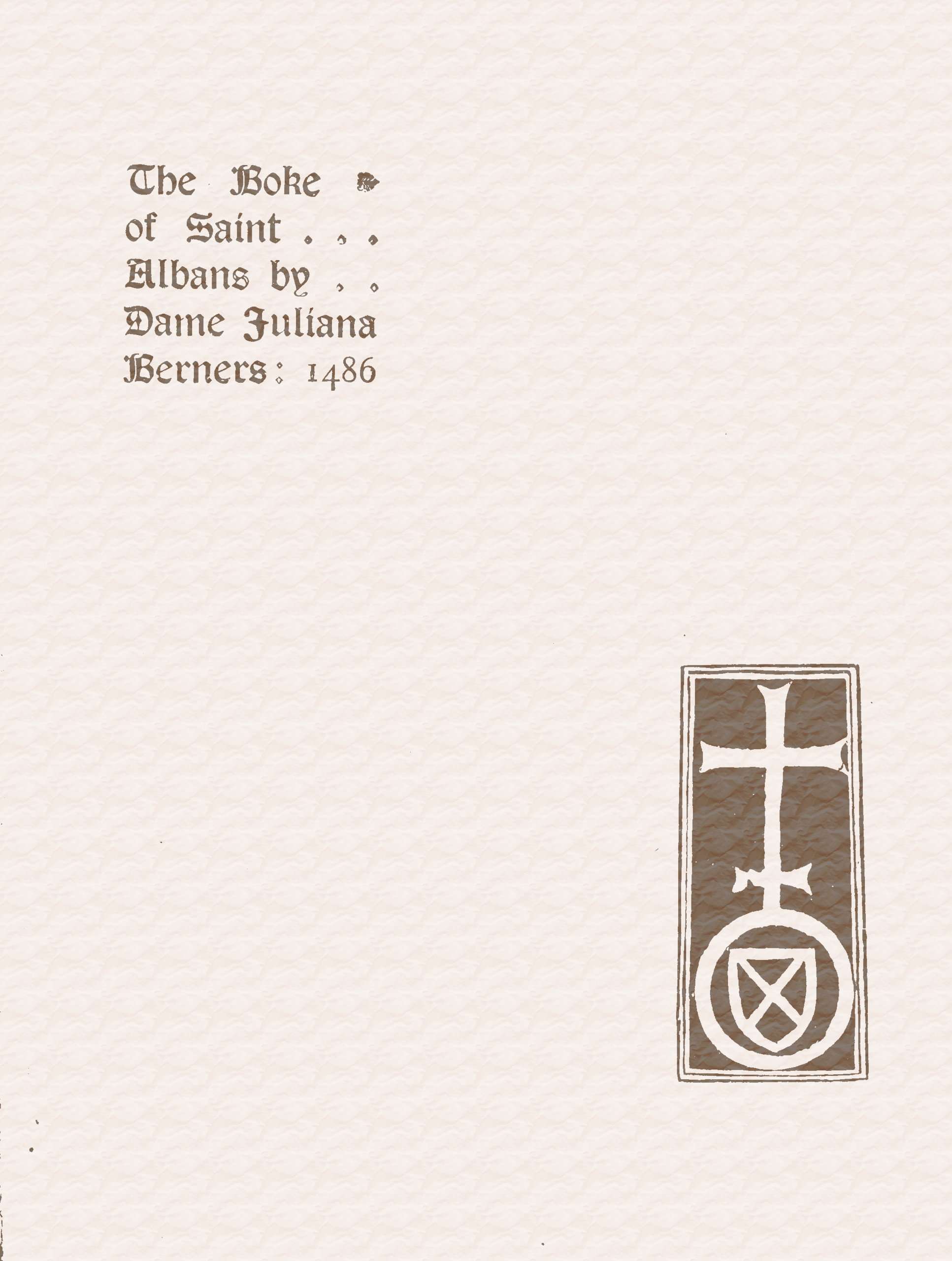
The Boke of Saint Albans: Containing Treatises on Hawking, Hunting, and Cote Armour
1486
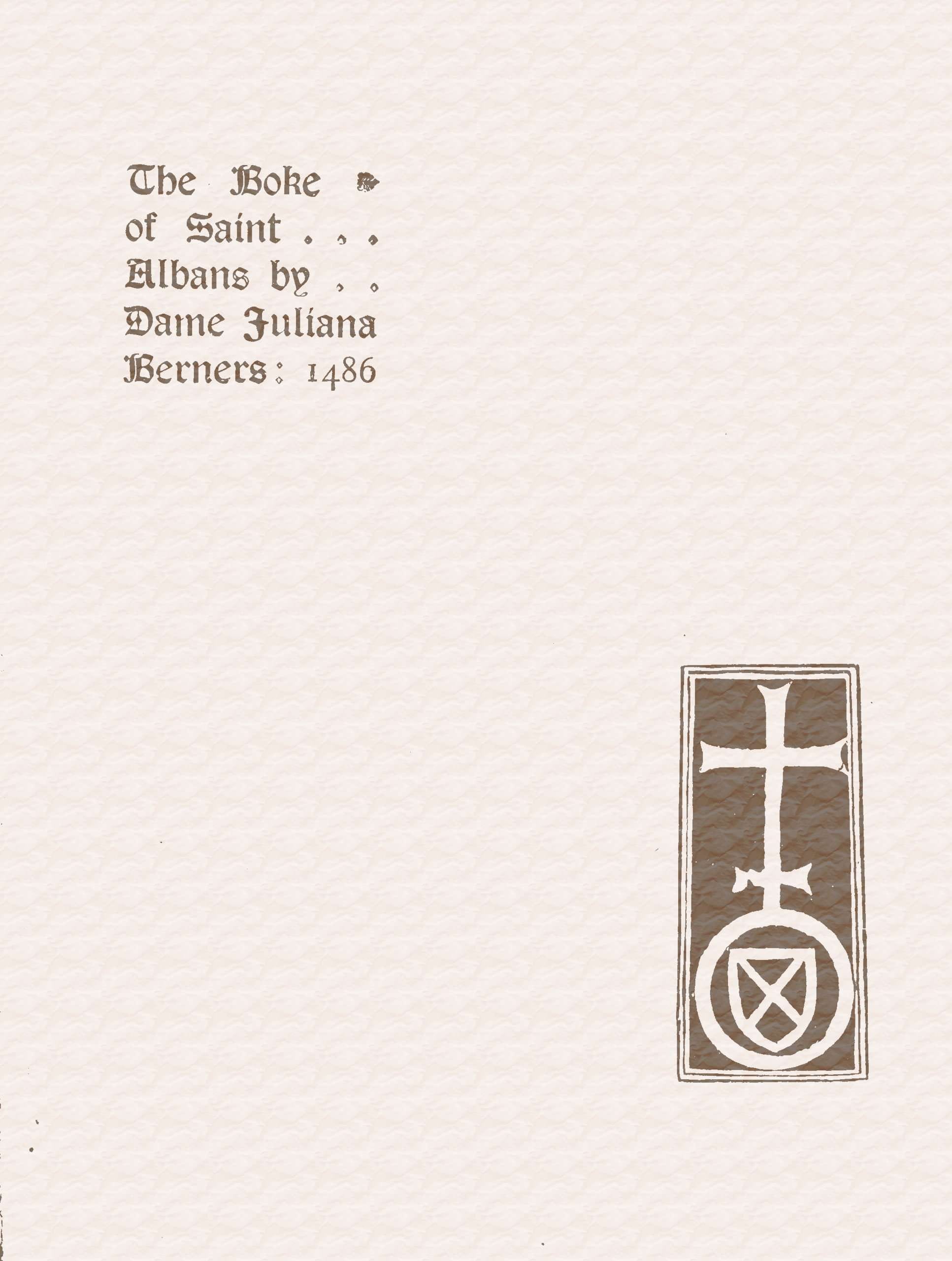
The Boke of Saint Albans: Containing Treatises on Hawking, Hunting, and Cote Armour
1486
The oldest book on field sports in English, the Boke of Saint Albans survives as a fascinating time capsule of medieval aristocratic life. Originally printed in 1486 and attributed to the prioress Juliana Berners, it served as the definitive guide for the gentry class: a complete education in hawking, hunting, and heraldry that defined what it meant to be well-born. Here readers will find the elaborate vocabulary of the field and mews, the proper terms for every feather and posture of the falcon, the art of blazoning coat armor, and the secret languages of lineage and status. Berners writes with an instructive warmth, addressing her reader as "my deare chylde," blending practical wisdom with the intimate tone of a maternal instructor. For modern readers, the book offers a remarkable window into how medieval elites constructed their identities through carefully codified sporting traditions, and how the chase itself was a language of power and pedigree.
Editions
X-Ray
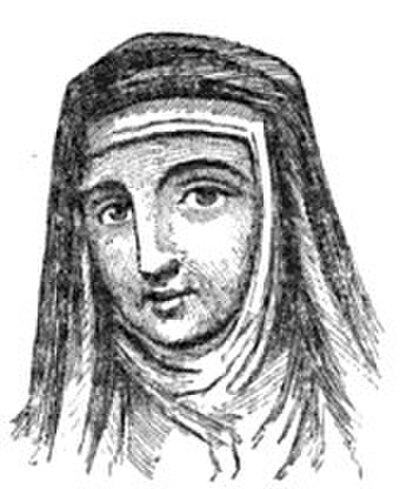
The attributed author of the hunting treatise, though her actual existence is disputed by scholars. She is credited with compiling rhymes on hunting and venery.
The anonymous printer and compiler of the book at St. Albans. He compiled the treatises from various manuscripts and added his own prologues.
The Victorian scholar who wrote the introduction analyzing the book's authorship, typography, and historical significance. He provides critical commentary on the work's origins.
The legendary knight of the Round Table, invoked as the ultimate authority on hunting terms and practices throughout the hunting treatise.
About The Boke of Saint Albans: Containing Treatises on Hawking, Hunting, and Cote Armour
Chapter Summaries
- Introduction
- Blades introduces the historical significance of the Book of St. Albans, discussing its rarity, the mystery of its printer, and its importance as an early English printed work on gentlemanly pursuits.
- 1
- Blades examines the disputed authorship of Dame Juliana Berners, arguing that much of her biography is fictional and that only the hunting treatise can be reliably attributed to her compilation.
- 2
- Analysis of the printing techniques, paper, and bibliographical details of the St. Albans press, including comparison with other contemporary printers and discussion of the book's various editions.
Key Themes
- Social Hierarchy and Gentility
- The book extensively defines what makes a gentleman versus a churl, tracing nobility back to biblical origins and establishing codes of conduct for different social ranks.
- Medieval Education and Knowledge Transmission
- The work serves as an instructional manual, teaching proper terminology and techniques for aristocratic pursuits through verse and prose.
- Chivalric Values and Honor
- Throughout the treatises, emphasis is placed on proper conduct, courtesy, and the virtues expected of knights and gentlemen.
Characters
- Dame Juliana Berners(major)
- The attributed author of the hunting treatise, though her actual existence is disputed by scholars. She is credited with compiling rhymes on hunting and venery.
- The Schoolmaster-Printer(major)
- The anonymous printer and compiler of the book at St. Albans. He compiled the treatises from various manuscripts and added his own prologues.
- William Blades(major)
- The Victorian scholar who wrote the introduction analyzing the book's authorship, typography, and historical significance. He provides critical commentary on the work's origins.
- Sir Tristram(minor)
- The legendary knight of the Round Table, invoked as the ultimate authority on hunting terms and practices throughout the hunting treatise.
- Wynken de Worde(minor)
- The printer who reprinted the work in 1496, adding information about the original schoolmaster-printer and later adding a fishing treatise.
Link to this book
Add a free, dofollow link to Lex on your blog, forum, syllabus, or reading list.

<a href="https://lex-books.com/book/the-boke-of-saint-albans-containing-treatises-on-hawking-hunting-and-cote-armour-3868220e-abd3-42e2-9a19-5421407aeffa"><img src="https://lex-books.com/badges/read-on-lex.svg" alt="Read The Boke of Saint Albans: Containing Treatises on Hawking, Hunting, and Cote Armour by Juliana Berners free on Lex" width="160" height="40"></a>[](https://lex-books.com/book/the-boke-of-saint-albans-containing-treatises-on-hawking-hunting-and-cote-armour-3868220e-abd3-42e2-9a19-5421407aeffa)[url=https://lex-books.com/book/the-boke-of-saint-albans-containing-treatises-on-hawking-hunting-and-cote-armour-3868220e-abd3-42e2-9a19-5421407aeffa][img]https://lex-books.com/badges/read-on-lex.svg[/img][/url]Read The Boke of Saint Albans: Containing Treatises on Hawking, Hunting, and Cote Armour by Juliana Berners free on Lex: https://lex-books.com/book/the-boke-of-saint-albans-containing-treatises-on-hawking-hunting-and-cote-armour-3868220e-abd3-42e2-9a19-5421407aeffaCite this book
Reading this edition for a paper or guide? Copy a citation.
Berners, Juliana. The Boke of Saint Albans: Containing Treatises on Hawking, Hunting, and Cote Armour. Lex, lex-books.com/book/the-boke-of-saint-albans-containing-treatises-on-hawking-hunting-and-cote-armour-3868220e-abd3-42e2-9a19-5421407aeffa.Berners, J. (1486). The Boke of Saint Albans: Containing Treatises on Hawking, Hunting, and Cote Armour. Lex. https://lex-books.com/book/the-boke-of-saint-albans-containing-treatises-on-hawking-hunting-and-cote-armour-3868220e-abd3-42e2-9a19-5421407aeffaBerners, Juliana. The Boke of Saint Albans: Containing Treatises on Hawking, Hunting, and Cote Armour. Lex. https://lex-books.com/book/the-boke-of-saint-albans-containing-treatises-on-hawking-hunting-and-cote-armour-3868220e-abd3-42e2-9a19-5421407aeffa.